Normale

Perché la traduzione accurata dei metadati potenzia la SEO globale

MultiLipi
MultiLipiData non valida
20 Minuti leggi
Immagine di copertina del blog

Banner visivo intitolato 'Importanza dei meta tag per la creazione di siti web multilingue' per un sito web SEO multilingue

I motori di ricerca trattano i metadati tradotti (come titoli di pagina e meta descrizioni) in modo leggermente diverso dai contenuti normali, e questo può influire in modo significativo su come il tuo sito multilingue si posiziona a livello globale. Tradurre accuratamente i metadati del tuo sito web è essenziale per una traduzione efficace del sito web e SEO multilingue. Se fatto bene, migliora la comprensione delle tue pagine da parte dei motori di ricerca e influenza direttamente i fattori di coinvolgimento degli utenti come i tassi di clic, aumentando infine la visibilità internazionale. In altre parole, la traduzione dei metadati è un fattore SEO chiave che nessun proprietario di sito web globale può permettersi di ignorare – sebbene raggiungere l'accuratezza comporti delle sfide. In questa guida, esploreremo perché la traduzione dei metadati è importante e come farla correttamente per traduci il tuo sito web per una migliore portata globale.

Punti chiave:

  1. Migliore visibilità nei motori di ricerca: La traduzione accurata dei metadati aiuta i motori di ricerca a comprendere meglio i tuoi contenuti in ogni lingua, migliorando direttamente la visibilità e il posizionamento del tuo sito multilingue (weglot.com).

  2. Ottimizzazione specifica per lingua: Ogni lingua ha caratteristiche uniche: le strategie efficaci devono tenere conto delle differenze di parole chiave, lunghezza e contesto culturale, piuttosto che utilizzare metadati uguali per tutti.
     
  3. Impostazione Tecnica SEO: Una corretta implementazione tecnica (ad esempio, tag hreflang, strutture URL, sitemap) è essenziale per garantire che i motori di ricerca indicizzino e servano correttamente le tue pagine tradotte al pubblico giusto.
     
  4. L'approccio alla traduzione conta: Puoi traduci sito web i metadati manualmente o automaticamente – un approccio ibrido che combina entrambi offre spesso il miglior equilibrio tra scalabilità e qualità.
     
  5. Flussi di lavoro semplificati con lo strumento giusto: L'utilizzo di una piattaforma dedicata per la traduzione di siti web multilingue può semplificare la traduzione dei metadati automatizzando le traduzioni iniziali e consentendo facili perfezionamenti manuali. Ad esempio, la soluzione di traduzione basata sull'IA di MultiLipi automatizza la traduzione dei metadati, dandoti il pieno controllo per modificare e ottimizzare ogni frammento (multilipi.com)

Perché la traduzione accurata dei metadati influisce direttamente sui ranking di ricerca globali
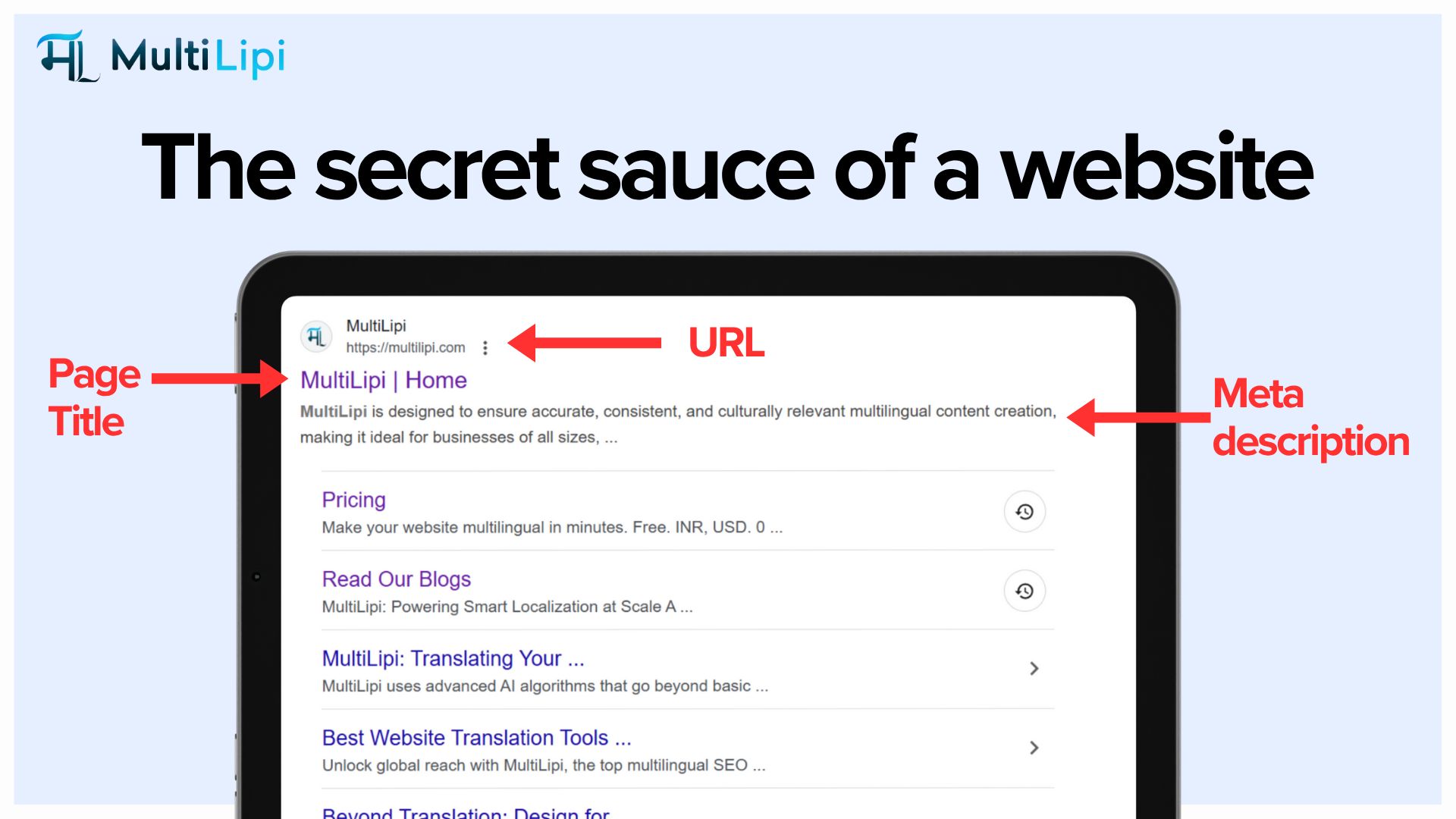
Risultato di ricerca MultiLipi che mostra titolo della pagina, URL e meta descrizione come elementi SEO chiave per un sito web multilingue

I metadati – inclusi i tag del titolo e le meta descrizioni – fungono da riassunto conciso del contenuto di una pagina web nei risultati di ricerca. Tradurre questi elementi accuratamente nelle tue lingue di destinazione assicura che i motori di ricerca possano interpretare e categorizzare correttamente i tuoi contenuti per ogni locale, migliorando il tuo posizionamento nei risultati di ricerca locali (weglot.com). Altrettanto importante, questi snippet tradotti sono la prima introduzione al tuo marchio che gli utenti vedono in una pagina di ricerca, quindi fare una buona prima impressione è fondamentale per incoraggiare i clic.

D'altra parte, metadati tradotti in modo errato possono confondere o fuorviare gli utenti. Se il tuo titolo o la tua descrizione risultano strani o irrilevanti a causa di una traduzione errata, è probabile che gli utenti saltino il tuo risultato o abbandonino rapidamente il tuo sito, danneggiando il tuo tasso di clic e aumentando il tasso di rimbalzo, il che a sua volta danneggia le prestazioni SEO (weglot.comlinguise.com). In breve, traduzioni inaccurate portano a traffico perso.

Un altro fattore critico è l'implementazione tag hreflang per tutte le versioni linguistiche del tuo sito. Le annotazioni Hreflang segnalano ai motori di ricerca per quale lingua e regione è destinata ciascuna pagina. Se questi tag sono mancanti o configurati in modo errato, anche i metadati tradotti al meglio potrebbero non essere mostrati al pubblico giusto (weglot.comlinguise.com). Ogni sito multilingue dovrebbe utilizzare hreflang (con i codici lingua-paese corretti) in modo che Google e altri motori di ricerca mostrino agli utenti la versione locale appropriata dei tuoi contenuti. Senza hreflang, una meta descrizione francese potrebbe apparire erroneamente agli utenti di lingua inglese, o viceversa, minando i tuoi sforzi.

In conclusione: Una traduzione accurata dei metadati migliora sia comprensione dei motori di ricerca del tuo contenuto e del attrattiva per l'utente dei tuoi snippet di ricerca. È un contributore diretto a prestazioni SEO globali più elevate se abbinato a una corretta configurazione tecnica SEO.

Componenti Critici della Traduzione di Metadati di Successo

Visualizzazione che mostra i componenti chiave di una traduzione di metadati di successo: testo incentrato sull'intento, parole chiave localizzate e memoria di traduzione.

Ottenere traduzioni di metadati di alta qualità richiede considerazioni sia linguistiche che strategiche:

  • Ricerca di parole chiave specifica per il mercato: Inizia ricercando il comportamento di ricerca nel tuo mercato di riferimento. Identifica le parole chiave e le frasi che gli utenti locali cercano effettivamente, piuttosto che tradurre direttamente le tue parole chiave inglesi. Concentrati sui termini che hanno un buon volume di ricerca e si allineano con l'intento dell'utente in quella lingua. Strumenti come Semrush e Ahrefs (e risorse gratuite come Google Trends) sono preziosi per questo processo, aiutandoti a scoprire termini e argomenti di ricerca locali ad alto volume (localizejs.com. Adattando titoli e descrizioni per includere parole chiave specifiche della lingua, ti connetti in modo più efficace con il pubblico locale e gli algoritmi di ricerca.
     
  • Intento Oltre la Traduzione Letterale: Dai sempre la priorità alla trasmissione significato e l'intento dei metadati, piuttosto che fare una traduzione parola per parola. Una frase che funziona bene in inglese potrebbe non avere un equivalente, diciamo, in giapponese o arabo. Potrebbe richiedere una riformulazione o un approccio creativo (noto anche come transcreazione) per risuonare nella lingua di destinazione. Ad esempio, uno slogan di marketing accattivante in inglese potrebbe suonare strano o addirittura cambiare significato se tradotto letteralmente ("linguise.com). Mantieni il messaggio principale ma adatta la formulazione per adattarla alle sfumature culturali locali e al comportamento di ricerca. Ciò garantisce che i tuoi metadati rimangano chiari, convincenti e pertinenti per i madrelingua.
     
  • Utilizzo di Memorie di Traduzione e Glossari: La coerenza è fondamentale nei contenuti multilingue. L'implementazione di un sistema di memoria di traduzione o di un glossario può migliorare notevolmente la coerenza tra pagine simili. Questi strumenti memorizzano segmenti tradotti in precedenza e la terminologia preferita in modo da poterli riutilizzare per nuovi contenuti. Ad esempio, MultiLipi offre un glossario integrato che consente di definire le traduzioni per termini specifici (ad es. nomi di prodotti o slogan) per imporre una formulazione uniforme in tutte le lingue (multilipi.com). Utilizzando un glossario o una memoria di traduzione, ti assicuri che una frase come “Prova Gratuita” o lo slogan del tuo marchio venga sempre tradotta nello stesso modo preferito ogni volta che appare, rafforzando il riconoscimento del marchio ed evitando formulazioni incoerenti.
     
  • Sfrutta Dati e Analisi: Oltre all'accuratezza linguistica, utilizza i dati per guidare la tua strategia di metadati. Monitora come gli utenti in diverse regioni interagiscono con le tue pagine tradotte. Strumenti di analisi e business intelligence possono fornire informazioni su quali versioni di metadati tradotti hanno tassi di clic o tassi di conversione più elevati. Ad esempio, l'integrazione di piattaforme come MicroStrategy o Sisense potrebbe aiutarti ad analizzare le prestazioni per regione (weglot.com). Se la meta description in tedesco ha un CTR inferiore a quella in inglese, potrebbe indicare che la formulazione non è efficace e necessita di modifiche. Le modifiche basate sui dati garantiscono che i tuoi metadati non siano solo tradotti accuratamente, ma anche ottimizzati per i risultati.
     

Combinando ricerche approfondite di parole chiave, intuizioni culturali, strumenti di coerenza e analisi delle prestazioni, poni solide basi per una traduzione efficace dei metadati in tutte le tue lingue di destinazione.

Ottimizzazione specifica per lingua e limiti di caratteri

Lingue diverse spesso richiedono approcci di ottimizzazione su misura a causa di variazioni di lunghezza e script. Una considerazione importante è espansione o contrazione del testo. Ad esempio, una frase in tedesco può essere circa il 20-30% più lunga del suo equivalente in inglese (dorotapawlak.eu). Ciò significa che un meta titolo che rientra nei limiti di pixel di Google in inglese potrebbe essere troppo lungo in tedesco, causando il troncamento nei risultati di ricerca. Tieni sempre conto di queste differenze: se traduci un titolo inglese direttamente, verifica che la versione tradotta rimanga entro i limiti di caratteri consigliati (circa 55-60 caratteri per i titoli, ~155-160 per le descrizioni nella maggior parte dei casi, sebbene questi limiti possano variare a seconda della lingua e del motore di ricerca). La pianificazione per l'espansione (o la contrazione, in lingue come il cinese) del testo aiuterà a preservare il messaggio completo dei tuoi metadati nelle SERP.

Caratteri CJK e script speciali: Lingue come il cinese, il giapponese e il coreano utilizzano caratteri che occupano spazi singoli ma trasmettono più significato per carattere. Potrebbero essere visualizzati in modo diverso nelle pagine dei risultati di ricerca (ad esempio, Google spesso mostra meno caratteri per le lingue CJK). Assicurati che i tuoi titoli e le tue descrizioni in queste lingue siano concisi ma comunque informativi. Tieni anche presente eventuali formati richiesti (ad esempio, i metadati giapponesi potrebbero includere punteggiatura a larghezza intera).

Lingue da destra a sinistra (RTL): Le lingue arabe, ebraiche e altre lingue RTL richiedono un'attenzione particolare per la presentazione dei metadati. Assicurati che il codice del tuo sito web dichiari correttamente la direzione della lingua in modo che titoli e descrizioni vengano visualizzati correttamente. Anche nei risultati di ricerca, è necessario evitare testo confuso o disordinato. Semplici cose come il posizionamento della punteggiatura nel testo RTL possono influire sulla leggibilità. In breve, testa sempre come appaiono i tuoi metadati per le lingue RTL: spesso necessitano di aggiustamenti nella formulazione o nella formattazione per chiarezza (linguise.com).)

Punteggiatura e caratteri locali: Ogni lingua ha le proprie convenzioni tipografiche. Lo spagnolo usa punti interrogativi/esclamativi invertiti, il francese e il tedesco usano caratteri accentati, ecc. Utilizza i corretti caratteri localizzati nei tuoi metadati: non solo apparirà più professionale, ma può anche influire sulla pertinenza delle parole chiave (ad esempio, “años” con la ñ è una parola diversa da “anos” senza). Non dare per scontato di poter usare la punteggiatura inglese per tutto; adottare la punteggiatura e la spaziatura specifiche della località farà sembrare i tuoi snippet nativi. Trascurare queste sfumature può portare a interpretazioni errate o a un'impressione non rifinita, il che può danneggiare il coinvolgimento dell'utente.

Infine, sempre visualizza in anteprima i tuoi metadati tradotti come apparirebbe nei risultati di ricerca. Molti strumenti SEO forniscono la funzionalità di anteprima dello snippet. Questo ti consente di individuare problemi come troncamenti, simboli strani o formulazioni che potrebbero richiedere perfezionamenti prima che vengano pubblicati.

Requisiti Tecnici: Tag Hreflang e Struttura URL

Una traduzione accurata da sola non è sufficiente: anche la configurazione SEO tecnica del tuo sito multilingue deve essere valida. Corretta implementazione tecnica garantisce che i motori di ricerca possano scoprire e indicizzare i tuoi contenuti tradotti in modo efficiente (weglot.com). Gli elementi fondamentali da fare bene sono hreflang, struttura URL, tag canonici e sitemap:

  • Attributi Hreflang: Come accennato, usa sempre i tag hreflang per specificare la lingua (e opzionalmente, la regione) di ogni pagina. Ad esempio, la tua pagina francese dovrebbe avere un hreflang="fr" (o “fr-FR” per la Francia rispetto a “fr-CA” per il francese canadese) che rimanda a se stessa, e tag reciproci che rimandano alle versioni in altre lingue. Questo aiuta Google a servire la pagina francese agli utenti francesi, la pagina spagnola agli utenti spagnoli, ecc., invece di indovinare. Impedisce inoltre problemi di contenuti duplicati collegando esplicitamente pagine equivalenti. Una configurazione hreflang correttamente implementata è fondamentale: senza di essa, anche se traduci perfettamente i meta tag, i motori di ricerca “non so quale versione linguistica mostrare agli utenti”, portando a risultati subottimali (linguise.com). Sii meticoloso con i codici lingua e assicurati che ogni pagina faccia riferimento a tutte le sue alternative (incluso un tag autoreferenziale).
     
  • Struttura URL (Sottodomini vs Sottodirectory): Decidi una strategia URL per i tuoi contenuti multilingue e applicala in modo coerente. I due approcci comuni sono le sottodirectory (ad es. iltuosito.com/es/pagina) o sottodomini (es. es.tuosito.com/pagina). Non esiste una risposta valida per tutti: ognuno ha i suoi pro e contro, e entrambi possono funzionare per la SEO se fatti bene. Le sottodirectory sono spesso più semplici da implementare e concentrano tutta l'autorità SEO su un unico dominio, mentre i sottodomini possono consentire una maggiore separazione (a volte utilizzati se si prendono di mira diversi paesi o quando si utilizza un servizio proxy). La chiave è essere coerenti e assicurati che le pagine di ciascuna lingua siano chiaramente separate in una di queste strutture (localizejs.com) . MultiLipi supporta entrambe le opzioni – ad esempio, è possibile scegliere sottocartelle specifiche per lingua come /fr/ o sottodomini dedicati come fr.yoursite.com a seconda delle tue esigenze (wordpress.org). Qualunque sia la struttura scelta, aggiorna i link interni e la navigazione per indirizzare gli utenti (e i crawler) agli URL localizzati corretti.
     
  • Tag canonici: Se hai più versioni di una pagina, usa i tag canonici in modo appropriato per evitare penalità per contenuti duplicati. In generale, ogni pagina in una lingua dovrebbe fare riferimento canonico a se stessa (poiché è contenuto originale in quella lingua, non un duplicato). Fai non puntare pagine in lingue diverse a un singolo URL canonico, altrimenti i motori di ricerca potrebbero ignorare le alternative. L'unico momento in cui il canonico entra in gioco è se hai contenuti duplicati nel stesso lingua (ad esempio, una pagina stampabile). Per la SEO multilingue, hreflang è lo strumento principale, non i canonical cross-lingua. Assicurati che il tuo CMS o plugin di traduzione lo imposti correttamente.
     
  • Sitemap localizzate: Per siti di grandi dimensioni, considera la creazione di sitemap XML separate per ogni lingua (o una sitemap combinata che elenchi tutti gli URL alternativi con hreflang). Questo aiuta i bot dei motori di ricerca a scansionare in modo efficiente la struttura del tuo sito. Ad esempio, potresti avere sitemap-en.xml, sitemap-fr.xml, ecc., ognuno contenente URL solo per quella lingua. Invia questi in Google Search Console (e Bing Webmaster Tools, ecc.) per le rispettive località. Ciò garantisce che nessuna pagina tradotta venga trascurata a causa di problemi di profondità di scansione. Se mantenere più sitemap è gravoso, anche una singola sitemap va bene: assicurati solo che ogni URL sia incluso e che le relazioni hreflang siano annotate.
     
  • Altri Elementi Tecnici: Ricorda che i metadati non sono solo titoli e descrizioni. Non dimenticare di tradurre attributi alt delle immagini, tag Open Graph (per la condivisione sui social media) e qualsiasi altro meta tag che contenga contenuto (come metadati Twitter Card, descrizioni schema JSON-LD, ecc.). Questi possono influire sulla SEO e su come le tue pagine appaiono sulle piattaforme social. Ad esempio, il testo alternativo di un'immagine nella lingua dell'utente può aiutare la SEO delle immagini e l'accessibilità, e una descrizione Open Graph tradotta renderà il tuo contenuto più accattivante quando condiviso sulle reti sociali locali. Molti proprietari di siti trascurano questi elementi di metadati tecnici durante la localizzazione (linguise.com), quindi assicurati che il tuo flusso di lavoro o strumento di traduzione li catturi.
     

Ottenere questi dettagli tecnici corretti va di pari passo con l'accuratezza linguistica. Insieme, creano un'infrastruttura solida per sito multilingue Successo SEO – dove ogni pagina localizzata può performare al suo massimo potenziale nei ranking di ricerca.

Automazione vs. Traduzione manuale Approcci MultiLipi

Funzionalità MultiLipi per SEO globale, inclusa traduzione metadati, best practice SEO multilingue, strumenti glossario, editor visuale, sincronizzazione e gestione bulk.

Quando si tratta di tradurre i metadati per un sito web multilingue, sorge una domanda comune: dovresti affidarti a strumenti di traduzione automatica o investire in traduttori umani per questo compito? La risposta spesso si trova nel mezzo. Esaminiamo entrambi gli approcci:

Traduzione automatica dei metadati: pro e contro

  • (+) Velocità e Scalabilità: La traduzione automatica offre una velocità incredibile. Se hai un sito di e-commerce di grandi dimensioni o aggiornamenti frequenti del blog, la traduzione automatica può elaborare centinaia di meta tag quasi istantaneamente. Questa scalabilità la rende fattibile per traduci questa pagina web e migliaia di altri senza attendere le tempistiche umane. È ideale per rapidi turnaround o per testare più lingue velocemente.
     
  • (+) Aggiornamenti tempestivi: Per i contenuti che cambiano spesso (articoli di notizie, elenchi di prodotti dinamici), gli strumenti automatici garantiscono che i tuoi metadati in tutte le lingue rimangano aggiornati. Non rischierai di avere una meta descrizione spagnola obsoleta perché un traduttore non era disponibile; il sistema traduce i nuovi metadati al volo.
     
  • (-) Problemi di sfumatura e qualità: Lo svantaggio è che la traduzione automatica pura potrebbe mancare delle sfumature culturali necessarie per una copia SEO efficace. Gli strumenti automatici possono interpretare male modi di dire, tono o contesto. Una traduzione letterale potrebbe risultare goffa o poco chiara per i madrelingua (linguise.com). Ciò potrebbe danneggiare i tassi di clic se la meta descrizione non ha senso o non attrae il pubblico locale.
     
  • (-) Allineamento errato delle parole chiave: Le macchine potrebbero non scegliere le stesse parole chiave che sceglierebbe un traduttore SEO umano. Ad esempio, una traduzione automatica potrebbe utilizzare una parola tecnicamente corretta che ha zero volume di ricerca nella lingua di destinazione, mentre un umano saprebbe usare il sinonimo più popolare. Queste sottigliezze significano che le traduzioni di metadati completamente automatizzate possono a volte essere subottimali per le prestazioni SEO.

Traduzione Manuale dei Metadati: Pro e Contro

  • (+) Maggiore Accuratezza e Rilevanza Culturale: I traduttori umani (specialmente quelli esperti in SEO) possono creare metadati che suonano naturali e persuasivi nella lingua di destinazione. Possono mantenere la voce del tuo brand e incorporare riferimenti culturalmente rilevanti o call-to-action che le macchine non coglierebbero. Il risultato sono titoli e descrizioni meta che risuonano sia con gli utenti locali che con i motori di ricerca. Questo è particolarmente importante per i contenuti di marketing dove tono ed emozione contano.
     
  • (+) Corrispondenza dell'intento: Un traduttore umano esperto si concentrerà sull'intento dell'utente e sulle parole chiave pertinenti, non solo sul significato letterale. Può garantire che i metadati tradotti attraggano effettivamente ciò che gli utenti locali cercando per. Ad esempio, se il tuo meta titolo in inglese è “10 Tips for Great Web Design”, un umano potrebbe sapere che in francese gli utenti hanno maggiori probabilità di cercare una frase che si traduce in “10 modi per migliorare il tuo sito web” – adattando la formulazione per corrispondere alle abitudini di ricerca locali.
     
  • (-) Richiede tempo e costi: Fare tutto manualmente richiede molto più tempo. Creare e rivedere i metadati per decine o centinaia di pagine in più lingue può essere un processo lento, ritardando i lanci di contenuti globali. Questo può essere impraticabile per siti di grandi dimensioni o aggiornamenti sensibili al tempo. Inoltre, la traduzione umana di qualità (e la successiva modifica SEO) può essere costosa, soprattutto se sono necessari linguisti professionisti per molte lingue.
     
  • (-) Rischi di Incoerenza: Senza un processo strutturato, la traduzione manuale da parte di persone diverse può introdurre incongruenze. Un traduttore potrebbe usare una frase diversa da un altro per lo stesso concetto, il che potrebbe diluire il tuo messaggio. (Ciò può essere mitigato utilizzando glossari e fornendo linee guida chiare ai traduttori, ma è qualcosa da gestire con attenzione.)
     

Trovare il giusto equilibrio – L'approccio ibrido: La buona notizia è che non devi scegliere rigorosamente l'uno o l'altro. Molte organizzazioni scoprono che una approccio ibrido alla traduzione dei metadati produce i migliori risultati (weglot.com). In pratica, ciò significa utilizzare la traduzione automatica per gestire il grosso del lavoro di traduzione iniziale, per poi far rivedere e perfezionare tali traduzioni da un essere umano (come un editor madrelingua o il tuo team di marketing). Questo approccio offre la velocità dell'automazione con la sfumatura della supervisione umana. Puoi ottenere rapidamente una traduzione preliminare per, diciamo, 100 meta descrizioni di prodotti, e poi dedicare tempo mirato a perfezionare quelle più importanti o a correggere eventuali formulazioni goffe.

Le moderne piattaforme di traduzione supportano questo flusso di lavoro senza problemi. Ad esempio, potresti collegare il tuo sito a una piattaforma basata sull'IA traduttore di pagine web come MultiLipi per generare traduzioni istantanee di metadati, e quindi utilizzare la sua interfaccia di post-editing per perfezionare ciascuna di esse per tono e parole chiave. Automatizzando il lavoro ripetitivo e riservando lo sforzo umano al controllo qualità, si ottiene un'elevata qualità di traduzione e rapida consegna (weglot.com). Molte aziende riferiscono che questa combinazione (spesso chiamata AI + umano nel ciclo) riduce drasticamente il time-to-market per le nuove lingue senza sacrificare le prestazioni SEO.

In sintesi, automazione vs manuale non è una decisione o/o. Utilizza l'automazione per lavorare su larga scala, ma pianifica sempre una fase di revisione umana, specialmente per testi rivolti ai clienti come i metadati, dove una piccola sfumatura fa una grande differenza.

Accelera i tuoi sforzi SEO globali con MultiLipi
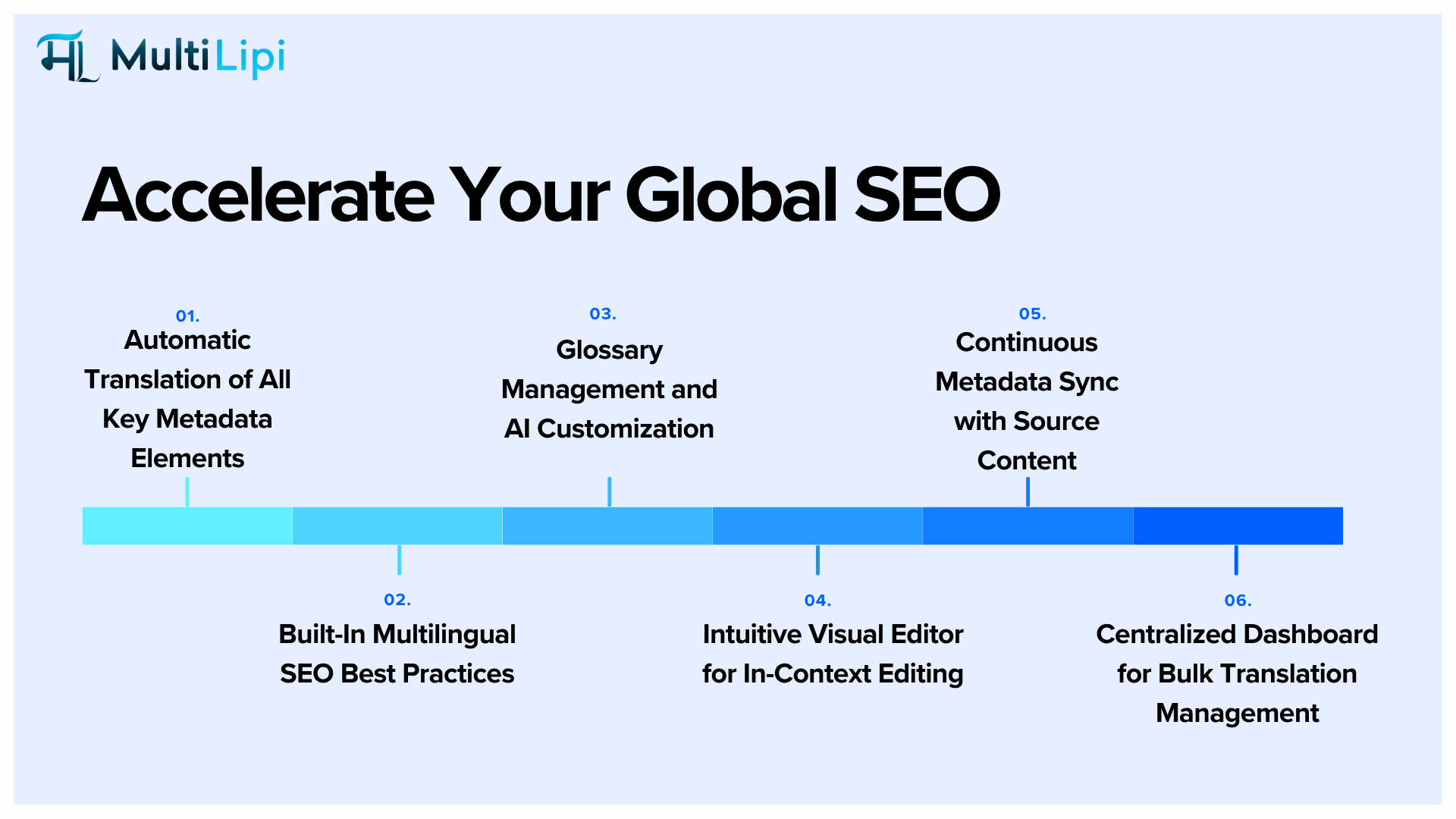
Infografica che evidenzia sei caratteristiche chiave di MultiLipi per il SEO multilingue Accelerare il tuo SEO globale

MultiLipi è un sistema basato sull'IA traduzione sito web piattaforma progettata per semplificare la traduzione dei metadati e eliminare i grattacapi dall'SEO multilingue. Combina la potenza dell'automazione con la finezza della revisione umana in un flusso di lavoro coeso. Ecco come MultiLipi ti aiuta a ottimizzare i tuoi metadati (e contenuti più ampi) per successo nella ricerca globale:

  • Traduzione Automatica di Tutti gli Elementi Chiave: La soluzione di MultiLipi rileva e traduce automaticamente elementi essenziali della pagina come meta titoli, meta descrizioni, intestazioni, testo alternativo dell'immagine, e persino campi personalizzati o tag SEO. Ciò garantisce che nessun metadato rimanga non tradotto. La piattaforma è costruita per gestire completamente sito multilingue SEO – ad esempio, tradurrà i tuoi slug URL o creerà strutture URL SEO-friendly per ogni lingua, anziché mantenere gli URL in inglese (wordpress.org). Coprendo aspetti come URL tradotti e tag alt, MultiLipi assicura che l'intera pagina sia ottimizzata per la ricerca locale, non solo il testo visibile.
     
  • Migliori pratiche SEO multilingue integrate: Quando utilizzi MultiLipi, la configurazione SEO tecnica è in gran parte gestita per te. La piattaforma può creare automaticamente sottodirectory o sottodomini specifici per la lingua per i tuoi contenuti tradotti, a seconda delle tue preferenze, e implementare tag hreflang su tutto il sito (wordpress.org). Ciò significa che fin dal primo giorno, le tue pagine tradotte sono strutturate correttamente e indicizzate dai motori di ricerca in ogni regione. MultiLipi è ottimizzato per la SEO multilingue, come evidenziato dalla descrizione del plugin WordPress – ogni pagina tradotta è indicizzabile da Google e l'architettura del tuo sito è configurata per il targeting internazionale out of the box (wordpress.orgwordpress.org.)
     
  • Glossario e personalizzazione AI: MultiLipi include la gestione di glossari e una memoria di traduzione, che ti consentono di definire traduzioni specifiche per nomi di marchi, termini del settore o qualsiasi frase a cui tieni. La piattaforma utilizzerà costantemente quelle traduzioni preferite in tutto il tuo sito, preservando la voce del marchio e la terminologia in tutte le lingue (Memoria di traduzione MultiLipi). Ad esempio, se traduci sempre “Contattaci” come “Kontakteer Ons” in olandese (invece del valore predefinito di una macchina), puoi bloccarlo. Questa funzionalità garantisce che le sfumature del tuo marchio e del tuo messaggio vengano trasmesse accuratamente, il che è un grande vantaggio per i metadati in cui piccole differenze di formulazione contano.
     
  • Dashboard di modifica intuitiva (Editor visivo): Una caratteristica distintiva di MultiLipi è la sua dashboard intuitiva e editor visivo live. Dopo la traduzione automatica iniziale, puoi facilmente rivedere e modificare le traduzioni all'interno di un'anteprima della tua pagina web. Ciò significa che puoi vedere il tuo titolo o descrizione tradotto nel contesto – come si adatta alla pagina, se supera i limiti di caratteri, ecc. – e regolarlo sul momento (editor virtuale multilipi). L'editor ti consente di perfezionare le traduzioni per la SEO, ad esempio modificando una meta description per includere una parola chiave di destinazione o per incoraggiare meglio i clic. Poiché stai modificando nel contesto, è facile assicurarsi che i tuoi metadati tradotti rimangano entro la lunghezza richiesta e abbiano un aspetto perfetto per gli utenti.
     
  • Aggiornamenti continui e gestione in blocco: Man mano che il contenuto principale del tuo sito cambia, MultiLipi rileva automaticamente i metadati nuovi o aggiornati e richiede aggiornamenti di traduzione nelle tue altre lingue. Questa automazione riduce significativamente lo sforzo manuale per mantenere sincronizzate tutte le versioni linguistiche. Inoltre, la dashboard centralizzata della piattaforma ti consente di gestire le traduzioni in blocco. Ad esempio, puoi filtrare specificamente i metadati SEO (come tutti i tuoi meta titoli in francese) e modificarli in un unico posto. Questa capacità di modifica in blocco consente di risparmiare molto tempo per siti web più grandi. MultiLipi fornisce essenzialmente un flusso di lavoro end-to-end: dalla traduzione iniziale alla modifica fino alla pubblicazione, tutto in un unico hub.
     

Tutte queste funzionalità lavorano insieme per garantire che i tuoi metadati tradotti non siano solo accurati, ma ottimizzato. L'approccio di MultiLipi, che combina traduzione automatica di alta qualità con un facile perfezionamento umano, garantisce sia velocità che precisione. Utilizzando la piattaforma, le aziende possono raggiungere le migliori pratiche SEO multilingue con molto meno sforzo rispetto a fare tutto manualmente. In breve, MultiLipi ti consente di presentare al mondo un sito web multilingue completamente ottimizzato, senza bisogno di essere un esperto di SEO tecnico o di parlare fluentemente più lingue.

(MultiLipi vs. altri:) Se hai considerato alternative – come la traduzione puramente manuale o i plugin di traduzione generici – vale la pena notare come una soluzione come MultiLipi si distingua. MultiLipi è stato creato pensando alla SEO, quindi gestisce intrinsecamente cose che altri potrebbero richiedere configurazioni aggiuntive (hreflang, traduzione dei metadati, ecc.). Il suo flusso di lavoro ibrido AI-umano significa che non scambi qualità per velocità. E funzionalità come l'editing collaborativo (aggiunta di membri del team alla dashboard) lo rendono scalabile per le organizzazioni. Essenzialmente, MultiLipi racchiude traduzione + localizzazione + SEO in un unico pacchetto in modo che tu possa concentrarti sulla crescita del tuo pubblico globale.

Migliori pratiche per la traduzione dei metadati

Per concludere, ecco una checklist di best practice e suggerimenti per garantire che la traduzione dei tuoi metadati aumenti veramente il tuo SEO globale:

  • Considera le differenze di lunghezza del testo: Considera sempre quanto più lungo o più corto potrebbe essere il tuo testo tradotto. Progetta i tuoi titoli e le tue descrizioni in modo che rientrino nelle lunghezze consigliate dai motori di ricerca. per ogni lingua. Ad esempio, prevedi circa il 30% di spazio in più per l'espansione del testo tedesco (dorotapawlak.eu). Dopo la traduzione, utilizzare uno strumento di snippet SEO o l'anteprima di Google per verificare il troncamento in ogni lingua di destinazione. Modificare se necessario per evitare che parole importanti vengano tagliate.
     
  • Incorpora parole chiave specifiche per lingua: Non dare per scontato che le parole chiave nella tua lingua di origine siano le migliori in un altro mercato. Fai una ricerca approfondita delle parole chiave o usa strumenti come Google Trends per scoprire quali frasi usano i locali. Quindi incorpora in modo naturale tali parole chiave nei tuoi metadati tradotti. Ciò migliora la pertinenza e può potenziare significativamente i ranking di ricerca locali (localizejs.com). (Suggerimento: localizza anche eventuali formati numerici o unità nei tuoi metadati, ad esempio convertendo formati di valuta o data, poiché i ricercatori potrebbero utilizzare notazioni locali nelle query.)
     
  • Utilizza lo Schema Markup appropriato per la lingua: Se utilizzi dati strutturati (JSON-LD, ecc.) nelle tue pagine, traduci anche qualsiasi contenuto all'interno di quel markup, o utilizza proprietà schema che supportano più lingue. Ad esempio, per lo schema Organizzazione o Prodotto, fornisci traduzioni nome o descrizione campi ove applicabile. Ciò aiuta i motori di ricerca a visualizzare risultati pertinenti (come pannelli informativi o snippet avanzati) nella lingua dell'utente. È un aspetto della SEO multilingue spesso trascurato.
     
  • Implementa Hreflang e URL Specifici per Località: Vale la pena ripeterlo: usa hreflang per ogni pagina e verifica che sia corretto. Inoltre, struttura il tuo sito con chiari indicatori linguistici negli URL (sia sottodirectory che sottodominio). Ad esempio, un URL che termina con /es/producto segnala istantaneamente sia agli utenti che ai bot di ricerca che questa è una pagina in spagnolo. Se hai contenuti regionali distinti (ad es. en-US vs en-GB), includilo in hreflang e possibilmente usa URL separati per chiarezza. Un targeting linguistico corretto evita la confusione degli utenti e migliora l'indicizzazione per il pubblico giusto (weglot.com).
     
  • Considera le varianti regionali e i dialetti: Ottimizza per le differenze regionali all'interno della stessa lingua. Ad esempio, lo spagnolo in Spagna rispetto allo spagnolo in Messico: se ti rivolgi a entrambi, potresti aver bisogno di lievi modifiche ai metadati (vocabolario diverso o tono formale/informale). Allo stesso modo, il francese europeo e il francese canadese presentano alcune distinzioni. Rifletti queste differenze nella tua meta copy per massimizzare la rilevanza locale. Se utilizzi hreflang con codici regionali (come fr-FR, fr-CA), assicurati che il contenuto corrisponda effettivamente a tali località.
     
  • Attenzione alle regole specifiche dei motori di ricerca: Se stai prendendo di mira mercati in cui Google non è il motore dominante, adatta la tua strategia di metadati di conseguenza:
     
    • Baidu: I titoli dovrebbero essere inferiori a 80 caratteri (e le meta descrizioni inferiori a ~200) per l'indice di Baidu (advance-metrics.com). Usa parole chiave in cinese semplificato nei tuoi titoli, poiché Baidu si basa molto sulla presenza di parole chiave. Inoltre, Baidu presta ancora attenzione al tag meta keywords (a differenza di Google), quindi considera di aggiungerne alcuni pertinenti in cinese.
       
    • Yandex: Il motore di ricerca russo predilige contenuti completamente localizzati. Assicurati che i tuoi titoli e le tue descrizioni non siano solo tradotti, ma anche localizzati con caratteri cirillici e contesto russo. L'algoritmo di Yandex ti consente anche di impostare un target regionale in Yandex Webmaster: fallo per aumentare le classifiche locali (delante.co). Evita qualsiasi formulazione spam o ripetitiva; Yandex è più severo di Google riguardo al keyword stuffing e penalizzerà le pagine che appaiono sovra-ottimizzate. Concentrati su meta descrizioni chiare e utili che siano in linea con le aspettative degli utenti russi.
       
    • Naver: Il principale motore di ricerca della Corea del Sud ha preferenze di lunghezza degli snippet più brevi – circa <40 caratteri per i titoli e <80 per le descrizioni è consigliato (delante.co). Naver pone anche una grande enfasi sui click-through e sull'engagement degli utenti. Crea i tuoi metadati per includere una forte call-to-action o una proposta di valore che incoraggi i click (questo potrebbe migliorare indirettamente i ranking, poiché si ritiene che un CTR più alto avvantaggi la SEO di Naver). Inoltre, se possibile, integra funzionalità specifiche di Naver come i metadati per la ricerca su Naver Blog se utilizzi tali servizi. Nel complesso, tratta Naver come un ecosistema unico: ciò che funziona su Google (metadati lunghi e ricchi di parole chiave) potrebbe non funzionare su Naver, che preferisce la brevità e l'engagement.
       
  • Traduci Tutto Metadati (e non solo): Non è solo il </span></span><span style="font-family:Arial,sans-serif"><span style="color:#000000" mlms_t="true"> e </span></span><span style="font-family:'Roboto Mono',monospace"><span style="color:#188038"><meta description></span></span><span style="font-family:Arial,sans-serif"><span style="color:#000000" mlms_t="true"> che necessitano di traduzione. Assicurati di tradurre il testo di ancoraggio nei meta tag (se presenti), il testo alternativo delle immagini e persino lo slug dell'URL se ha senso. Un URL localizzato (ad es. </span></span><span style="font-family:'Roboto Mono',monospace"><span style="color:#188038" mlms_t="true">.../migliori-giocatori</span></span><span style="font-family:Arial,sans-serif"><span style="color:#000000" mlms_t="true"> invece di </span></span><span style="font-family:'Roboto Mono',monospace"><span style="color:#188038">.../best-players</span></span><span style="font-family:Arial,sans-serif"><span style="color:#000000" mlms_t="true">) può migliorare la pertinenza per le query locali (</span></span><a href="https://www.linguise.com/blog/guide/how-to-translate-metadata-for-better-multilingual-seo/#:~:text=Not%20translating%20slug%20URLs" style="text-decoration:none"><span style="font-family:Arial,sans-serif"><span style="color:#1155cc"><u>linguise.com</u></span></span></a><span style="font-family:Arial,sans-serif"><span style="color:#000000" mlms_t="true">) – assicurati solo di implementare reindirizzamenti 301 dagli URL precedenti se li cambi, per preservare il valore SEO. Allo stesso modo, traduci i tuoi tag Open Graph e Twitter Card in modo che quando la tua pagina viene condivisa sui social media in un'altra lingua, lo snippet sia in quella lingua. Questi dettagli contribuiscono a un'esperienza localizzata coesa e possono influire indirettamente sulla SEO (attraverso segnali di comportamento degli utenti e condivisione di link).</span></span></span><br/>  </li> <li style="list-style-type:disc"><span style="font-size:20px"><span style="font-family:Arial,sans-serif"><span style="color:#000000" mlms_t="true"><strong mlms_t="true">Mantieni la coerenza del marchio e della terminologia:</strong> Assicurati che il nome del tuo brand e i termini chiave dei prodotti siano usati in modo coerente in tutte le lingue. Usa la stessa traslitterazione o traduzione per il tuo brand in ogni tag del titolo, a meno che non ci sia un motivo strategico per adattarlo. Nelle meta description, se hai uno slogan o una proposta di valore, mantienilo coerente nello spirito. L'uso di un glossario di traduzione, come notato, è utile qui – la funzione glossario di MultiLipi, ad esempio, applicherà automaticamente i tuoi termini approvati in modo da non ritrovarti con traduttori diversi che chiamano il tuo prodotto con tre nomi diversi (</span></span><a href="https://it.multilipi.com/#:~:text=experience,maintain%20consistent%20terminology%20across%20all" style="text-decoration:none"><span style="font-family:Arial,sans-serif"><span style="color:#1155cc"><u>multilipi.com</u></span></span></a><span style="font-family:Arial,sans-serif"><span style="color:#000000" mlms_t="true">). La coerenza nei metadati non solo favorisce il riconoscimento del marchio, ma appare anche professionale agli utenti che potrebbero confrontare gli snippet. È stridente se la meta descrizione di una lingua utilizza un nome di azienda diverso o un tono informale quando tutte le altre sono formali.</span></span></span><br/>  </li> </ul> <p><span style="font-size:20px"><span style="font-family:Arial,sans-serif"><span style="color:#000000" mlms_t="true">Infine, sempre <strong mlms_t="true">testare e monitorare</strong>. Dopo aver implementato le traduzioni dei metadati, monitora i dati di analytics e search console. Guarda i tassi di click-through per paese/lingua e verifica se i nuovi metadati stanno performando bene. Se la pagina francese ha un CTR basso nonostante il ranking, forse il testo meta non è abbastanza accattivante in francese – puoi testare una modifica con A/B testing. La SEO è iterativa, e la SEO multilingue lo è ancora di più. Continua a perfezionare i tuoi metadati basandoti su dati reali e migliorerai continuamente le tue prestazioni di ricerca globali.</span></span></span></p> <h2><span style="font-size:24px"><span style="font-family:Arial,sans-serif"><span style="color:#000000"><strong mlms_t="true">Prova MultiLipi Gratuitamente e Potenzia il Tuo SEO Globale</strong></span></span></span><br/> <img alt="Banner di contatto MultiLipi che incoraggia le aziende a crescere con contenuti localizzati, con dettagli di supporto via email e sito web " src="https://ik.imagekit.io/multilipi/media/media/https%3A/static.multilipi.com/media/uploads/2025/06/24/6_F3BMPQP.png" style="height:450px; width:800px" mlms_t="true" /></h2> <p><span style="font-size:20px"><span style="font-family:Arial,sans-serif"><span style="color:#000000" mlms_t="true">Metadati correttamente tradotti e ottimizzati possono avere un effetto trasformativo sulla SEO globale del tuo sito. Abbiamo visto come l'implementazione dei tag hreflang, la conduzione di ricerche di parole chiave specifiche per lingua e il mantenimento della rilevanza culturale nei tuoi meta tag contribuiscano tutti a una migliore visibilità nei mercati esteri (</span></span><a href="https://www.weglot.com/blog/metadata-translation#:~:text=%E2%80%8DWe%E2%80%99ve%20seen%20the%20benefits%20that,significantly%20improve%20their%20SEO%20overseas" style="text-decoration:none"><span style="font-family:Arial,sans-serif"><span style="color:#1155cc"><u>weglot.com</u></span></span></a><span style="font-family:Arial,sans-serif"><span style="color:#000000" mlms_t="true">). Tuttavia, eseguire tutto questo manualmente può essere complesso e richiedere tempo. È qui che entra in gioco </span></span><a href="https://it.multilipi.com/" style="text-decoration:none"><span style="font-family:Arial,sans-serif"><span style="color:#1155cc"><strong><u>MultiLipi</u></strong></span></span><span style="font-family:Arial,sans-serif"><span style="color:#1155cc"><u> </u></span></span></a><span style="font-family:Arial,sans-serif"><span style="color:#000000" mlms_t="true">entra in gioco come tua soluzione per semplificare il processo.</span></span></span></p> <p><span style="font-size:20px"><span style="font-family:Arial,sans-serif"><span style="color:#000000" mlms_t="true">MultiLipi ti consente di superare le sfide tipiche della SEO multilingue tramite <strong mlms_t="true">tradurre automaticamente</strong> tutti gli elementi cruciali dei metadati, garantendo al contempo che vengano indicizzati correttamente e ottimizzati per ogni locale. La piattaforma gestisce il grosso del lavoro di configurazione tecnica (come la creazione di URL localizzati e l'aggiunta di hreflang) e ti fornisce un'interfaccia intuitiva per perfezionare le traduzioni. Essenzialmente, MultiLipi è il facilitatore di cui hai bisogno per accelerare la tua presenza online in nuove lingue e regioni (</span></span><a href="https://it.multilipi.com/#:~:text=define%20your%20brand%E2%80%99s%20global%20success,Try%20MultiLipi%20for" style="text-decoration:none"><span style="font-family:Arial,sans-serif"><span style="color:#1155cc"><u>multilipi.com</u></span></span></a><span style="font-family:Arial,sans-serif"><span style="color:#000000" mlms_t="true">) – senza compromettere la qualità o le best practice SEO.</span></span></span></p> <p><span style="font-size:20px"><span style="font-family:Arial,sans-serif"><span style="color:#000000" mlms_t="true"><strong mlms_t="true">Pronto per il multilinguismo?</strong> Puoi iniziare con MultiLipi in pochi minuti. La piattaforma offre una prova gratuita (un mese gratuito tramite il plugin WordPress, con un livello gratuito continuativo disponibile) (</span></span><a href="https://wordpress.org/plugins/multilipi-multilingual-seo/#:~:text=Enhance%20your%20visibility%2C%20boost%20conversions%2C,quality%20translations%20powered%20by%20AI" style="text-decoration:none"><span style="font-family:Arial,sans-serif"><span style="color:#1155cc"><u>wordpress.org</u></span></span></a><span style="font-family:Arial,sans-serif"><span style="color:#000000" mlms_t="true">), così puoi vedere in prima persona come migliora le prestazioni del tuo sito web tradotto. Con il toolkit di traduzione e SEO basato sull'IA di MultiLipi, sarai in grado di <strong mlms_t="true">tradurre questa pagina web e il tuo intero sito</strong> con facilità, quindi perfezionalo per ottenere il massimo impatto nei risultati di ricerca.</span></span></span></p> <p><span style="font-size:20px"><span style="font-family:Arial,sans-serif"><span style="color:#000000" mlms_t="true">Non lasciare che le barriere linguistiche ostacolino la tua crescita. Investi in una traduzione accurata dei metadati e in uno strumento robusto come MultiLipi per <strong mlms_t="true">migliora il tuo SEO multilingue</strong>Inizia oggi stesso la tua prova gratuita con MultiLipi e sperimenta l'aumento del traffico globale e del coinvolgimento che deriva dal parlare la lingua dei tuoi clienti, su ogni SERP e ogni pagina.</span></span></span></p> <p> </p><style> .blog-content { font-family: ui-sans-serif, system-ui, sans-serif, "Apple Color Emoji", "Segoe UI Emoji", "Segoe UI Symbol", "Noto Color Emoji"; color: var(--text-main, #0F172A); line-height: 1.75; font-size: 1.125rem; /* 18px */ max-width: 100%; } /* Headings */ .blog-content h1, .blog-content h2, .blog-content h3, .blog-content h4, .blog-content h5, .blog-content h6 { color: var(--text-main, #0F172A); font-weight: 700; margin-top: 2.5em; margin-bottom: 1em; letter-spacing: -0.02em; line-height: 1.25; } .blog-content h1:first-child, .blog-content h2:first-child, .blog-content h3:first-child { margin-top: 0; } .blog-content h1 { font-size: 2.5rem; /* 40px */ line-height: 1.2; margin-bottom: 1.5rem; } .blog-content h2 { font-size: 2rem; /* 32px */ border-bottom: 2px solid #E2E8F0; padding-bottom: 0.5em; margin-top: 3rem; } .blog-content h3 { font-size: 1.5rem; /* 24px */ margin-top: 2rem; } .blog-content h4 { font-size: 1.25rem; /* 20px */ font-weight: 600; } .blog-content h5 { font-size: 1.125rem; /* 18px */ font-weight: 600; } .blog-content h6 { font-size: 1rem; /* 16px */ font-weight: 600; color: #475569; } /* Paragraphs */ .blog-content p { margin-bottom: 1.75em; color: #334155; line-height: 1.8; } .blog-content p:last-child { margin-bottom: 0; } .blog-content strong, .blog-content b { font-weight: 600; color: #0F172A; } .blog-content em, .blog-content i { font-style: italic; } /* Lists */ .blog-content ul, .blog-content ol { margin-bottom: 2em; padding-left: 2em; color: #334155; } .blog-content ul li, .blog-content ol li { margin-bottom: 0.75em; padding-left: 0.5em; line-height: 1.75; } .blog-content ul li:last-child, .blog-content ol li:last-child { margin-bottom: 0; } .blog-content ul { list-style-type: disc; } .blog-content ol { list-style-type: decimal; } .blog-content ul ul, .blog-content ol ul { margin-top: 0.5em; margin-bottom: 0.5em; } .blog-content ul ol, .blog-content ol ol { margin-top: 0.5em; margin-bottom: 0.5em; } /* Links */ .blog-content a { color: #2563EB; text-decoration: none; border-bottom: 1px solid transparent; transition: all 0.2s ease; font-weight: 500; } .blog-content a:hover { border-bottom-color: #2563EB; color: #1E40AF; } .blog-content a:focus { outline: 2px solid #3B82F6; outline-offset: 2px; border-radius: 2px; } /* Images */ .blog-content img { border-radius: 0.75rem; /* 12px */ margin: 2.5em 0; max-width: 100%; height: auto; box-shadow: 0 10px 30px -10px rgba(0, 0, 0, 0.1), 0 4px 6px -2px rgba(0, 0, 0, 0.05); border: 1px solid #E2E8F0; } .blog-content figure { margin: 2.5em 0; } .blog-content figcaption { margin-top: 1em; text-align: center; font-size: 0.875rem; color: #64748B; font-style: italic; } /* Blockquotes */ .blog-content blockquote { border-left: 4px solid #3B82F6; padding: 1.5em 1.75em; margin: 2.5em 0; font-style: italic; color: #475569; background: linear-gradient(135deg, #F8FAFC 0%, #F1F5F9 100%); border-radius: 0 0.75rem 0.75rem 0; box-shadow: 0 2px 8px rgba(0, 0, 0, 0.05); } .blog-content blockquote p { margin-bottom: 0.75em; } .blog-content blockquote p:last-child { margin-bottom: 0; } .blog-content blockquote cite { display: block; margin-top: 1em; font-size: 0.875rem; color: #64748B; font-style: normal; } /* Code Blocks */ .blog-content pre { background: #1E293B; color: #E2E8F0; padding: 1.5em; border-radius: 0.75rem; overflow-x: auto; margin: 2em 0; border: 1px solid #334155; box-shadow: 0 4px 12px rgba(0, 0, 0, 0.15); line-height: 1.6; } .blog-content code { font-family: 'Menlo', 'Monaco', 'Courier New', monospace; font-size: 0.875em; } .blog-content pre code { background: transparent; color: inherit; padding: 0; border-radius: 0; } .blog-content p code, .blog-content li code { background: #F1F5F9; color: #0F172A; padding: 0.25em 0.5em; border-radius: 0.375rem; font-weight: 500; border: 1px solid #E2E8F0; } /* Tables */ .blog-content table { width: 100%; border-collapse: collapse; margin: 2.5em 0; border-radius: 0.75rem; overflow: hidden; box-shadow: 0 4px 12px rgba(0, 0, 0, 0.08); } .blog-content table thead { background: linear-gradient(135deg, #3B82F6 0%, #2563EB 100%); } .blog-content table th { padding: 1em 1.25em; text-align: left; font-weight: 600; color: #FFFFFF; font-size: 0.875rem; text-transform: uppercase; letter-spacing: 0.05em; } .blog-content table td { padding: 1em 1.25em; border-bottom: 1px solid #E2E8F0; color: #334155; } .blog-content table tbody tr { background: #FFFFFF; transition: background 0.2s ease; } .blog-content table tbody tr:nth-child(even) { background: #F8FAFC; } .blog-content table tbody tr:hover { background: #F1F5F9; } .blog-content table tbody tr:last-child td { border-bottom: none; } /* Horizontal Rule */ .blog-content hr { border: none; border-top: 2px solid #E2E8F0; margin: 3em 0; } /* Responsive Typography */ @media (max-width: 768px) { .blog-content { font-size: 1rem; /* 16px on mobile */ line-height: 1.7; } .blog-content h1 { font-size: 2rem; /* 32px */ } .blog-content h2 { font-size: 1.625rem; /* 26px */ } .blog-content h3 { font-size: 1.375rem; /* 22px */ } .blog-content h4 { font-size: 1.125rem; /* 18px */ } .blog-content ul, .blog-content ol { padding-left: 1.5em; } .blog-content pre { padding: 1em; font-size: 0.875rem; } .blog-content blockquote { padding: 1em 1.25em; } } </style></div></article><div class="mt-12 space-y-12"><div><h3 style="font-size:28px;font-weight:700;color:#0F172A;margin-bottom:24px" mlms_t="true">Leggi Successivo</h3><div class="grid md:grid-cols-3 gap-6 read-next-grid"><a href="/blog/ai-search-brand-authority-demand" class="block h-full" style="text-decoration:none"><article class="rounded-xl overflow-hidden cursor-pointer group h-full" style="background:#FFFFFF;border:1px solid #E2E8F0"><div class="relative overflow-hidden" style="height:160px"><div class="relative inline-block overflow-hidden w-full h-full object-cover transition-transform duration-700 group-hover:scale-110"><img alt="Era della ricerca AI: come l'autorit del brand modella la domanda nelle SERP guidate dall'AI" loading="lazy" decoding="async" data-nimg="fill" class="w-full h-full object-cover transition-transform duration-700 group-hover:scale-110" style="position:absolute;height:100%;width:100%;left:0;top:0;right:0;bottom:0;object-fit:cover;color:transparent" src="https://ik.imagekit.io/multilipi/media/cover_images/blog_title_card_hkB8j1H.png" mlms_t="true" /></div></div><div class="p-5"><span class="inline-block rounded-full px-3 py-1 mb-3" style="background:#64748B15;font-size:11px;font-weight:700;color:#64748B;text-transform:uppercase" mlms_t="true">Normale</span><h4 style="font-size:16px;font-weight:700;color:#0F172A;margin-bottom:12px;line-height:1.4" mlms_t="true">Era della ricerca AI: come l'autorit del brand modella la domanda nelle SERP guidate dall'AI</h4><div class="flex items-center gap-2" style="color:#94A3B8;font-size:12px"><span>7/7/2026</span><span>•</span><span mlms_t="true">15 Min<!-- --> leggi</span></div></div></article></a><a href="/blog/aeo-geo-ai-search-strategy" class="block h-full" style="text-decoration:none"><article class="rounded-xl overflow-hidden cursor-pointer group h-full" style="background:#FFFFFF;border:1px solid #E2E8F0"><div class="relative overflow-hidden" style="height:160px"><div class="relative inline-block overflow-hidden w-full h-full object-cover transition-transform duration-700 group-hover:scale-110"><img alt="AEO, GEO e l'era dei motori di ricerca AI" loading="lazy" decoding="async" data-nimg="fill" class="w-full h-full object-cover transition-transform duration-700 group-hover:scale-110" style="position:absolute;height:100%;width:100%;left:0;top:0;right:0;bottom:0;object-fit:cover;color:transparent" src="https://ik.imagekit.io/multilipi/media/cover_images/blog_title_card_AwxDH7i.png" mlms_t="true" /></div></div><div class="p-5"><span class="inline-block rounded-full px-3 py-1 mb-3" style="background:#64748B15;font-size:11px;font-weight:700;color:#64748B;text-transform:uppercase" mlms_t="true">Normale</span><h4 style="font-size:16px;font-weight:700;color:#0F172A;margin-bottom:12px;line-height:1.4" mlms_t="true">AEO, GEO e l'Era dei Motori di Ricerca AI: Cosa Devono Fare le Aziende Ora</h4><div class="flex items-center gap-2" style="color:#94A3B8;font-size:12px"><span>7/6/2026</span><span>•</span><span mlms_t="true">10 Min<!-- --> leggi</span></div></div></article></a><a href="/blog/local-seo-global-multilingual-signals" class="block h-full" style="text-decoration:none"><article class="rounded-xl overflow-hidden cursor-pointer group h-full" style="background:#FFFFFF;border:1px solid #E2E8F0"><div class="relative overflow-hidden" style="height:160px"><div class="relative inline-block overflow-hidden w-full h-full object-cover transition-transform duration-700 group-hover:scale-110"><img alt="SEO Locale Diventa Globale: Segnali Locali per Pubblici Multilingue" loading="lazy" decoding="async" data-nimg="fill" class="w-full h-full object-cover transition-transform duration-700 group-hover:scale-110" style="position:absolute;height:100%;width:100%;left:0;top:0;right:0;bottom:0;object-fit:cover;color:transparent" src="https://ik.imagekit.io/multilipi/media/cover_images/blog_title_card_wvyUOnq.png" mlms_t="true" /></div></div><div class="p-5"><span class="inline-block rounded-full px-3 py-1 mb-3" style="background:#64748B15;font-size:11px;font-weight:700;color:#64748B;text-transform:uppercase" mlms_t="true">Normale</span><h4 style="font-size:16px;font-weight:700;color:#0F172A;margin-bottom:12px;line-height:1.4" mlms_t="true">SEO Locale Diventa Globale: Segnali Locali per Pubblici Multilingue</h4><div class="flex items-center gap-2" style="color:#94A3B8;font-size:12px"><span>7/1/2026</span><span>•</span><span mlms_t="true">5 Min<!-- --> leggi</span></div></div></article></a></div></div></div></div><div class="lg:col-span-3" style="min-width:0"><div class="sticky rounded-2xl p-6 toc-pad" style="top:100px;background:#FFFFFF;border:1px solid #E2E8F0"><h3 style="font-size:16px;font-weight:700;color:#0F172A;margin-bottom:20px;text-transform:uppercase;letter-spacing:0.05em" mlms_t="true">In questo articolo</h3><nav class="space-y-1"></nav><button class="flex items-center justify-center gap-2 rounded-xl py-3 px-4 transition-all w-full mt-4" style="background:linear-gradient(135deg, #3B82F6 0%, #2563EB 100%);color:#FFFFFF;font-size:14px;font-weight:700;border:none;cursor:pointer;box-shadow:0 4px 12px rgba(59, 130, 246, 0.25)" tabindex="0"><span mlms_t="true">Riassumi in ChatGPT</span><svg xmlns="http://www.w3.org/2000/svg" width="24" height="24" viewBox="0 0 24 24" fill="none" stroke="currentColor" stroke-width="2" stroke-linecap="round" stroke-linejoin="round" class="lucide lucide-arrow-right h-4 w-4"><path d="M5 12h14"></path><path d="m12 5 7 7-7 7"></path></svg></button><div class="mt-8 pt-6" style="border-top:1px solid #E2E8F0"><p style="font-size:13px;font-weight:600;color:#64748B;margin-bottom:12px;text-transform:uppercase;letter-spacing:0.05em" mlms_t="true">Condividi</p><div class="flex gap-2"><button class="flex-1 rounded-lg py-2 px-3 transition-all hover:bg-blue-50" style="background:#F8FAFC;border:1px solid #E2E8F0;cursor:pointer" title="LinkedIn" mlms_t="true"><svg xmlns="http://www.w3.org/2000/svg" width="24" height="24" viewBox="0 0 24 24" fill="none" stroke="currentColor" stroke-width="2" stroke-linecap="round" stroke-linejoin="round" class="lucide lucide-linkedin h-4 w-4 mx-auto" style="color:#64748B"><path d="M16 8a6 6 0 0 1 6 6v7h-4v-7a2 2 0 0 0-2-2 2 2 0 0 0-2 2v7h-4v-7a6 6 0 0 1 6-6z"></path><rect width="4" height="12" x="2" y="9"></rect><circle cx="4" cy="4" r="2"></circle></svg></button><button class="flex-1 rounded-lg py-2 px-3 transition-all hover:bg-blue-50" style="background:#F8FAFC;border:1px solid #E2E8F0;cursor:pointer" title="Twitter" mlms_t="true"><svg xmlns="http://www.w3.org/2000/svg" width="24" height="24" viewBox="0 0 24 24" fill="none" stroke="currentColor" stroke-width="2" stroke-linecap="round" stroke-linejoin="round" class="lucide lucide-twitter h-4 w-4 mx-auto" style="color:#64748B"><path d="M22 4s-.7 2.1-2 3.4c1.6 10-9.4 17.3-18 11.6 2.2.1 4.4-.6 6-2C3 15.5.5 9.6 3 5c2.2 2.6 5.6 4.1 9 4-.9-4.2 4-6.6 7-3.8 1.1 0 3-1.2 3-1.2z"></path></svg></button><button class="flex-1 rounded-lg py-2 px-3 transition-all hover:bg-blue-50" style="background:#F8FAFC;border:1px solid #E2E8F0;cursor:pointer" title="Copia Link" mlms_t="true"><svg xmlns="http://www.w3.org/2000/svg" width="24" height="24" viewBox="0 0 24 24" fill="none" stroke="currentColor" stroke-width="2" stroke-linecap="round" stroke-linejoin="round" class="lucide lucide-link h-4 w-4 mx-auto" style="color:#64748B"><path d="M10 13a5 5 0 0 0 7.54.54l3-3a5 5 0 0 0-7.07-7.07l-1.72 1.71"></path><path d="M14 11a5 5 0 0 0-7.54-.54l-3 3a5 5 0 0 0 7.07 7.07l1.71-1.71"></path></svg></button></div><div class="mt-4 rounded-lg px-3 py-2.5" style="background:linear-gradient(135deg, rgba(37, 99, 235, 0.05) 0%, rgba(147, 51, 234, 0.05) 100%);border:1px solid rgba(37, 99, 235, 0.15)"><p style="font-size:11px;color:#64748B;line-height:1.5" mlms_t="true">💡 <strong style="color:#2563EB" mlms_t="true">Suggerimento Pro:</strong> Condividere conoscenze multilingue aiuta la comunità globale ad imparare. Taggaci<!-- --> <span style="color:#2563EB;font-weight:600">@MultiLipi</span> e ti metteremo in evidenza!</p></div></div></div></div></div></div></section><section class="relative py-24" style="background:#FAFAFC"><div class="mx-auto max-w-[1200px] px-6"><div class="grid md:grid-cols-2 gap-12 items-center"><div style="opacity:0;transform:translateX(-30px)"><h2 class="mb-4 text-3xl md:text-5xl" style="font-weight:700;letter-spacing:-0.02em;color:#0F172A;line-height:1.2" mlms_t="true">Pronto per andare globale?</h2><p class="mb-6" style="font-size:20px;line-height:1.7;color:#64748B" mlms_t="true">Discutiamo come MultiLipi può trasformare la tua strategia di contenuti e aiutarti a raggiungere un pubblico globale con l'ottimizzazione multilingue basata sull'IA.</p><p style="font-size:16px;line-height:1.7;color:#64748B" mlms_t="true">Compila il modulo e il nostro team ti risponderà entro 24 ore.</p></div><div class="rounded-3xl p-8" style="background:rgba(255, 255, 255, 0.9);backdrop-filter:blur(20px);border:1px solid rgba(226, 232, 240, 0.8);box-shadow:0 20px 50px rgba(0, 0, 0, 0.08);opacity:0;transform:translateX(30px)"><form class="space-y-4"><div class="grid md:grid-cols-2 gap-4"><input type="text" placeholder="Nome Completo" required="" class="rounded-xl px-4 py-3 focus:outline-none focus:ring-2 focus:ring-blue-500 transition-all" style="background:#F1F5F9;border:none;font-size:15px;color:#0F172A;opacity:1" name="name" value="" mlms_t="true" /><input type="email" placeholder="Email" required="" class="rounded-xl px-4 py-3 focus:outline-none focus:ring-2 focus:ring-blue-500 transition-all" style="background:#F1F5F9;border:none;font-size:15px;color:#0F172A;opacity:1" name="email" value="" mlms_t="true" /></div><div class="grid md:grid-cols-2 gap-4"><input type="tel" placeholder="N. Telefono" class="rounded-xl px-4 py-3 focus:outline-none focus:ring-2 focus:ring-blue-500 transition-all" style="background:#F1F5F9;border:none;font-size:15px;color:#0F172A;opacity:1" name="phone" value="" mlms_t="true" /><input type="text" placeholder="Nome Azienda" class="rounded-xl px-4 py-3 focus:outline-none focus:ring-2 focus:ring-blue-500 transition-all" style="background:#F1F5F9;border:none;font-size:15px;color:#0F172A;opacity:1" name="company" value="" mlms_t="true" /></div><input type="text" placeholder="Oggetto" class="w-full rounded-xl px-4 py-3 focus:outline-none focus:ring-2 focus:ring-blue-500 transition-all" style="background:#F1F5F9;border:none;font-size:15px;color:#0F172A;opacity:1" name="subject" value="" mlms_t="true" /><textarea name="message" placeholder="Messaggio" rows="5" class="w-full rounded-xl px-4 py-3 focus:outline-none focus:ring-2 focus:ring-blue-500 transition-all" style="background:#F1F5F9;border:none;font-size:15px;color:#0F172A;resize:none;opacity:1" mlms_t="true"></textarea><div class="pt-2 flex justify-center"><div id="cf-turnstile"></div></div><button type="submit" disabled="" class="w-full flex items-center justify-center gap-2 rounded-xl px-6 py-4 transition-all" style="background:#3B82F6;color:#FFFFFF;font-size:16px;font-weight:700;border:none;cursor:not-allowed;box-shadow:0 8px 24px rgba(59, 130, 246, 0.3);opacity:0.6" tabindex="0" mlms_t="true">Invia Messaggio<svg xmlns="http://www.w3.org/2000/svg" width="24" height="24" viewBox="0 0 24 24" fill="none" stroke="currentColor" stroke-width="2" stroke-linecap="round" stroke-linejoin="round" class="lucide lucide-send h-5 w-5"><path d="M14.536 21.686a.5.5 0 0 0 .937-.024l6.5-19a.496.496 0 0 0-.635-.635l-19 6.5a.5.5 0 0 0-.024.937l7.93 3.18a2 2 0 0 1 1.112 1.11z"></path><path d="m21.854 2.147-10.94 10.939"></path></svg></button></form></div></div></div></section></div><!--$--><!--/$--></main><footer class="relative mt-0" style="background:#000000"><div class="absolute inset-0" style="opacity:0.08;pointer-events:none"><svg class="h-full w-full" xmlns="http://www.w3.org/2000/svg"><defs><pattern id="footer-grid" width="60" height="60" patternUnits="userSpaceOnUse"><path d="M 60 0 L 0 0 0 60" fill="none" stroke="#FFFFFF" stroke-width="0.5"></path></pattern></defs><rect width="100%" height="100%" fill="url(#footer-grid)"></rect></svg></div><div class="absolute left-0 top-0 h-full w-1/3" style="background:radial-gradient(ellipse at left center, rgba(37, 99, 235, 0.15) 0%, rgba(37, 99, 235, 0.05) 40%, transparent 70%);filter:blur(60px);pointer-events:none"></div><div class="absolute right-0 top-0 h-full w-1/3" style="background:radial-gradient(ellipse at right center, rgba(147, 51, 234, 0.15) 0%, rgba(147, 51, 234, 0.05) 40%, transparent 70%);filter:blur(60px);pointer-events:none"></div><div class="relative mx-auto max-w-[1400px] px-4 md:px-12 pt-16 pb-12"><div class="grid grid-cols-1 md:grid-cols-2 gap-8 md:gap-16 items-start"><div><div class="flex items-center justify-between mb-6" style="height:50px"><div class="flex items-center gap-2.5 mb-6"><div class="relative flex h-30 w-30 items-center justify-center rounded-lg"><img alt="logo" loading="lazy" decoding="async" data-nimg="fill" class="object-contain" style="position:absolute;height:100%;width:100%;left:0;top:0;right:0;bottom:0;color:transparent" sizes="100vw" srcSet="/_next/image?url=%2F_next%2Fstatic%2Fmedia%2FMultiLip.0xgex_hqqpl37.png&w=640&q=75 640w, /_next/image?url=%2F_next%2Fstatic%2Fmedia%2FMultiLip.0xgex_hqqpl37.png&w=750&q=75 750w, /_next/image?url=%2F_next%2Fstatic%2Fmedia%2FMultiLip.0xgex_hqqpl37.png&w=828&q=75 828w, /_next/image?url=%2F_next%2Fstatic%2Fmedia%2FMultiLip.0xgex_hqqpl37.png&w=1080&q=75 1080w, /_next/image?url=%2F_next%2Fstatic%2Fmedia%2FMultiLip.0xgex_hqqpl37.png&w=1200&q=75 1200w, /_next/image?url=%2F_next%2Fstatic%2Fmedia%2FMultiLip.0xgex_hqqpl37.png&w=1920&q=75 1920w, /_next/image?url=%2F_next%2Fstatic%2Fmedia%2FMultiLip.0xgex_hqqpl37.png&w=2048&q=75 2048w, /_next/image?url=%2F_next%2Fstatic%2Fmedia%2FMultiLip.0xgex_hqqpl37.png&w=3840&q=75 3840w" src="/_next/image?url=%2F_next%2Fstatic%2Fmedia%2FMultiLip.0xgex_hqqpl37.png&w=3840&q=75" mlms_t="true" /></div></div><div class="flex items-center gap-3"><a href="https://www.linkedin.com/company/multilipi-technologies-pvt-ltd/ " target="_blank" rel="noopener noreferrer" class="flex items-center justify-center rounded-full transition-all hover:scale-110" style="width:36px;height:36px;background:rgba(255, 255, 255, 0.08);border:1px solid rgba(255, 255, 255, 0.15)" aria-label="LinkedIn" mlms_t="true"><svg xmlns="http://www.w3.org/2000/svg" width="24" height="24" viewBox="0 0 24 24" fill="none" stroke="currentColor" stroke-width="2" stroke-linecap="round" stroke-linejoin="round" class="lucide lucide-linkedin h-4 w-4 transition-colors" style="color:#94A3B8;stroke-width:1.5"><path d="M16 8a6 6 0 0 1 6 6v7h-4v-7a2 2 0 0 0-2-2 2 2 0 0 0-2 2v7h-4v-7a6 6 0 0 1 6-6z"></path><rect width="4" height="12" x="2" y="9"></rect><circle cx="4" cy="4" r="2"></circle></svg></a><a href="https://www.youtube.com/@multilipi2628" target="_blank" rel="noopener noreferrer" class="flex items-center justify-center rounded-full transition-all hover:scale-110" style="width:36px;height:36px;background:rgba(255, 255, 255, 0.08);border:1px solid rgba(255, 255, 255, 0.15)" aria-label="YouTube" mlms_t="true"><svg xmlns="http://www.w3.org/2000/svg" width="24" height="24" viewBox="0 0 24 24" fill="none" stroke="currentColor" stroke-width="2" stroke-linecap="round" stroke-linejoin="round" class="lucide lucide-youtube h-4 w-4 transition-colors" style="color:#94A3B8;stroke-width:1.5"><path d="M2.5 17a24.12 24.12 0 0 1 0-10 2 2 0 0 1 1.4-1.4 49.56 49.56 0 0 1 16.2 0A2 2 0 0 1 21.5 7a24.12 24.12 0 0 1 0 10 2 2 0 0 1-1.4 1.4 49.55 49.55 0 0 1-16.2 0A2 2 0 0 1 2.5 17"></path><path d="m10 15 5-3-5-3z"></path></svg></a><a href="https://x.com/MultiLipi?s=20" target="_blank" rel="noopener noreferrer" class="flex items-center justify-center rounded-full transition-all hover:scale-110" style="width:36px;height:36px;background:rgba(255, 255, 255, 0.08);border:1px solid rgba(255, 255, 255, 0.15)" aria-label="X" mlms_t="true"><svg xmlns="http://www.w3.org/2000/svg" width="24" height="24" viewBox="0 0 24 24" fill="none" stroke="currentColor" stroke-width="2" stroke-linecap="round" stroke-linejoin="round" class="lucide lucide-twitter h-4 w-4 transition-colors" style="color:#94A3B8;stroke-width:1.5"><path d="M22 4s-.7 2.1-2 3.4c1.6 10-9.4 17.3-18 11.6 2.2.1 4.4-.6 6-2C3 15.5.5 9.6 3 5c2.2 2.6 5.6 4.1 9 4-.9-4.2 4-6.6 7-3.8 1.1 0 3-1.2 3-1.2z"></path></svg></a></div></div><h3 class="mb-5" style="font-size:16px;font-weight:600;color:#E2E8F0;line-height:1.5;font-family:'Inter', 'SF Pro Display', -apple-system, sans-serif" mlms_t="true">Traduzione del sito web con intelligenza artificiale, SEO multilingue e piattaforma GEO</h3><p style="font-size:14px;line-height:1.7;color:#94A3B8;font-family:'Inter', 'SF Pro Text', -apple-system, sans-serif;font-style:italic" mlms_t="true">"MultiLipi è stato progettato per farti risparmiare tempo, così puoi scalare <span style="color:#60A5FA;font-weight:600" mlms_t="true">globalmente</span> senza la fatica del manuale <span style="color:#60A5FA;font-weight:600" mlms_t="true">localizzazione</span>."</p></div><div class="space-y-6"><div class="flex items-center gap-4 p-4 rounded-2xl transition-all hover:scale-[1.02]" style="background:rgba(255, 255, 255, 0.05);backdrop-filter:blur(12px);border:1px solid rgba(255, 255, 255, 0.1);cursor:pointer"><div class="relative inline-block overflow-hidden rounded-xl" style="width:56px;height:56px;object-fit:cover;border:2px solid rgba(255, 255, 255, 0.15)"><img alt="Dewang Bhardwaj" loading="lazy" decoding="async" data-nimg="fill" class="rounded-xl" style="position:absolute;height:100%;width:100%;left:0;top:0;right:0;bottom:0;object-fit:cover;color:transparent" sizes="100vw" srcSet="/_next/image?url=https%3A%2F%2Fstatic.multilipi.com%2Fstatic-staging%2Fimgs%2Fdewang-pfp.jpg&w=640&q=75 640w, /_next/image?url=https%3A%2F%2Fstatic.multilipi.com%2Fstatic-staging%2Fimgs%2Fdewang-pfp.jpg&w=750&q=75 750w, /_next/image?url=https%3A%2F%2Fstatic.multilipi.com%2Fstatic-staging%2Fimgs%2Fdewang-pfp.jpg&w=828&q=75 828w, /_next/image?url=https%3A%2F%2Fstatic.multilipi.com%2Fstatic-staging%2Fimgs%2Fdewang-pfp.jpg&w=1080&q=75 1080w, /_next/image?url=https%3A%2F%2Fstatic.multilipi.com%2Fstatic-staging%2Fimgs%2Fdewang-pfp.jpg&w=1200&q=75 1200w, /_next/image?url=https%3A%2F%2Fstatic.multilipi.com%2Fstatic-staging%2Fimgs%2Fdewang-pfp.jpg&w=1920&q=75 1920w, /_next/image?url=https%3A%2F%2Fstatic.multilipi.com%2Fstatic-staging%2Fimgs%2Fdewang-pfp.jpg&w=2048&q=75 2048w, /_next/image?url=https%3A%2F%2Fstatic.multilipi.com%2Fstatic-staging%2Fimgs%2Fdewang-pfp.jpg&w=3840&q=75 3840w" src="/_next/image?url=https%3A%2F%2Fstatic.multilipi.com%2Fstatic-staging%2Fimgs%2Fdewang-pfp.jpg&w=3840&q=75" mlms_t="true" /></div><div class="flex-1"><div style="font-size:15px;font-weight:600;color:#F8FAFC;font-family:'Inter', 'SF Pro Display', -apple-system, sans-serif">Dewang Bhardwaj</div><div style="font-size:13px;color:#94A3B8;font-family:'Inter', 'SF Pro Text', -apple-system, sans-serif" mlms_t="true">Co-Fondatore @MultiLipi</div></div><a href="https://www.linkedin.com/in/dewang-bhardwaj-7718091b4/" target="_blank" rel="noopener noreferrer" class="flex items-center justify-center rounded-lg transition-all hover:scale-110" style="width:32px;height:32px;background:rgba(255, 255, 255, 0.08);border:1px solid rgba(255, 255, 255, 0.15);flex-shrink:0" aria-label="Dewang Bhardwaj LinkedIn" mlms_t="true"><svg xmlns="http://www.w3.org/2000/svg" width="24" height="24" viewBox="0 0 24 24" fill="none" stroke="currentColor" stroke-width="2" stroke-linecap="round" stroke-linejoin="round" class="lucide lucide-linkedin h-4 w-4 transition-colors" style="color:#94A3B8;stroke-width:1.5"><path d="M16 8a6 6 0 0 1 6 6v7h-4v-7a2 2 0 0 0-2-2 2 2 0 0 0-2 2v7h-4v-7a6 6 0 0 1 6-6z"></path><rect width="4" height="12" x="2" y="9"></rect><circle cx="4" cy="4" r="2"></circle></svg></a></div><div class="flex items-center gap-4 p-4 rounded-2xl transition-all hover:scale-[1.02]" style="background:rgba(255, 255, 255, 0.05);backdrop-filter:blur(12px);border:1px solid rgba(255, 255, 255, 0.1);cursor:pointer"><div class="relative inline-block overflow-hidden rounded-xl" style="width:56px;height:56px;object-fit:cover;border:2px solid rgba(255, 255, 255, 0.15)"><img alt="Kunal Singh Shekhawat" loading="lazy" decoding="async" data-nimg="fill" class="rounded-xl" style="position:absolute;height:100%;width:100%;left:0;top:0;right:0;bottom:0;object-fit:cover;color:transparent" sizes="100vw" srcSet="/_next/image?url=https%3A%2F%2Fstatic.multilipi.com%2Fstatic-staging%2Fimgs%2Fkunal-pfp.jpeg&w=640&q=75 640w, /_next/image?url=https%3A%2F%2Fstatic.multilipi.com%2Fstatic-staging%2Fimgs%2Fkunal-pfp.jpeg&w=750&q=75 750w, /_next/image?url=https%3A%2F%2Fstatic.multilipi.com%2Fstatic-staging%2Fimgs%2Fkunal-pfp.jpeg&w=828&q=75 828w, /_next/image?url=https%3A%2F%2Fstatic.multilipi.com%2Fstatic-staging%2Fimgs%2Fkunal-pfp.jpeg&w=1080&q=75 1080w, /_next/image?url=https%3A%2F%2Fstatic.multilipi.com%2Fstatic-staging%2Fimgs%2Fkunal-pfp.jpeg&w=1200&q=75 1200w, /_next/image?url=https%3A%2F%2Fstatic.multilipi.com%2Fstatic-staging%2Fimgs%2Fkunal-pfp.jpeg&w=1920&q=75 1920w, /_next/image?url=https%3A%2F%2Fstatic.multilipi.com%2Fstatic-staging%2Fimgs%2Fkunal-pfp.jpeg&w=2048&q=75 2048w, /_next/image?url=https%3A%2F%2Fstatic.multilipi.com%2Fstatic-staging%2Fimgs%2Fkunal-pfp.jpeg&w=3840&q=75 3840w" src="/_next/image?url=https%3A%2F%2Fstatic.multilipi.com%2Fstatic-staging%2Fimgs%2Fkunal-pfp.jpeg&w=3840&q=75" mlms_t="true" /></div><div class="flex-1"><div style="font-size:15px;font-weight:600;color:#F8FAFC;font-family:'Inter', 'SF Pro Display', -apple-system, sans-serif">Kunal Singh Shekhawat</div><div style="font-size:13px;color:#94A3B8;font-family:'Inter', 'SF Pro Text', -apple-system, sans-serif" mlms_t="true">Co-Fondatore @MultiLipi</div></div><a href="https://www.linkedin.com/in/kunal-singh-shekhawat-3904ba196/" target="_blank" rel="noopener noreferrer" class="flex items-center justify-center rounded-lg transition-all hover:scale-110" style="width:32px;height:32px;background:rgba(255, 255, 255, 0.08);border:1px solid rgba(255, 255, 255, 0.15);flex-shrink:0" aria-label="Dewang Bhardwaj LinkedIn" mlms_t="true"><svg xmlns="http://www.w3.org/2000/svg" width="24" height="24" viewBox="0 0 24 24" fill="none" stroke="currentColor" stroke-width="2" stroke-linecap="round" stroke-linejoin="round" class="lucide lucide-linkedin h-4 w-4 transition-colors" style="color:#94A3B8;stroke-width:1.5"><path d="M16 8a6 6 0 0 1 6 6v7h-4v-7a2 2 0 0 0-2-2 2 2 0 0 0-2 2v7h-4v-7a6 6 0 0 1 6-6z"></path><rect width="4" height="12" x="2" y="9"></rect><circle cx="4" cy="4" r="2"></circle></svg></a></div></div></div></div><div class="mx-4 md:mx-12" style="height:1px;background:rgba(255, 255, 255, 0.1)"></div><div class="relative mx-auto max-w-[1400px] px-4 md:px-12 pt-12 pb-12"><div class="grid grid-cols-2 md:grid-cols-4 lg:grid-cols-7 gap-8"><div class="col-span-1"><h3 class="mb-5" style="font-size:12px;font-weight:700;color:#FFFFFF;text-transform:uppercase;letter-spacing:0.1em;font-family:'Inter', 'SF Pro Display', -apple-system, sans-serif" mlms_t="true">Strumenti Gratuiti</h3><ul class="space-y-3"><li><a class="transition-colors hover:text-blue-400" style="font-size:14px;line-height:1.6;color:#94A3B8;text-decoration:none;font-family:'Inter', 'SF Pro Text', -apple-system, sans-serif;display:block" href="/tools/word-count" mlms_t="true">Strumento Conteggio Parole</a></li><li><a class="transition-colors hover:text-blue-400" style="font-size:14px;line-height:1.6;color:#94A3B8;text-decoration:none;font-family:'Inter', 'SF Pro Text', -apple-system, sans-serif;display:block" href="/tools/seo-analyzer" mlms_t="true">Analizzatore SEO IA</a></li><li><a class="transition-colors hover:text-blue-400" style="font-size:14px;line-height:1.6;color:#94A3B8;text-decoration:none;font-family:'Inter', 'SF Pro Text', -apple-system, sans-serif;display:block" href="/tools/hreflang-checker" mlms_t="true">Rilevatore Hreflang</a></li><li><a class="transition-colors hover:text-blue-400" style="font-size:14px;line-height:1.6;color:#94A3B8;text-decoration:none;font-family:'Inter', 'SF Pro Text', -apple-system, sans-serif;display:block" href="/tools/llms-generator" mlms_t="true">Creatore LLMS.txt</a></li><li><a class="transition-colors hover:text-blue-400" style="font-size:14px;line-height:1.6;color:#94A3B8;text-decoration:none;font-family:'Inter', 'SF Pro Text', -apple-system, sans-serif;display:block" href="/tools/schema-generator" mlms_t="true">Creatore Schema.org</a></li><li><a class="transition-colors hover:text-blue-400" style="font-size:14px;line-height:1.6;color:#60A5FA;text-decoration:none;font-family:'Inter', 'SF Pro Text', -apple-system, sans-serif;display:block" href="/tools" mlms_t="true">Visualizza tutti gli strumenti</a></li></ul></div><div class="col-span-1"><h3 class="mb-5" style="font-size:12px;font-weight:700;color:#FFFFFF;text-transform:uppercase;letter-spacing:0.1em;font-family:'Inter', 'SF Pro Display', -apple-system, sans-serif" mlms_t="true">Soluzioni</h3><ul class="space-y-3"><li><a class="transition-colors hover:text-blue-400" style="font-size:14px;line-height:1.6;color:#94A3B8;text-decoration:none;font-family:'Inter', 'SF Pro Text', -apple-system, sans-serif;display:block" href="/solutions/ecommerce" mlms_t="true">Per l'eCommerce</a></li><li><a class="transition-colors hover:text-blue-400" style="font-size:14px;line-height:1.6;color:#94A3B8;text-decoration:none;font-family:'Inter', 'SF Pro Text', -apple-system, sans-serif;display:block" href="/solutions/government" mlms_t="true">Per il Governo</a></li><li><a class="transition-colors hover:text-blue-400" style="font-size:14px;line-height:1.6;color:#94A3B8;text-decoration:none;font-family:'Inter', 'SF Pro Text', -apple-system, sans-serif;display:block" href="/solutions/marketing" mlms_t="true">Per il Marketing</a></li><li><a class="transition-colors hover:text-blue-400" style="font-size:14px;line-height:1.6;color:#94A3B8;text-decoration:none;font-family:'Inter', 'SF Pro Text', -apple-system, sans-serif;display:block" href="/solutions/agencies" mlms_t="true">Per Agenzie Web</a></li></ul></div><div class="col-span-1"><h3 class="mb-5" style="font-size:12px;font-weight:700;color:#FFFFFF;text-transform:uppercase;letter-spacing:0.1em;font-family:'Inter', 'SF Pro Display', -apple-system, sans-serif" mlms_t="true">Integrazioni</h3><ul class="space-y-3"><li><a class="transition-colors hover:text-blue-400" style="font-size:14px;line-height:1.6;color:#94A3B8;text-decoration:none;font-family:'Inter', 'SF Pro Text', -apple-system, sans-serif;display:block" href="/integrations/wordpress">WordPress</a></li><li><a class="transition-colors hover:text-blue-400" style="font-size:14px;line-height:1.6;color:#94A3B8;text-decoration:none;font-family:'Inter', 'SF Pro Text', -apple-system, sans-serif;display:block" href="/integrations/wix">Wix</a></li><li><a class="transition-colors hover:text-blue-400" style="font-size:14px;line-height:1.6;color:#94A3B8;text-decoration:none;font-family:'Inter', 'SF Pro Text', -apple-system, sans-serif;display:block" href="/integrations/webflow">Webflow</a></li><li><a class="transition-colors hover:text-blue-400" style="font-size:14px;line-height:1.6;color:#94A3B8;text-decoration:none;font-family:'Inter', 'SF Pro Text', -apple-system, sans-serif;display:block" href="/integrations/shopify">Shopify</a></li></ul></div><div class="col-span-1"><h3 class="mb-5" style="font-size:12px;font-weight:700;color:#FFFFFF;text-transform:uppercase;letter-spacing:0.1em;font-family:'Inter', 'SF Pro Display', -apple-system, sans-serif">Platform</h3><ul class="space-y-3"><li><a class="transition-colors hover:text-blue-400" style="font-size:14px;line-height:1.6;color:#94A3B8;text-decoration:none;font-family:'Inter', 'SF Pro Text', -apple-system, sans-serif;display:block" href="/pricing" mlms_t="true">Prezzi</a></li><li><a class="transition-colors hover:text-blue-400" style="font-size:14px;line-height:1.6;color:#94A3B8;text-decoration:none;font-family:'Inter', 'SF Pro Text', -apple-system, sans-serif;display:block" href="/technology" mlms_t="true">Tecnologia</a></li><li><a class="transition-colors hover:text-blue-400" style="font-size:14px;line-height:1.6;color:#94A3B8;text-decoration:none;font-family:'Inter', 'SF Pro Text', -apple-system, sans-serif;display:block" href="/affiliate" mlms_t="true">Affiliato (40%)</a></li><li><a class="transition-colors hover:text-blue-400" style="font-size:14px;line-height:1.6;color:#94A3B8;text-decoration:none;font-family:'Inter', 'SF Pro Text', -apple-system, sans-serif;display:block" href="/available-languages" mlms_t="true">Lingue disponibili</a></li><li><a class="transition-colors hover:text-blue-400" style="font-size:14px;line-height:1.6;color:#94A3B8;text-decoration:none;font-family:'Inter', 'SF Pro Text', -apple-system, sans-serif;display:block" href="/help" mlms_t="true">Centro assistenza</a></li><li><a class="transition-colors hover:text-blue-400" style="font-size:14px;line-height:1.6;color:#94A3B8;text-decoration:none;font-family:'Inter', 'SF Pro Text', -apple-system, sans-serif;display:block" href="/contact-us" mlms_t="true">Contattaci</a></li></ul></div><div class="col-span-1"><h3 class="mb-5" style="font-size:12px;font-weight:700;color:#FFFFFF;text-transform:uppercase;letter-spacing:0.1em;font-family:'Inter', 'SF Pro Display', -apple-system, sans-serif" mlms_t="true">Risorse</h3><ul class="space-y-3"><li><a class="transition-colors hover:text-blue-400" style="font-size:14px;line-height:1.6;color:#94A3B8;text-decoration:none;font-family:'Inter', 'SF Pro Text', -apple-system, sans-serif;display:block" href="/blog">Blog</a></li><li><a class="transition-colors hover:text-blue-400" style="font-size:14px;line-height:1.6;color:#94A3B8;text-decoration:none;font-family:'Inter', 'SF Pro Text', -apple-system, sans-serif;display:block" href="/glossary" mlms_t="true">Glossario</a></li><li><a class="transition-colors hover:text-blue-400" style="font-size:14px;line-height:1.6;color:#94A3B8;text-decoration:none;font-family:'Inter', 'SF Pro Text', -apple-system, sans-serif;display:block" href="/case-studies" mlms_t="true">Casi di Studio</a></li><li><a class="transition-colors hover:text-blue-400" style="font-size:14px;line-height:1.6;color:#94A3B8;text-decoration:none;font-family:'Inter', 'SF Pro Text', -apple-system, sans-serif;display:block" href="/translate" mlms_t="true">Traduttore Gratuito</a></li><li><a class="transition-colors hover:text-blue-400" style="font-size:14px;line-height:1.6;color:#94A3B8;text-decoration:none;font-family:'Inter', 'SF Pro Text', -apple-system, sans-serif;display:block" href="/faq" mlms_t="true">Domande Frequenti</a></li><li><a class="transition-colors hover:text-blue-400" style="font-size:14px;line-height:1.6;color:#94A3B8;text-decoration:none;font-family:'Inter', 'SF Pro Text', -apple-system, sans-serif;display:block" href="/migration" mlms_t="true">Migrazioni</a></li></ul></div><div class="col-span-1"><h3 class="mb-5" style="font-size:12px;font-weight:700;color:#FFFFFF;text-transform:uppercase;letter-spacing:0.1em;font-family:'Inter', 'SF Pro Display', -apple-system, sans-serif" mlms_t="true">Impara</h3><ul class="space-y-3"><li><a class="transition-colors hover:text-blue-400" style="font-size:14px;line-height:1.6;color:#94A3B8;text-decoration:none;font-family:'Inter', 'SF Pro Text', -apple-system, sans-serif;display:block" href="/multilingual-seo" mlms_t="true">SEO multilingue</a></li><li><a class="transition-colors hover:text-blue-400" style="font-size:14px;line-height:1.6;color:#94A3B8;text-decoration:none;font-family:'Inter', 'SF Pro Text', -apple-system, sans-serif;display:block" href="/geo-guide" mlms_t="true">Guida GEO</a></li><li><a class="transition-colors hover:text-blue-400" style="font-size:14px;line-height:1.6;color:#94A3B8;text-decoration:none;font-family:'Inter', 'SF Pro Text', -apple-system, sans-serif;display:block" href="/aeo-guide" mlms_t="true">Guida AEO</a></li><li><a class="transition-colors hover:text-blue-400" style="font-size:14px;line-height:1.6;color:#94A3B8;text-decoration:none;font-family:'Inter', 'SF Pro Text', -apple-system, sans-serif;display:block" href="/llm-optimization" mlms_t="true">Ottimizzazione LLM</a></li></ul></div><div class="col-span-1"><h3 class="mb-5" style="font-size:12px;font-weight:700;color:#FFFFFF;text-transform:uppercase;letter-spacing:0.1em;font-family:'Inter', 'SF Pro Display', -apple-system, sans-serif" mlms_t="true">Confronta</h3><ul class="space-y-3"><li><a class="transition-colors hover:text-blue-400" style="font-size:14px;line-height:1.6;color:#94A3B8;text-decoration:none;font-family:'Inter', 'SF Pro Text', -apple-system, sans-serif;display:block;font-weight:400" href="/alternatives/weglot-vs-multilipi" mlms_t="true">Alternativa a Weglot</a></li><li><a class="transition-colors hover:text-blue-400" style="font-size:14px;line-height:1.6;color:#94A3B8;text-decoration:none;font-family:'Inter', 'SF Pro Text', -apple-system, sans-serif;display:block;font-weight:400" href="/alternatives/gtranslate-vs-multilipi" mlms_t="true">Alternativa a GTranslate</a></li><li><a class="transition-colors hover:text-blue-400" style="font-size:14px;line-height:1.6;color:#94A3B8;text-decoration:none;font-family:'Inter', 'SF Pro Text', -apple-system, sans-serif;display:block;font-weight:400" href="/alternatives/wpml-vs-multilipi" mlms_t="true">Alternativa a WPML</a></li><li><a class="transition-colors hover:text-blue-400" style="font-size:14px;line-height:1.6;color:#94A3B8;text-decoration:none;font-family:'Inter', 'SF Pro Text', -apple-system, sans-serif;display:block;font-weight:400" href="/alternatives/translatepress-vs-multilipi" mlms_t="true">Alternativa a TranslatePress</a></li><li><a class="transition-colors hover:text-blue-400" style="font-size:14px;line-height:1.6;color:#60A5FA;text-decoration:none;font-family:'Inter', 'SF Pro Text', -apple-system, sans-serif;display:block;font-weight:600" href="/alternatives" mlms_t="true">visualizza altro</a></li></ul></div><div class="col-span-2 md:col-span-4 lg:col-span-7 flex flex-wrap justify-center gap-x-82 gap-y-4 pt-2 pb-1"><a class="transition-colors hover:text-blue-400" style="font-size:14px;color:#94A3B8;text-decoration:none;font-family:'Inter', 'SF Pro Text', -apple-system, sans-serif" href="/terms_and_conditions" mlms_t="true">Termini di Servizio</a><a class="transition-colors hover:text-blue-400" style="font-size:14px;color:#94A3B8;text-decoration:none;font-family:'Inter', 'SF Pro Text', -apple-system, sans-serif" href="/privacy_policy" mlms_t="true">Informativa sulla privacy</a><a class="transition-colors hover:text-blue-400" style="font-size:14px;color:#94A3B8;text-decoration:none;font-family:'Inter', 'SF Pro Text', -apple-system, sans-serif" href="/refund_policy" mlms_t="true">Politica di rimborso</a></div></div></div><div class="relative border-t" style="border-color:rgba(255, 255, 255, 0.1)"><div class="mx-auto max-w-[1400px] px-4 md:px-12 py-8"><div class="flex items-center justify-center"><span style="font-size:13px;color:#94A3B8;font-family:'Inter', 'SF Pro Text', -apple-system, sans-serif;text-align:center" mlms_t="true">© 2026 MultiLipi – La soluzione completa per la traduzione di siti web basata sull'IA, SEO multilingue e Ottimizzazione del Motore Generativo (GEO).</span></div></div></div></footer><script src="/_next/static/chunks/0_k5kz-r4593u.js" id="_R_" async=""></script><script>(self.__next_f=self.__next_f||[]).push([0])</script><script>self.__next_f.push([1,"1:\"$Sreact.fragment\"\n2:I[39756,[\"/_next/static/chunks/0b82nu517l61p.js\",\"/_next/static/chunks/00-csyj9a6t-x.js\"],\"default\"]\n3:I[58298,[\"/_next/static/chunks/0b82nu517l61p.js\",\"/_next/static/chunks/00-csyj9a6t-x.js\",\"/_next/static/chunks/0t7ga2wirmt1q.js\",\"/_next/static/chunks/0adcua~-1pm01.js\"],\"default\"]\n4:I[37457,[\"/_next/static/chunks/0b82nu517l61p.js\",\"/_next/static/chunks/00-csyj9a6t-x.js\"],\"default\"]\n5:I[29306,[\"/_next/static/chunks/0b82nu517l61p.js\",\"/_next/static/chunks/00-csyj9a6t-x.js\",\"/_next/static/chunks/0v8~s1hkg7zf7.js\",\"/_next/static/chunks/0adcua~-1pm01.js\"],\"default\"]\n6:I[54576,[\"/_next/static/chunks/0b82nu517l61p.js\",\"/_next/static/chunks/00-csyj9a6t-x.js\"],\"GoogleAnalytics\"]\n7:I[79520,[\"/_next/static/chunks/0b82nu517l61p.js\",\"/_next/static/chunks/00-csyj9a6t-x.js\"],\"\"]\n8:I[83481,[\"/_next/static/chunks/0b82nu517l61p.js\",\"/_next/static/chunks/00-csyj9a6t-x.js\",\"/_next/static/chunks/16or0m9u55edp.js\",\"/_next/static/chunks/0adcua~-1pm01.js\"],\"PremiumNav\"]\n9:I[59598,[\"/_next/static/chunks/0b82nu517l61p.js\",\"/_next/static/chunks/00-csyj9a6t-x.js\",\"/_next/static/chunks/16or0m9u55edp.js\",\"/_next/static/chunks/0adcua~-1pm01.js\"],\"LegacyNavigationProvider\"]\na:I[20068,[\"/_next/static/chunks/0b82nu517l61p.js\",\"/_next/static/chunks/00-csyj9a6t-x.js\",\"/_next/static/chunks/16or0m9u55edp.js\",\"/_next/static/chunks/0adcua~-1pm01.js\"],\"PremiumFooter\"]\nb:I[23130,[\"/_next/static/chunks/0b82nu517l61p.js\",\"/_next/static/chunks/00-csyj9a6t-x.js\",\"/_next/static/chunks/16or0m9u55edp.js\",\"/_next/static/chunks/0adcua~-1pm01.js\"],\"default\"]\nc:I[48659,[\"/_next/static/chunks/0b82nu517l61p.js\",\"/_next/static/chunks/00-csyj9a6t-x.js\",\"/_next/static/chunks/16or0m9u55edp.js\",\"/_next/static/chunks/0adcua~-1pm01.js\"],\"MultilipiSlugTracker\"]\ne:I[97367,[\"/_next/static/chunks/0b82nu517l61p.js\",\"/_next/static/chunks/00-csyj9a6t-x.js\"],\"OutletBoundary\"]\nf:\"$Sreact.suspense\"\n12:I[97367,[\"/_next/static/chunks/0b82nu517l61p.js\",\"/_next/static/chunks/00-csyj9a6t-x.js\"],\"ViewportBoundary\"]\n14:I[97367,[\"/_next/static/chunks/0b82nu517l61p.js\",\"/_next/static/chunks/00-csyj9a6t-x.js\"],\"MetadataBoundary\"]\n16:I[63491,[\"/_next/static/chunks/0b82nu517l61p.js\",\"/_next/static/chunks/00-csyj9a6t-x.js\",\"/_next/static/chunks/0i42mm_yh40_-.js\",\"/_next/static/chunks/0adcua~-1pm01.js\"],\"default\"]\n:HL[\"/_next/static/chunks/10e8vgd.bn__w.css\",\"style\"]\n"])</script><script>self.__next_f.push([1,"0:{\"P\":null,\"c\":[\"\",\"blog\",\"metadata-translation-for-global-seo\"],\"q\":\"\",\"i\":false,\"f\":[[[\"\",{\"children\":[\"(main)\",{\"children\":[\"blog\",{\"children\":[[\"slug\",\"metadata-translation-for-global-seo\",\"d\",null],{\"children\":[\"__PAGE__\",{}]}]}]}]},\"$undefined\",\"$undefined\",16],[[\"$\",\"$1\",\"c\",{\"children\":[[[\"$\",\"link\",\"0\",{\"rel\":\"stylesheet\",\"href\":\"/_next/static/chunks/10e8vgd.bn__w.css\",\"precedence\":\"next\",\"crossOrigin\":\"$undefined\",\"nonce\":\"$undefined\"}],[\"$\",\"script\",\"script-0\",{\"src\":\"/_next/static/chunks/0b82nu517l61p.js\",\"async\":true,\"nonce\":\"$undefined\"}],[\"$\",\"script\",\"script-1\",{\"src\":\"/_next/static/chunks/00-csyj9a6t-x.js\",\"async\":true,\"nonce\":\"$undefined\"}]],[\"$\",\"html\",null,{\"lang\":\"en\",\"suppressHydrationWarning\":true,\"children\":[\"$\",\"body\",null,{\"className\":\"font-sans antialiased\",\"suppressHydrationWarning\":true,\"children\":[[\"$\",\"$L2\",null,{\"parallelRouterKey\":\"children\",\"error\":\"$3\",\"errorStyles\":[],\"errorScripts\":[[\"$\",\"script\",\"script-0\",{\"src\":\"/_next/static/chunks/0t7ga2wirmt1q.js\",\"async\":true}],[\"$\",\"script\",\"script-1\",{\"src\":\"/_next/static/chunks/0adcua~-1pm01.js\",\"async\":true}]],\"template\":[\"$\",\"$L4\",null,{}],\"templateStyles\":\"$undefined\",\"templateScripts\":\"$undefined\",\"notFound\":[[\"$\",\"$L5\",null,{}],[]],\"forbidden\":\"$undefined\",\"unauthorized\":\"$undefined\"}],[\"$\",\"$L6\",null,{\"gaId\":\"G-3LLSTZJTF8\"}],[\"$\",\"$L7\",null,{\"src\":\"https://referly.so/affiliate-tracker.js\",\"data-affiliate\":true,\"data-program-id\":\"45a2a404-fa09-4700-ae94-9873c0eedb4e\",\"strategy\":\"afterInteractive\"}]]}]}]]}],{\"children\":[[\"$\",\"$1\",\"c\",{\"children\":[[[\"$\",\"script\",\"script-0\",{\"src\":\"/_next/static/chunks/16or0m9u55edp.js\",\"async\":true,\"nonce\":\"$undefined\"}],[\"$\",\"script\",\"script-1\",{\"src\":\"/_next/static/chunks/0adcua~-1pm01.js\",\"async\":true,\"nonce\":\"$undefined\"}]],[[\"$\",\"$L8\",null,{}],[\"$\",\"$L9\",null,{\"children\":[\"$\",\"main\",null,{\"className\":\"pt-16 min-h-screen bg-[#FAFAFC]\",\"children\":[\"$\",\"$L2\",null,{\"parallelRouterKey\":\"children\",\"error\":\"$undefined\",\"errorStyles\":\"$undefined\",\"errorScripts\":\"$undefined\",\"template\":[\"$\",\"$L4\",null,{}],\"templateStyles\":\"$undefined\",\"templateScripts\":\"$undefined\",\"notFound\":[[\"$\",\"$L5\",null,{}],[]],\"forbidden\":\"$undefined\",\"unauthorized\":\"$undefined\"}]}]}],[\"$\",\"$La\",null,{}],[\"$\",\"$Lb\",null,{}],[\"$\",\"$Lc\",null,{}]]]}],{\"children\":[[\"$\",\"$1\",\"c\",{\"children\":[null,[\"$\",\"$L2\",null,{\"parallelRouterKey\":\"children\",\"error\":\"$undefined\",\"errorStyles\":\"$undefined\",\"errorScripts\":\"$undefined\",\"template\":[\"$\",\"$L4\",null,{}],\"templateStyles\":\"$undefined\",\"templateScripts\":\"$undefined\",\"notFound\":\"$undefined\",\"forbidden\":\"$undefined\",\"unauthorized\":\"$undefined\"}]]}],{\"children\":[[\"$\",\"$1\",\"c\",{\"children\":[null,[\"$\",\"$L2\",null,{\"parallelRouterKey\":\"children\",\"error\":\"$undefined\",\"errorStyles\":\"$undefined\",\"errorScripts\":\"$undefined\",\"template\":[\"$\",\"$L4\",null,{}],\"templateStyles\":\"$undefined\",\"templateScripts\":\"$undefined\",\"notFound\":\"$undefined\",\"forbidden\":\"$undefined\",\"unauthorized\":\"$undefined\"}]]}],{\"children\":[[\"$\",\"$1\",\"c\",{\"children\":[\"$Ld\",[[\"$\",\"script\",\"script-0\",{\"src\":\"/_next/static/chunks/0xmirdrmqtj_2.js\",\"async\":true,\"nonce\":\"$undefined\"}],[\"$\",\"script\",\"script-1\",{\"src\":\"/_next/static/chunks/0ur35.19~28r..js\",\"async\":true,\"nonce\":\"$undefined\"}],[\"$\",\"script\",\"script-2\",{\"src\":\"/_next/static/chunks/0i7tr9jd~aj4e.js\",\"async\":true,\"nonce\":\"$undefined\"}]],[\"$\",\"$Le\",null,{\"children\":[\"$\",\"$f\",null,{\"name\":\"Next.MetadataOutlet\",\"children\":\"$@10\"}]}]]}],{},null,false,null]},null,false,\"$@11\"]},null,false,\"$@11\"]},null,false,null]},null,false,null],[\"$\",\"$1\",\"h\",{\"children\":[null,[\"$\",\"$L12\",null,{\"children\":\"$L13\"}],[\"$\",\"div\",null,{\"hidden\":true,\"children\":[\"$\",\"$L14\",null,{\"children\":[\"$\",\"$f\",null,{\"name\":\"Next.Metadata\",\"children\":\"$L15\"}]}]}],null]}],false]],\"m\":\"$undefined\",\"G\":[\"$16\",[[\"$\",\"link\",\"0\",{\"rel\":\"stylesheet\",\"href\":\"/_next/static/chunks/10e8vgd.bn__w.css\",\"precedence\":\"next\",\"crossOrigin\":\"$undefined\",\"nonce\":\"$undefined\"}]]],\"S\":false,\"h\":null,\"s\":\"$undefined\",\"l\":\"$undefined\",\"p\":\"$undefined\",\"d\":\"$undefined\",\"b\":\"CNDthXac-j_jcA8opsFBG\"}\n"])</script><script>self.__next_f.push([1,"17:[]\n11:\"$W17\"\n13:[[\"$\",\"meta\",\"0\",{\"charSet\":\"utf-8\"}],[\"$\",\"meta\",\"1\",{\"name\":\"viewport\",\"content\":\"width=device-width, initial-scale=1\"}]]\n"])</script><script>self.__next_f.push([1,"19:I[69993,[\"/_next/static/chunks/0b82nu517l61p.js\",\"/_next/static/chunks/00-csyj9a6t-x.js\",\"/_next/static/chunks/16or0m9u55edp.js\",\"/_next/static/chunks/0adcua~-1pm01.js\",\"/_next/static/chunks/0xmirdrmqtj_2.js\",\"/_next/static/chunks/0ur35.19~28r..js\",\"/_next/static/chunks/0i7tr9jd~aj4e.js\"],\"default\"]\n1e:I[27201,[\"/_next/static/chunks/0b82nu517l61p.js\",\"/_next/static/chunks/00-csyj9a6t-x.js\"],\"IconMark\"]\n18:T795,"])</script><script>self.__next_f.push([1,"{\"@context\":\"https://schema.org\",\"@graph\":[{\"@type\":\"Organization\",\"@id\":\"https://multilipi.com/#organization\",\"name\":\"MultiLipi\",\"legalName\":\"MultiLipi Technologies Pvt Ltd\",\"url\":\"https://multilipi.com\",\"logo\":{\"@type\":\"ImageObject\",\"url\":\"https://static.multilipi.com/static-staging/files/image.webp\",\"width\":112,\"height\":112},\"sameAs\":[\"https://www.linkedin.com/company/multilipi-technologies-pvt-ltd/\",\"https://x.com/MultiLipi\",\"https://www.youtube.com/@multilipi2628\",\"https://www.g2.com/products/multilipi/reviews\"],\"contactPoint\":{\"@type\":\"ContactPoint\",\"email\":\"support@multilipi.com\",\"contactType\":\"customer support\",\"areaServed\":\"World\",\"availableLanguage\":[\"English\",\"Hindi\",\"French\",\"Japanese\"]}},{\"@type\":\"WebSite\",\"@id\":\"https://multilipi.com/#website\",\"url\":\"https://multilipi.com\",\"name\":\"MultiLipi\",\"description\":\"The #1 Multilingual SEO \u0026 Generative Engine Optimization (GEO) Platform.\",\"publisher\":{\"@id\":\"https://multilipi.com/#organization\"},\"inLanguage\":\"en\"},{\"@type\":\"SoftwareApplication\",\"@id\":\"https://multilipi.com/#software\",\"name\":\"MultiLipi Website Translator\",\"applicationCategory\":\"BusinessApplication\",\"operatingSystem\":\"Cloud, SaaS\",\"offers\":{\"@type\":\"Offer\",\"price\":\"0\",\"priceCurrency\":\"USD\",\"availability\":\"https://schema.org/InStock\"},\"aggregateRating\":{\"@type\":\"AggregateRating\",\"ratingValue\":\"4.8\",\"ratingCount\":\"120\"}},{\"@type\":\"BlogPosting\",\"@id\":\"https://multilipi.com/blog/metadata-translation-for-global-seo#main-content\",\"url\":\"https://multilipi.com/blog/metadata-translation-for-global-seo\",\"name\":\"Why Accurate Metadata Translation Matters for SEO\",\"description\":\"Read this article on MultiLipi.\",\"image\":{\"@type\":\"ImageObject\",\"url\":\"https://multilipi.com/default-og.png\"},\"isPartOf\":{\"@id\":\"https://multilipi.com/#website\"},\"about\":{\"@id\":\"https://multilipi.com/#software\"},\"author\":{\"@type\":\"Person\",\"name\":\"MultiLipi Team\"},\"headline\":\"Why Accurate Metadata Translation Matters for SEO\"}]}"])</script><script>self.__next_f.push([1,"1a:Tf4dc,"])</script><script>self.__next_f.push([1,"\u003cstyle\u003e\r\n:root{\r\n --ba-ink:#0b1324;\r\n --ba-copy:#475569;\r\n --ba-muted:#64748b;\r\n --ba-line:#d9e2f0;\r\n --ba-paper:#ffffff;\r\n --ba-blue:#2563eb;\r\n --ba-indigo:#4f46e5;\r\n --ba-violet:#7c3aed;\r\n --ba-teal:#0f9f92;\r\n --ba-amber:#d97706;\r\n --ba-rose:#e11d48;\r\n --ba-grid:linear-gradient(rgba(37,99,235,.045) 1px,transparent 1px),linear-gradient(90deg,rgba(37,99,235,.045) 1px,transparent 1px);\r\n --ba-aurora:radial-gradient(circle at 12% 12%,rgba(37,99,235,.18),transparent 30%),radial-gradient(circle at 88% 20%,rgba(124,58,237,.14),transparent 34%),linear-gradient(145deg,#f8fbff,#fff 58%,#fbf8ff);\r\n --ba-night:radial-gradient(circle at 10% 10%,rgba(59,130,246,.28),transparent 34%),radial-gradient(circle at 90% 80%,rgba(124,58,237,.24),transparent 34%),linear-gradient(145deg,#07101f,#0d1930 55%,#111a33);\r\n --ba-cta:linear-gradient(130deg,#1d4ed8 0%,#4f46e5 48%,#7c3aed 100%);\r\n}\r\n.ba-article,.ba-article *{box-sizing:border-box}\r\n.ba-article{max-width:1120px;margin:0 auto;padding:46px;background:var(--ba-paper);border:1px solid rgba(37,99,235,.12);border-radius:30px;box-shadow:0 18px 64px rgba(37,99,235,.09);font-family:Inter,ui-sans-serif,system-ui,-apple-system,\"Segoe UI\",sans-serif;color:var(--ba-ink)}\r\n.ba-section{margin:0 0 78px}\r\n.ba-section:last-child{margin-bottom:0}\r\n.ba-lead{font-size:21px;line-height:1.82;color:var(--ba-copy);font-weight:520;margin:0 0 24px}\r\n.ba-copy{font-size:17px;line-height:1.82;color:var(--ba-copy);margin:0 0 20px}\r\n.ba-link{color:var(--ba-blue);font-weight:750;text-decoration:underline;text-decoration-thickness:1.5px;text-underline-offset:3px}\r\n.ba-link:hover{color:var(--ba-violet)}\r\n.ba-section-head{display:grid;grid-template-columns:74px 1fr;gap:20px;align-items:start;margin-bottom:26px}\r\n.ba-section-no{width:58px;height:58px;border-radius:20px;display:flex;align-items:center;justify-content:center;background:#0b1324;color:white;font-size:16px;font-weight:900;box-shadow:0 12px 28px rgba(15,23,42,.16)}\r\n.ba-eyebrow{font-size:12px;letter-spacing:.12em;text-transform:uppercase;font-weight:900;color:var(--ba-blue);margin:0 0 8px}\r\n.ba-h2{font-size:clamp(30px,3.4vw,43px);line-height:1.08;letter-spacing:-.045em;font-weight:950;margin:0;color:var(--ba-ink)}\r\n.ba-h3{font-size:23px;line-height:1.25;letter-spacing:-.02em;font-weight:900;margin:0 0 12px;color:var(--ba-ink)}\r\n.ba-kicker{display:inline-flex;align-items:center;gap:8px;padding:8px 12px;border-radius:999px;background:#eef4ff;border:1px solid #c9d8ff;color:#1d4ed8;font-size:12px;font-weight:900;letter-spacing:.08em;text-transform:uppercase}\r\n\r\n/* Signature intro: authority signal atlas */\r\n.ba-atlas{position:relative;overflow:hidden;margin-top:32px;padding:36px;border-radius:30px;background:var(--ba-night);color:white;border:1px solid rgba(147,197,253,.18);box-shadow:0 28px 80px rgba(15,23,42,.22)}\r\n.ba-atlas:before{content:\"\";position:absolute;inset:0;background-image:var(--ba-grid);background-size:36px 36px;opacity:.58;mask-image:linear-gradient(to bottom,#000,transparent 95%)}\r\n.ba-atlas-inner{position:relative;z-index:1;display:grid;grid-template-columns:1fr 260px;gap:30px;align-items:center}\r\n.ba-atlas h3{font-size:30px;line-height:1.08;letter-spacing:-.035em;margin:15px 0 14px;color:#fff}\r\n.ba-atlas p{font-size:16px;line-height:1.72;color:#cbd5e1;margin:0}\r\n.ba-orbit{position:relative;width:250px;height:250px;margin:auto;border-radius:50%;border:1px dashed rgba(191,219,254,.38);display:flex;align-items:center;justify-content:center}\r\n.ba-orbit:before,.ba-orbit:after{content:\"\";position:absolute;border-radius:50%;border:1px solid rgba(167,139,250,.27)}\r\n.ba-orbit:before{width:188px;height:188px}.ba-orbit:after{width:118px;height:118px}\r\n.ba-core{position:relative;z-index:2;width:88px;height:88px;border-radius:28px;display:flex;align-items:center;justify-content:center;background:linear-gradient(145deg,#2563eb,#7c3aed);font-size:34px;box-shadow:0 0 0 10px rgba(99,102,241,.10),0 18px 44px rgba(37,99,235,.35)}\r\n.ba-orbit-node{position:absolute;display:flex;align-items:center;gap:7px;padding:8px 10px;border-radius:12px;background:rgba(15,23,42,.88);border:1px solid rgba(191,219,254,.22);font-size:11px;font-weight:850;color:#dbeafe;white-space:nowrap;box-shadow:0 10px 24px rgba(0,0,0,.25)}\r\n.ba-n1{top:4px;left:78px}.ba-n2{top:100px;right:-22px}.ba-n3{bottom:10px;left:72px}.ba-n4{top:100px;left:-28px}\r\n.ba-atlas-ledger{display:grid;grid-template-columns:repeat(4,1fr);gap:10px;margin-top:28px;position:relative;z-index:1}\r\n.ba-atlas-ledger div{padding:14px;border-radius:16px;background:rgba(255,255,255,.07);border:1px solid rgba(255,255,255,.10)}\r\n.ba-atlas-ledger b{display:block;color:#fff;font-size:13px;margin-bottom:5px}.ba-atlas-ledger span{color:#94a3b8;font-size:12px;line-height:1.5}\r\n\r\n/* Evidence ledger */\r\n.ba-ledger{margin-top:26px;border:1px solid var(--ba-line);border-radius:26px;overflow:hidden;background:#fff;box-shadow:0 16px 40px rgba(15,23,42,.06)}\r\n.ba-ledger-row{display:grid;grid-template-columns:180px 1fr 116px;gap:20px;align-items:center;padding:20px 22px;border-bottom:1px solid #e8eef7}\r\n.ba-ledger-row:last-child{border-bottom:0}.ba-ledger-label{font-size:15px;font-weight:900;color:#0f172a}.ba-ledger-copy{font-size:14px;line-height:1.65;color:#64748b}.ba-meter{height:10px;border-radius:999px;background:#e8eef7;overflow:hidden}.ba-meter i{display:block;height:100%;border-radius:999px;background:linear-gradient(90deg,#2563eb,#7c3aed)}\r\n\r\n/* Prompt laboratory */\r\n.ba-prompt-lab{margin-top:26px;border-radius:28px;overflow:hidden;background:#08111f;border:1px solid rgba(148,163,184,.22);box-shadow:0 22px 62px rgba(2,6,23,.22)}\r\n.ba-terminal-bar{display:flex;align-items:center;justify-content:space-between;padding:15px 20px;border-bottom:1px solid rgba(148,163,184,.16);color:#94a3b8;font-size:12px;font-weight:800}\r\n.ba-dots{display:flex;gap:7px}.ba-dots i{width:10px;height:10px;border-radius:50%;background:#ef4444}.ba-dots i:nth-child(2){background:#f59e0b}.ba-dots i:nth-child(3){background:#22c55e}\r\n.ba-prompt-body{display:grid;grid-template-columns:1.1fr .9fr;gap:0}.ba-prompt-query{padding:28px;border-right:1px solid rgba(148,163,184,.16)}\r\n.ba-prompt-query small,.ba-prompt-result small{display:block;color:#60a5fa;font-size:11px;font-weight:900;text-transform:uppercase;letter-spacing:.1em;margin-bottom:12px}\r\n.ba-prompt-query code{display:block;color:#e2e8f0;font-size:15px;line-height:1.75;white-space:normal;font-family:ui-monospace,SFMono-Regular,Menlo,monospace}\r\n.ba-prompt-result{padding:28px}.ba-prompt-result ul{list-style:none;padding:0;margin:0;display:grid;gap:11px}.ba-prompt-result li{display:flex;gap:10px;color:#cbd5e1;font-size:14px;line-height:1.55}.ba-prompt-result li:before{content:\"✓\";color:#34d399;font-weight:900}\r\n\r\n/* Citation constellation */\r\n.ba-constellation{position:relative;min-height:320px;margin-top:28px;border-radius:30px;background:var(--ba-aurora);border:1px solid rgba(37,99,235,.14);overflow:hidden}\r\n.ba-constellation:before{content:\"\";position:absolute;inset:0;background-image:var(--ba-grid);background-size:38px 38px}\r\n.ba-constellation-center{position:absolute;left:50%;top:50%;transform:translate(-50%,-50%);width:150px;height:150px;border-radius:50%;display:flex;flex-direction:column;align-items:center;justify-content:center;text-align:center;background:#fff;border:10px solid rgba(37,99,235,.09);box-shadow:0 18px 48px rgba(37,99,235,.16);z-index:3}\r\n.ba-constellation-center strong{font-size:18px;line-height:1.15}.ba-constellation-center span{font-size:12px;color:#64748b;margin-top:7px}\r\n.ba-star{position:absolute;z-index:3;width:148px;padding:13px;border-radius:17px;background:#fff;border:1px solid #dbe5f4;box-shadow:0 12px 28px rgba(15,23,42,.08)}\r\n.ba-star b{display:block;font-size:13px;margin-bottom:5px}.ba-star span{font-size:12px;line-height:1.45;color:#64748b}\r\n.ba-s1{left:5%;top:12%}.ba-s2{right:5%;top:14%}.ba-s3{left:7%;bottom:12%}.ba-s4{right:7%;bottom:12%}\r\n.ba-beam{position:absolute;height:2px;background:linear-gradient(90deg,transparent,#818cf8,transparent);transform-origin:left center;opacity:.7}.ba-b1{width:34%;left:20%;top:31%;transform:rotate(17deg)}.ba-b2{width:34%;left:50%;top:30%;transform:rotate(-17deg)}.ba-b3{width:34%;left:20%;top:69%;transform:rotate(-17deg)}.ba-b4{width:34%;left:50%;top:70%;transform:rotate(17deg)}\r\n\r\n/* Editorial blueprint */\r\n.ba-blueprint{display:grid;grid-template-columns:1.05fr .95fr;gap:20px;margin-top:28px}\r\n.ba-page-frame{border-radius:26px;border:1px solid #dce5f2;background:#fff;box-shadow:0 16px 42px rgba(15,23,42,.06);padding:24px}\r\n.ba-page-top{height:14px;width:42%;border-radius:999px;background:#0f172a;margin-bottom:18px}.ba-line{height:9px;border-radius:999px;background:#e6edf7;margin:10px 0}.ba-line.short{width:62%}.ba-line.mid{width:82%}.ba-answer-block{margin:18px 0;padding:17px;border-radius:18px;background:#eef4ff;border-left:5px solid #2563eb}.ba-answer-block b{display:block;font-size:13px;color:#1d4ed8;margin-bottom:7px}.ba-answer-block span{font-size:13px;line-height:1.55;color:#475569}\r\n.ba-blueprint-notes{display:grid;gap:12px}.ba-note{padding:18px;border-radius:20px;border:1px solid #dce5f2;background:#f8fafc}.ba-note b{display:block;margin-bottom:6px}.ba-note span{font-size:14px;line-height:1.6;color:#64748b}\r\n\r\n/* GEO flywheel */\r\n.ba-flywheel{display:grid;grid-template-columns:repeat(5,1fr);gap:12px;margin-top:28px;position:relative}\r\n.ba-flywheel:before{content:\"\";position:absolute;left:8%;right:8%;top:44px;height:2px;background:linear-gradient(90deg,#bfdbfe,#818cf8,#c4b5fd);z-index:0}\r\n.ba-fly{position:relative;z-index:1;text-align:center}.ba-fly-icon{width:88px;height:88px;margin:0 auto 12px;border-radius:28px;display:flex;align-items:center;justify-content:center;background:#fff;border:1px solid #dbe5f4;box-shadow:0 14px 32px rgba(15,23,42,.08);font-size:30px}.ba-fly b{display:block;font-size:14px;margin-bottom:5px}.ba-fly span{font-size:12px;line-height:1.45;color:#64748b}\r\n\r\n/* Reputation monitor */\r\n.ba-monitor{margin-top:28px;padding:28px;border-radius:28px;background:#0f172a;color:#fff;display:grid;grid-template-columns:.75fr 1.25fr;gap:26px}\r\n.ba-monitor-score{display:flex;flex-direction:column;justify-content:center;align-items:center;text-align:center;border:1px solid rgba(255,255,255,.12);border-radius:24px;background:rgba(255,255,255,.05);padding:24px}.ba-monitor-score strong{font-size:58px;line-height:1;color:#a7f3d0}.ba-monitor-score span{font-size:13px;color:#cbd5e1;margin-top:9px}.ba-tracks{display:grid;gap:17px}.ba-track-row{display:grid;grid-template-columns:140px 1fr 44px;gap:12px;align-items:center;font-size:13px;color:#cbd5e1}.ba-track{height:9px;border-radius:999px;background:rgba(255,255,255,.10);overflow:hidden}.ba-track i{display:block;height:100%;border-radius:999px;background:linear-gradient(90deg,#22c55e,#60a5fa)}\r\n\r\n/* Language lanes */\r\n.ba-lanes{margin-top:28px;padding:28px;border:1px solid #dce5f2;border-radius:28px;background:var(--ba-aurora)}\r\n.ba-lane{display:grid;grid-template-columns:110px 1fr 120px;gap:14px;align-items:center;padding:14px 0;border-bottom:1px dashed #cbd5e1}.ba-lane:last-child{border-bottom:0}.ba-lang{font-weight:900;color:#0f172a}.ba-lane-flow{display:flex;align-items:center;gap:8px}.ba-lane-flow i{height:8px;border-radius:999px;background:linear-gradient(90deg,#2563eb,#7c3aed)}.ba-lane-flow i:nth-child(1){width:33%}.ba-lane-flow i:nth-child(2){width:24%;opacity:.75}.ba-lane-flow i:nth-child(3){width:18%;opacity:.5}.ba-status{font-size:12px;font-weight:850;text-align:right;color:#047857}\r\n\r\n.ba-faq{display:grid;gap:14px;margin-top:26px}.ba-faq-item{padding:22px 24px;border-radius:22px;background:#fff;border:1px solid #dce5f2;box-shadow:0 10px 28px rgba(15,23,42,.04)}.ba-faq-item h3{font-size:18px;margin:0 0 9px}.ba-faq-item p{font-size:15.5px;line-height:1.72;color:#475569;margin:0}\r\n.ba-cta{position:relative;overflow:hidden;padding:42px;border-radius:30px;background:var(--ba-cta);color:#fff;box-shadow:0 26px 72px rgba(79,70,229,.24)}.ba-cta:before{content:\"\";position:absolute;width:280px;height:280px;border-radius:50%;right:-90px;top:-110px;background:rgba(255,255,255,.14)}.ba-cta h2{position:relative;z-index:1;font-size:38px;line-height:1.08;letter-spacing:-.04em;margin:0 0 16px}.ba-cta p{position:relative;z-index:1;font-size:17px;line-height:1.7;color:#e0e7ff;max-width:820px;margin:0 0 24px}.ba-cta a{position:relative;z-index:1;display:inline-flex;align-items:center;justify-content:center;padding:14px 20px;border-radius:14px;background:#fff;color:#1e3a8a;text-decoration:none;font-weight:900;box-shadow:0 14px 34px rgba(0,0,0,.16)}\r\n@media(max-width:860px){.ba-article{padding:26px 20px;border-radius:22px}.ba-atlas-inner,.ba-prompt-body,.ba-blueprint,.ba-monitor{grid-template-columns:1fr}.ba-atlas-ledger,.ba-flywheel{grid-template-columns:1fr 1fr}.ba-flywheel:before{display:none}.ba-ledger-row{grid-template-columns:1fr}.ba-section-head{grid-template-columns:54px 1fr}.ba-section-no{width:46px;height:46px;border-radius:15px}.ba-constellation{min-height:560px}.ba-constellation-center{top:50%}.ba-s1{left:5%;top:6%}.ba-s2{right:5%;top:25%}.ba-s3{left:5%;bottom:25%}.ba-s4{right:5%;bottom:6%}.ba-beam{display:none}.ba-lane{grid-template-columns:80px 1fr}.ba-status{grid-column:2;text-align:left}.ba-atlas-ledger{grid-template-columns:1fr 1fr}}\r\n@media(max-width:560px){.ba-atlas{padding:24px}.ba-orbit{width:220px;height:220px}.ba-atlas-ledger,.ba-flywheel{grid-template-columns:1fr}.ba-constellation{min-height:650px}.ba-star{width:84%;left:8%!important;right:auto!important}.ba-s1{top:4%}.ba-s2{top:22%}.ba-s3{bottom:22%}.ba-s4{bottom:4%}}\r\n\u003c/style\u003e\r\n\r\n\u003cstyle\u003e\r\n.ba-tldr{padding:28px;border-radius:26px;background:linear-gradient(145deg,#eff6ff,#faf5ff);border:1px solid rgba(79,70,229,.18);box-shadow:0 14px 38px rgba(37,99,235,.07)}\r\n.ba-tldr-head{display:flex;align-items:center;gap:12px;margin-bottom:16px}.ba-tldr-icon{width:44px;height:44px;border-radius:15px;display:flex;align-items:center;justify-content:center;background:#0f172a;color:#fff;font-size:20px}.ba-tldr h3{margin:0;font-size:21px;font-weight:950}.ba-tldr ul,.ba-list{margin:0;padding:0;list-style:none;display:grid;gap:12px}.ba-tldr li,.ba-list li{position:relative;padding-left:27px;font-size:16px;line-height:1.72;color:#475569}.ba-tldr li:before,.ba-list li:before{content:\"\";position:absolute;left:0;top:.62em;width:10px;height:10px;border-radius:4px;background:linear-gradient(135deg,#2563eb,#7c3aed);box-shadow:0 0 0 4px rgba(79,70,229,.09)}\r\n.ba-number-list{counter-reset:item;list-style:none;padding:0;margin:0;display:grid;gap:12px}.ba-number-list li{counter-increment:item;position:relative;padding-left:42px;font-size:16px;line-height:1.72;color:#475569}.ba-number-list li:before{content:counter(item);position:absolute;left:0;top:1px;width:28px;height:28px;border-radius:9px;display:flex;align-items:center;justify-content:center;background:#0f172a;color:#fff;font-size:12px;font-weight:900}\r\n.ba-editorial-quote{margin-top:22px;padding:25px 27px 25px 76px;border-radius:24px;background:#0f172a;color:#e2e8f0;position:relative;overflow:hidden}.ba-editorial-quote:before{content:\"“\";position:absolute;left:22px;top:5px;font-size:78px;line-height:1;color:#60a5fa;font-family:Georgia,serif}.ba-editorial-quote p{margin:0;font-size:17px;line-height:1.75;color:#e2e8f0;font-style:italic}.ba-editorial-quote span{display:block;margin-top:10px;font-size:12px;font-weight:900;letter-spacing:.09em;text-transform:uppercase;color:#93c5fd}\r\n.ba-subsection{margin-top:34px}.ba-subsection:first-child{margin-top:0}.ba-mini-label{font-size:13px!important;letter-spacing:.08em;text-transform:uppercase;font-weight:900!important;color:#1d4ed8!important;margin:26px 0 12px!important}\r\n.ba-resource{margin:24px 0;padding:17px 19px;border-radius:18px;background:#f8fafc;border:1px solid #dce5f2;font-size:15px;line-height:1.7;color:#475569}.ba-resource strong{color:#0f172a}\r\n.ba-matrix{display:grid;gap:12px;margin:26px 0}.ba-matrix-card{display:grid;grid-template-columns:190px 1fr;gap:18px;padding:20px 22px;border-radius:21px;background:#fff;border:1px solid #dce5f2;box-shadow:0 10px 28px rgba(15,23,42,.045)}.ba-matrix-key{font-size:15px;font-weight:950;color:#0f172a}.ba-matrix-body{display:grid;grid-template-columns:repeat(var(--cols,2),minmax(0,1fr));gap:12px}.ba-matrix-point{padding:12px 14px;border-radius:14px;background:#f8fafc;border:1px solid #e5eaf2}.ba-matrix-point b{display:block;font-size:11px;letter-spacing:.07em;text-transform:uppercase;color:#64748b;margin-bottom:6px}.ba-matrix-point span{font-size:14px;line-height:1.55;color:#475569}\r\n.ba-audit-questions{display:grid;grid-template-columns:repeat(3,1fr);gap:14px;margin:22px 0}.ba-audit-question{padding:20px;border-radius:20px;background:linear-gradient(145deg,#f8fafc,#fff);border:1px solid #dce5f2;font-size:15px;line-height:1.6;color:#334155;font-weight:750}\r\n.ba-section-divider{height:1px;background:linear-gradient(90deg,transparent,#cbd5e1,transparent);margin:34px 0}\r\n.ba-cta-links{display:flex;flex-wrap:wrap;gap:12px;margin-top:22px;position:relative;z-index:1}.ba-btn{display:inline-flex;align-items:center;justify-content:center;padding:13px 18px;border-radius:13px;text-decoration:none;font-weight:900;font-size:14px}.ba-btn-light{background:#fff;color:#1d4ed8}.ba-btn-ghost{border:1px solid rgba(255,255,255,.25);color:#fff;background:rgba(255,255,255,.08)}\r\n@media(max-width:820px){.ba-article{padding:26px 20px}.ba-section-head{grid-template-columns:54px 1fr}.ba-section-no{width:46px;height:46px;border-radius:15px}.ba-atlas-inner,.ba-prompt-body,.ba-blueprint,.ba-monitor{grid-template-columns:1fr}.ba-prompt-query{border-right:0;border-bottom:1px solid rgba(148,163,184,.16)}.ba-atlas-ledger,.ba-flywheel,.ba-audit-questions{grid-template-columns:1fr}.ba-flywheel:before{display:none}.ba-ledger-row,.ba-lane,.ba-matrix-card{grid-template-columns:1fr}.ba-matrix-body{grid-template-columns:1fr}.ba-constellation{min-height:auto;padding:22px;display:grid;gap:12px}.ba-constellation-center,.ba-star{position:relative;left:auto!important;right:auto!important;top:auto!important;bottom:auto!important;transform:none;margin:auto;width:100%}.ba-beam{display:none}}\r\n\u003c/style\u003e\r\n\u003carticle class=\"ba-article\" role=\"article\" aria-label=\"AI Search Era: How Brand Authority Shapes Demand in AI-Driven SERPs\"\u003e\u003csection id=\"executive-brief\" class=\"ba-section\"\u003e\u003cdiv class=\"ba-tldr\"\u003e\u003cdiv class=\"ba-tldr-head\"\u003e\u003cdiv class=\"ba-tldr-icon\"\u003e↳\u003c/div\u003e\u003ch3\u003eExecutive brief\u003c/h3\u003e\u003c/div\u003e\u003cul\u003e\u003cli\u003eAI-driven search shifts visibility from links to concise, credible AI Overviews; brand signals must be clear, verifiable, and consistently presented across languages and regions (e.g., Hindi, French, Japanese, Arabic, Spanish) to influence AI summaries and knowledge panels.\u003c/li\u003e\u003cli\u003eBuild an EEAT-informed framework: establish Expertise, Authority, and Trust signals with structured data, verifiable citations, author credentials, and up-to-date data to boost AI-visible credibility.\u003c/li\u003e\u003cli\u003eOptimize prompts and content algorithms (GEO) for AI-friendly discovery: use precise terminology, diverse credible sources, time-stamped data, and canonical product naming to improve AI agent trust and cross-surface consistency.\u003c/li\u003e\u003c/ul\u003e\u003c/div\u003e\u003cdiv class=\"ba-editorial-quote\"\u003e\u003cp\u003e\u0026quot;AI-powered search is redefining credibility: brand mentions and structured, trustworthy content now steer visibility in AI Overviews, making E-E-A-T more critical than ever for sustained recognition.\u0026quot;\u003c/p\u003e\u003cspan\u003eEditorial insight\u003c/span\u003e\u003c/div\u003e\u003c/section\u003e\u003csection id=\"introduction\" class=\"ba-section\"\u003e\u003cdiv class=\"ba-section-head\"\u003e\u003cdiv class=\"ba-section-no\"\u003e00\u003c/div\u003e\u003cdiv\u003e\u003cp class=\"ba-eyebrow\"\u003eSearch Shift\u003c/p\u003e\u003ch2 class=\"ba-h2\"\u003eIntroduction\u003c/h2\u003e\u003c/div\u003e\u003c/div\u003e\u003cdiv class=\"ba-atlas\"\u003e\u003cdiv class=\"ba-atlas-inner\"\u003e\u003cdiv\u003e\u003cspan class=\"ba-kicker\"\u003eAuthority Signal Atlas\u003c/span\u003e\u003ch3\u003eAI systems do not see a brand through one page.\u003c/h3\u003e\u003cp\u003eThey assemble identity from owned content, external citations, structured entities, local listings, expert authorship, and multilingual proof. Authority grows when every signal points to the same source of truth.\u003c/p\u003e\u003c/div\u003e\u003cdiv class=\"ba-orbit\"\u003e\u003cdiv class=\"ba-core\"\u003e◎\u003c/div\u003e\u003cdiv class=\"ba-orbit-node ba-n1\"\u003eExpertise\u003c/div\u003e\u003cdiv class=\"ba-orbit-node ba-n2\"\u003eCitations\u003c/div\u003e\u003cdiv class=\"ba-orbit-node ba-n3\"\u003eLocalization\u003c/div\u003e\u003cdiv class=\"ba-orbit-node ba-n4\"\u003eEntity data\u003c/div\u003e\u003c/div\u003e\u003c/div\u003e\u003cdiv class=\"ba-atlas-ledger\"\u003e\u003cdiv\u003e\u003cb\u003eIdentity\u003c/b\u003e\u003cspan\u003eStable names, products, locations, and descriptions.\u003c/span\u003e\u003c/div\u003e\u003cdiv\u003e\u003cb\u003eEvidence\u003c/b\u003e\u003cspan\u003eCurrent facts, case studies, benchmarks, and credentials.\u003c/span\u003e\u003c/div\u003e\u003cdiv\u003e\u003cb\u003eCorroboration\u003c/b\u003e\u003cspan\u003eTrusted third-party mentions and consistent citations.\u003c/span\u003e\u003c/div\u003e\u003cdiv\u003e\u003cb\u003eLocalization\u003c/b\u003e\u003cspan\u003eNative market context without semantic drift.\u003c/span\u003e\u003c/div\u003e\u003c/div\u003e\u003c/div\u003e\u003cp class=\"ba-resource\"\u003e\u003cstrong\u003eMultiLipi resource:\u003c/strong\u003e For the wider strategic foundation, use MultiLipi’s \u003ca class=\"ba-link\" href=\"https://multilipi.com/blog/what-is-ai-search-complete-guide-2026\"\u003eAI Search Guide\u003c/a\u003e to understand the discovery shift and the \u003ca class=\"ba-link\" href=\"https://multilipi.com/geo-guide\"\u003eGEO Guide\u003c/a\u003e to structure content for retrieval, synthesis, and citation.\u003c/p\u003e\u003cdiv class=\"ba-subsection\"\u003e\u003ch3 class=\"ba-h3\"\u003eOverview of AI-driven SERPs and brand authority\u003c/h3\u003e\u003c/div\u003e\u003cp class=\"ba-copy\"\u003eAI-driven search results are changing how you are discovered. Instead of traditional link heavy pages, users see synthesized answers, quick summaries, and AI Overviews that blend signals from many sources. This shift increases the need for clear, credible signals from your brand. For example, ChatGPT and similar generative assistants increasingly surface brand details directly in AI summaries, making it essential to establish verifiable authority around your offerings.\u003c/p\u003e\u003cp class=\"ba-copy\"\u003eAuthority today rests on the quality and consistency of your brand narratives across AI channels, from AI Overviews to cited references in reputable outlets. Establishing AI agent credibility and source authority is essential, as it directly influences how AI systems perceive and relay information about your brand. Practicing effective brand authority signaling in AI search is crucial, as it helps your brand become a trusted reference point that AI systems recognize and reproduce consistently. For example, Google’s approach to ranking emphasizes trustworthy signals and broad cross‑channel credibility to support AI-driven summaries.\u003c/p\u003e\u003cp class=\"ba-copy\"\u003eImagine a prospective customer asking for the best multilingual translation tool. If your brand appears across credible sources with accurate product descriptions and verified use cases, AI can surface your solution in a concise summary instead of forcing a consumer to click multiple links. This direct exposure saves time and boosts perceived authority.\u003c/p\u003e\u003cdiv class=\"ba-subsection\"\u003e\u003ch3 class=\"ba-h3\"\u003eWhy brand signals matter in AI discovery\u003c/h3\u003e\u003c/div\u003e\u003cp class=\"ba-copy\"\u003eBrand signals guide AI agents to surface reliable information. Signals include consistent naming, precise descriptions of offerings, and credible mentions from reputable sources. When these signals align, AI systems are more likely to include your brand in summaries and recommendations.\u003c/p\u003e\u003cul class=\"ba-list\"\u003e\u003cli\u003eConsistency supports recognition: uniform naming, locations, and descriptors reduce confusion for AI agents.\u003c/li\u003e\u003cli\u003eCredibility compounds through citations: frequent references in reputable outlets boost perceived authority.\u003c/li\u003e\u003cli\u003eQuality content drives AI confidence: well structured, accurate information improves synthesis and trust.\u003c/li\u003e\u003c/ul\u003e\u003cp class=\"ba-copy\"\u003ePractical steps you can take now include auditing your product names across your site, press releases, and partner pages to ensure they match published descriptions within articles or guides. Create a canonical set of descriptors and maintain a living glossary that teams and partners can reference. When you publish new content, include quotes or data points from credible sources to improve your cite-ability.\u003c/p\u003e\u003cul class=\"ba-list\"\u003e\u003cli\u003eAudit example: a tech vendor aligns its product name, SKU, and feature bullets in 3 places, then updates all references within 48 hours of a changelog.\u003c/li\u003e\u003cli\u003eLink strategy: cultivate 5 to 7 high-quality citations from industry outlets and include them in a dedicated references section on your site.\u003c/li\u003e\u003cli\u003eContent discipline: publish case studies with measurable outcomes and clearly attributed data to boost trust signals.\u003c/li\u003e\u003c/ul\u003e\u003cp class=\"ba-copy\"\u003eAcross-markets and languages, guidance from credible sources emphasizes building an authority forward content strategy. As AI search evolves, your brand must appear as a credible, well documented entity across multiple AI surfaces and locales. For MultiLipi users, integrating multilingual authentic references and localized case studies can strengthen AI surface presence in diverse markets while maintaining a consistent brand narrative.\u003c/p\u003e\u003c/section\u003e\u003csection id=\"1-brand-signals-in-ai-the-new-eeat-framework\" class=\"ba-section\"\u003e\u003cdiv class=\"ba-section-head\"\u003e\u003cdiv class=\"ba-section-no\"\u003e01\u003c/div\u003e\u003cdiv\u003e\u003cp class=\"ba-eyebrow\"\u003eAuthority Infrastructure\u003c/p\u003e\u003ch2 class=\"ba-h2\"\u003e1. Brand Signals in AI: The New EEAT Framework\u003c/h2\u003e\u003c/div\u003e\u003c/div\u003e\u003cdiv class=\"ba-ledger\"\u003e\u003cdiv class=\"ba-ledger-row\"\u003e\u003cdiv class=\"ba-ledger-label\"\u003eExperience\u003c/div\u003e\u003cdiv class=\"ba-ledger-copy\"\u003eFirst-hand implementation details, outcomes, limitations, and market evidence.\u003c/div\u003e\u003cdiv class=\"ba-meter\"\u003e\u003ci style=\"width:88%\"\u003e\u003c/i\u003e\u003c/div\u003e\u003c/div\u003e\u003cdiv class=\"ba-ledger-row\"\u003e\u003cdiv class=\"ba-ledger-label\"\u003eExpertise\u003c/div\u003e\u003cdiv class=\"ba-ledger-copy\"\u003eNamed authors, verifiable credentials, review ownership, and specialist depth.\u003c/div\u003e\u003cdiv class=\"ba-meter\"\u003e\u003ci style=\"width:84%\"\u003e\u003c/i\u003e\u003c/div\u003e\u003c/div\u003e\u003cdiv class=\"ba-ledger-row\"\u003e\u003cdiv class=\"ba-ledger-label\"\u003eAuthority\u003c/div\u003e\u003cdiv class=\"ba-ledger-copy\"\u003eIndependent references, citations, partnerships, and category recognition.\u003c/div\u003e\u003cdiv class=\"ba-meter\"\u003e\u003ci style=\"width:78%\"\u003e\u003c/i\u003e\u003c/div\u003e\u003c/div\u003e\u003cdiv class=\"ba-ledger-row\"\u003e\u003cdiv class=\"ba-ledger-label\"\u003eTrust\u003c/div\u003e\u003cdiv class=\"ba-ledger-copy\"\u003eAccurate data, transparent sourcing, stable identity, and current information.\u003c/div\u003e\u003cdiv class=\"ba-meter\"\u003e\u003ci style=\"width:94%\"\u003e\u003c/i\u003e\u003c/div\u003e\u003c/div\u003e\u003c/div\u003e\u003cp class=\"ba-resource\"\u003e\u003cstrong\u003eMultiLipi resource:\u003c/strong\u003e Build this authority layer with the \u003ca class=\"ba-link\" href=\"https://multilipi.com/blog/global-eeat-authority-guide\"\u003eGlobal E-E-A-T Authority Guide\u003c/a\u003e and the \u003ca class=\"ba-link\" href=\"https://multilipi.com/blog/build-brand-entity-knowledge-graph\"\u003eBrand Entity and Knowledge Graph Guide\u003c/a\u003e. Create machine-readable identity signals with the \u003ca class=\"ba-link\" href=\"https://multilipi.com/tools/schema-generator\"\u003eSchema Generator\u003c/a\u003e, then validate them with the \u003ca class=\"ba-link\" href=\"https://multilipi.com/tools/schema-checker\"\u003eSchema Checker\u003c/a\u003e.\u003c/p\u003e\u003cdiv class=\"ba-subsection\"\u003e\u003ch3 class=\"ba-h3\"\u003eUnderstanding Expertise, Authority, and Trust in AI Narratives\u003c/h3\u003e\u003c/div\u003e\u003cp class=\"ba-copy\"\u003eBrand authority in AI search is the framework through which AI-driven discovery evaluates trust. It examines how expertise, citations, and consistent brand information travel across languages and surfaces to produce credible AI Overviews.\u003c/p\u003e\u003cp class=\"ba-copy\"\u003eIn AI narratives, these elements blend to form a clear perception. When you present concise evidence of expertise, a credible track record of mentions, and stable messaging across channels, AI agents are more likely to elevate your brand in summaries and recommendations.\u003c/p\u003e\u003cdiv class=\"ba-subsection\"\u003e\u003ch3 class=\"ba-h3\"\u003eTranslating EEAT into AI-visible signals\u003c/h3\u003e\u003c/div\u003e\u003cp class=\"ba-copy\"\u003eTo surface EEAT in AI outputs, translate the concepts into tangible signals that AI systems can parse. Focus on structured data, authoritative formatting, and verifiable references that AI can digest during synthesis.\u003c/p\u003e\u003cul class=\"ba-list\"\u003e\u003cli\u003eStructured content: Use clear headings, topic clusters, and scannable sections to aid AI comprehension.\u003c/li\u003e\u003cli\u003eCredible references: Cite reputable sources within your content and ensure authorial expertise is identifiable.\u003c/li\u003e\u003cli\u003eTransparent authorship: Show who authored pieces, their credentials, and any affiliations to bolster perceived expertise.\u003c/li\u003e\u003cli\u003eUp-to-date data: Regularly refresh content with the latest statistics, case studies, and benchmarks to avoid stale signals.\u003c/li\u003e\u003cli\u003eConsistent brand signals: Maintain uniform name, address, and contact details across all AI-visible surfaces.\u003c/li\u003e\u003c/ul\u003e\u003cp class=\"ba-copy\"\u003eReal-world example: a software firm like MultiLipi publishes quarterly white papers that include author bios, dates, and verifiable citations from recognized industry bodies. This practice yields clearer AI summaries and higher trust in product briefs drawn by assistants across platforms.\u003c/p\u003e\u003cp class=\"ba-mini-label\"\u003ePractical steps you can take now\u003c/p\u003e\u003col class=\"ba-number-list\"\u003e\u003cli\u003eAudit content for verifiable claims: add citations with publication dates and author credentials for every claim that could be questioned.\u003c/li\u003e\u003cli\u003eAdopt a content hub strategy: cluster topics under clearly labeled categories to improve navigability for AI readers.\u003c/li\u003e\u003cli\u003eEmbed structured data markup: implement schema.org figures, articles, and Organization markup on key pages.\u003c/li\u003e\u003cli\u003eStandardize author attribution: include bylines with credentials and a short, verifiable bio on each post.\u003c/li\u003e\u003cli\u003eSet a refresh cadence: schedule content reviews every 6 to 12 months to refresh data and references.\u003c/li\u003e\u003c/ol\u003e\u003cp class=\"ba-mini-label\"\u003eCaveats and edge cases\u003c/p\u003e\u003cul class=\"ba-list\"\u003e\u003cli\u003eOver-citation can backfire: too many sources without depth may confuse AI systems.\u003c/li\u003e\u003cli\u003eEvolving expertise requires transparency: if credentials change, update author profiles promptly.\u003c/li\u003e\u003cli\u003ePlatform variations exist: some AI systems favor certain formats over others; test across surfaces.\u003c/li\u003e\u003c/ul\u003e\u003cp class=\"ba-copy\"\u003eIncorporating these practices helps MultiLipi build a robust EEAT foundation. The result is AI-visible signals that improve the quality and consistency of AI-assisted summaries, recommendations, and cross-channel narratives.\u003c/p\u003e\u003cdiv class=\"ba-editorial-quote\"\u003e\u003cp\u003e\u0026quot;Trust, not just rankings, becomes the primary signal AI systems rely on to surface brands; EEAT, Experience, Expertise, Authoritativeness, and Trustworthiness, translates into concrete, verifiable signals that establish credibility across AI outputs.\u0026quot;\u003c/p\u003e\u003cspan\u003eEditorial insight\u003c/span\u003e\u003c/div\u003e\u003c/section\u003e\u003csection id=\"2-prompt-research-for-brand-visibility\" class=\"ba-section\"\u003e\u003cdiv class=\"ba-section-head\"\u003e\u003cdiv class=\"ba-section-no\"\u003e02\u003c/div\u003e\u003cdiv\u003e\u003cp class=\"ba-eyebrow\"\u003eDemand Intelligence\u003c/p\u003e\u003ch2 class=\"ba-h2\"\u003e2. Prompt Research for Brand Visibility\u003c/h2\u003e\u003c/div\u003e\u003c/div\u003e\u003cdiv class=\"ba-prompt-lab\"\u003e\u003cdiv class=\"ba-terminal-bar\"\u003e\u003cspan\u003ePrompt Research Laboratory\u003c/span\u003e\u003cspan class=\"ba-dots\"\u003e\u003ci\u003e\u003c/i\u003e\u003ci\u003e\u003c/i\u003e\u003ci\u003e\u003c/i\u003e\u003c/span\u003e\u003c/div\u003e\u003cdiv class=\"ba-prompt-body\"\u003e\u003cdiv class=\"ba-prompt-query\"\u003e\u003csmall\u003eHigh-intent research prompt\u003c/small\u003e\u003ccode\u003eWhich multilingual website platform demonstrates the strongest combination of localization quality, technical SEO, verifiable customer evidence, and AI-search readiness for a global SaaS company?\u003c/code\u003e\u003c/div\u003e\u003cdiv class=\"ba-prompt-result\"\u003e\u003csmall\u003eSignals to record\u003c/small\u003e\u003cul\u003e\u003cli\u003eWhich brands appear and in what order\u003c/li\u003e\u003cli\u003eHow each brand is described\u003c/li\u003e\u003cli\u003eWhich sources support the answer\u003c/li\u003e\u003cli\u003eWhether facts change by language\u003c/li\u003e\u003cli\u003eWhere product details drift or conflict\u003c/li\u003e\u003c/ul\u003e\u003c/div\u003e\u003c/div\u003e\u003c/div\u003e\u003cp class=\"ba-resource\"\u003e\u003cstrong\u003eMultiLipi resource:\u003c/strong\u003e Turn prompt findings into extractable answer blocks with MultiLipi’s \u003ca class=\"ba-link\" href=\"https://multilipi.com/aeo-guide\"\u003eAEO Guide\u003c/a\u003e.\u003c/p\u003e\u003cdiv class=\"ba-subsection\"\u003e\u003ch3 class=\"ba-h3\"\u003eShaping prompts to surface credible brands\u003c/h3\u003e\u003c/div\u003e\u003cp class=\"ba-copy\"\u003ePrompts steer which brands AI highlights in summaries. Craft prompts that foreground credibility, recency, and specific expertise to guide AI toward your brand or trusted peers. Keep prompts clear, complete, and packed with verifiable signals.\u003c/p\u003e\u003cp class=\"ba-mini-label\"\u003ePractical approaches\u003c/p\u003e\u003cul class=\"ba-list\"\u003e\u003cli\u003eSpecify authority markers: weave references to recognized outlets or credentials into the prompt.\u003c/li\u003e\u003cli\u003eAsk for source diversity: request citations from multiple credible domains to bolster perceived trust.\u003c/li\u003e\u003cli\u003eDefine context and scope: set geographic and industry boundaries to reduce ambiguity in AI responses.\u003c/li\u003e\u003c/ul\u003e\u003cp class=\"ba-copy\"\u003eTo apply this in real scenarios, imagine a regional fintech conference recap. If your goal is for MultiLipi to appear as a trusted content partner, instruct the model to highlight sources from established fintech journals, regulator reports, and major tech outlets, while noting the conference location and date for recency.\u003c/p\u003e\u003cp class=\"ba-mini-label\"\u003ePractical steps you can take today\u003c/p\u003e\u003cul class=\"ba-list\"\u003e\u003cli\u003eCreate a prompt template: include sections for authority markers, diverse sources, and scope. Save variants for A/B testing.\u003c/li\u003e\u003cli\u003eIncorporate time stamps: require citations with publication dates to emphasize current relevance.\u003c/li\u003e\u003cli\u003eSpecify format: demand a concise bullet list of brands with per-item credential lines to aid skimmability.\u003c/li\u003e\u003c/ul\u003e\u003cp class=\"ba-copy\"\u003eExperiment with prompt variants to identify phrasing that yields more consistent mentions of your brand across AI Overviews and agent outputs. Document results to refine future prompts. Track metrics such as which outlets appear most and how often MultiLipi is named as a recommended partner.\u003c/p\u003e\u003cdiv class=\"ba-subsection\"\u003e\u003ch3 class=\"ba-h3\"\u003eMeasuring brand presence in AI-generated answers\u003c/h3\u003e\u003c/div\u003e\u003cp class=\"ba-copy\"\u003eMeasurement goes beyond traditional rankings. Assess where and how your brand appears in AI outputs, including summaries, overviews, and embedded citations. Use a structured approach to capture signals that matter to AI agents.\u003c/p\u003e\u003cul class=\"ba-list\"\u003e\u003cli\u003ePresence checks: track appearances in AI-generated answers across platforms and languages.\u003c/li\u003e\u003cli\u003eSignal quality scoring: rate clarity of brand descriptors, accuracy of offerings, and currency of data within outputs.\u003c/li\u003e\u003cli\u003eCitation density: monitor how often credible sources reference your brand in AI-visible content.\u003c/li\u003e\u003cli\u003eConsistency audits: verify uniform naming, locations, and product terms across prompts and results.\u003c/li\u003e\u003c/ul\u003e\u003cp class=\"ba-copy\"\u003eFor example, a multilingual content test might show French language outputs referencing MultiLipi as a \u0026quot;verified content partner\u0026quot; with current pricing. Use this to refine prompts that emphasize regional relevance and real product terms.\u003c/p\u003e\u003cp class=\"ba-mini-label\"\u003ePractical implementation tips\u003c/p\u003e\u003cul class=\"ba-list\"\u003e\u003cli\u003eSet a periodic review cadence: monthly checks on brand mentions and citation quality.\u003c/li\u003e\u003cli\u003eMaintain a brand glossary: define approved spellings, abbreviations, and location formats to reduce drift in AI outputs.\u003c/li\u003e\u003cli\u003eUse qualitative and quantitative signals: combine number of mentions with perceived authority and recency scores.\u003c/li\u003e\u003c/ul\u003e\u003cp class=\"ba-copy\"\u003eRegularly compiling these metrics helps you identify gaps in authority signals and informs adjustments to content strategy and prompt design. For teams integrating AI outputs, partner with MultiLipi to ensure your prompts align with industry best practices and credible source templates.\u003c/p\u003e\u003cdiv class=\"ba-editorial-quote\"\u003e\u003cp\u003e\u0026quot;AI citations must be anchored to verifiable sources, with prompts that force traceability and forbid paraphrase, otherwise quotes are not quotes, they’re hallucinations.\u0026quot;\u003c/p\u003e\u003cspan\u003eEditorial insight\u003c/span\u003e\u003c/div\u003e\u003c/section\u003e\u003csection id=\"3-building-consistent-brand-citations-across-ai-sources\" class=\"ba-section\"\u003e\u003cdiv class=\"ba-section-head\"\u003e\u003cdiv class=\"ba-section-no\"\u003e03\u003c/div\u003e\u003cdiv\u003e\u003cp class=\"ba-eyebrow\"\u003eCorroboration Network\u003c/p\u003e\u003ch2 class=\"ba-h2\"\u003e3. Building Consistent Brand Citations Across AI Sources\u003c/h2\u003e\u003c/div\u003e\u003c/div\u003e\u003cdiv class=\"ba-constellation\"\u003e\u003cdiv class=\"ba-beam ba-b1\"\u003e\u003c/div\u003e\u003cdiv class=\"ba-beam ba-b2\"\u003e\u003c/div\u003e\u003cdiv class=\"ba-beam ba-b3\"\u003e\u003c/div\u003e\u003cdiv class=\"ba-beam ba-b4\"\u003e\u003c/div\u003e\u003cdiv class=\"ba-star ba-s1\"\u003e\u003cb\u003eOwned evidence\u003c/b\u003e\u003cspan\u003eProduct pages, docs, research, and case studies.\u003c/span\u003e\u003c/div\u003e\u003cdiv class=\"ba-star ba-s2\"\u003e\u003cb\u003eEarned mentions\u003c/b\u003e\u003cspan\u003eMedia, analysts, partners, reviews, and communities.\u003c/span\u003e\u003c/div\u003e\u003cdiv class=\"ba-star ba-s3\"\u003e\u003cb\u003eLocal signals\u003c/b\u003e\u003cspan\u003eNAP, maps, directories, regional profiles, and proof.\u003c/span\u003e\u003c/div\u003e\u003cdiv class=\"ba-star ba-s4\"\u003e\u003cb\u003eStructured identity\u003c/b\u003e\u003cspan\u003eOrganization, Product, Person, and Article relationships.\u003c/span\u003e\u003c/div\u003e\u003cdiv class=\"ba-constellation-center\"\u003e\u003cstrong\u003eShared brand truth\u003c/strong\u003e\u003cspan\u003eOne identity across sources\u003c/span\u003e\u003c/div\u003e\u003c/div\u003e\u003cp class=\"ba-resource\"\u003e\u003cstrong\u003eMultiLipi resource:\u003c/strong\u003e Use the \u003ca class=\"ba-link\" href=\"https://multilipi.com/tools/seo-analyzer\"\u003eSEO Analyzer\u003c/a\u003e to identify technical, metadata, and content-structure weaknesses that can undermine citation consistency.\u003c/p\u003e\u003cdiv class=\"ba-subsection\"\u003e\u003ch3 class=\"ba-h3\"\u003eStrategies to earn and maintain credible citations\u003c/h3\u003e\u003c/div\u003e\u003cp class=\"ba-copy\"\u003eCredible citations anchor AI trust. They signal that your brand appears across respected domains and formats. Prioritize consistency, accuracy, and recency in every reference.\u003c/p\u003e\u003cul class=\"ba-list\"\u003e\u003cli\u003eDevelop a citation playbook: document preferred sources, phrasing, and attribution standards to guide content creators.\u003c/li\u003e\u003cli\u003eSecure cross-domain mentions: pursue features in industry journals, analyst reports, and mainstream outlets to broaden signal diversity.\u003c/li\u003e\u003cli\u003eUse structured references: embed clear author names, publication dates, and source titles to aid AI parsing and credibility.\u003c/li\u003e\u003cli\u003eMonitor signal quality: regularly audit citations for accuracy and update outdated links or attributions.\u003c/li\u003e\u003cli\u003eEncourage user generated signals: nurture credible community contributions that reference your brand with proper context and links where allowed.\u003c/li\u003e\u003c/ul\u003e\u003cp class=\"ba-copy\"\u003eConsistency matters across formats. AI systems compare how a brand is cited in articles, maps, knowledge panels, and product pages. A unified reference footprint reduces confusion and improves recognition in AI summaries.\u003c/p\u003e\u003cdiv class=\"ba-subsection\"\u003e\u003ch3 class=\"ba-h3\"\u003eAligning NAP and local signals in AI ecosystems\u003c/h3\u003e\u003c/div\u003e\u003cp class=\"ba-copy\"\u003eNAP stands for name, address, and phone number. In AI ecosystems, uniform NAP helps agents anchor your local presence. Misalignment creates fragmentation and lowers trust signals.\u003c/p\u003e\u003cul class=\"ba-list\"\u003e\u003cli\u003eStandardize naming conventions: use a single brand name variant across all surfaces to prevent duplicates.\u003c/li\u003e\u003cli\u003eSynchronize addresses and contact details: ensure maps, directories, and business listings reflect the same data.\u003c/li\u003e\u003cli\u003eKeep profiles current: routinely update locations, hours, and contact methods as changes occur.\u003c/li\u003e\u003cli\u003eLink local signals to global branding: align local listings with your corporate messaging and visual identity.\u003c/li\u003e\u003cli\u003eAudit multilingual listings: ensure translated entries convey the same NAP information to support multilingual AI discovery.\u003c/li\u003e\u003c/ul\u003e\u003cp class=\"ba-copy\"\u003eFor multi-market brands, stabilize core identifiers while accommodating region-specific details. This balance strengthens AI agents’ confidence that they are referencing the correct entity across geographies.\u003c/p\u003e\u003c/section\u003e\u003csection id=\"4-creating-structured-ai-friendly-content-for-serps\" class=\"ba-section\"\u003e\u003cdiv class=\"ba-section-head\"\u003e\u003cdiv class=\"ba-section-no\"\u003e04\u003c/div\u003e\u003cdiv\u003e\u003cp class=\"ba-eyebrow\"\u003eContent Architecture\u003c/p\u003e\u003ch2 class=\"ba-h2\"\u003e4. Creating Structured, AI-Friendly Content for SERPs\u003c/h2\u003e\u003c/div\u003e\u003c/div\u003e\u003cdiv class=\"ba-blueprint\"\u003e\u003cdiv class=\"ba-page-frame\"\u003e\u003cdiv class=\"ba-page-top\"\u003e\u003c/div\u003e\u003cdiv class=\"ba-line mid\"\u003e\u003c/div\u003e\u003cdiv class=\"ba-line short\"\u003e\u003c/div\u003e\u003cdiv class=\"ba-answer-block\"\u003e\u003cb\u003eDirect answer block\u003c/b\u003e\u003cspan\u003eState the conclusion in a self-contained paragraph before adding narrative context.\u003c/span\u003e\u003c/div\u003e\u003cdiv class=\"ba-line\"\u003e\u003c/div\u003e\u003cdiv class=\"ba-line mid\"\u003e\u003c/div\u003e\u003cdiv class=\"ba-line short\"\u003e\u003c/div\u003e\u003c/div\u003e\u003cdiv class=\"ba-blueprint-notes\"\u003e\u003cdiv class=\"ba-note\"\u003e\u003cb\u003eClaim\u003c/b\u003e\u003cspan\u003eUse precise language and canonical product terminology.\u003c/span\u003e\u003c/div\u003e\u003cdiv class=\"ba-note\"\u003e\u003cb\u003eContext\u003c/b\u003e\u003cspan\u003eExplain audience, market, use case, and limitations.\u003c/span\u003e\u003c/div\u003e\u003cdiv class=\"ba-note\"\u003e\u003cb\u003eProof\u003c/b\u003e\u003cspan\u003eAdd dated evidence, sources, authorship, and methodology.\u003c/span\u003e\u003c/div\u003e\u003cdiv class=\"ba-note\"\u003e\u003cb\u003eStructure\u003c/b\u003e\u003cspan\u003eUse headings, lists, schema, and atomic paragraphs.\u003c/span\u003e\u003c/div\u003e\u003c/div\u003e\u003c/div\u003e\u003cp class=\"ba-resource\"\u003e\u003cstrong\u003eMultiLipi resource:\u003c/strong\u003e Pair this publishing blueprint with \u003ca class=\"ba-link\" href=\"https://multilipi.com/llm-optimization\"\u003eLLM Optimization\u003c/a\u003e and an AI-facing content roadmap built with the \u003ca class=\"ba-link\" href=\"https://multilipi.com/tools/llms-generator\"\u003ellms.txt Generator\u003c/a\u003e.\u003c/p\u003e\u003cdiv class=\"ba-subsection\"\u003e\u003ch3 class=\"ba-h3\"\u003eSemantic structuring, schema, and context for synthesis\u003c/h3\u003e\u003c/div\u003e\u003cp class=\"ba-copy\"\u003eAI-driven discovery rewards content that is easy to interpret. Signal how information relates across sections with clear semantic structuring. Use descriptive headings, topic tagging, and contextual cues that help AI agents weave a coherent narrative about your brand.\u003c/p\u003e\u003cp class=\"ba-copy\"\u003eIncorporate structured data to frame key facts and offerings. When AI agents can parse your content quickly, they assemble accurate summaries that boost visibility in AI Overviews and related prompts.\u003c/p\u003e\u003cdiv class=\"ba-subsection\"\u003e\u003ch3 class=\"ba-h3\"\u003eBalancing depth and brevity for AI summarization\u003c/h3\u003e\u003c/div\u003e\u003cp class=\"ba-copy\"\u003eAI agents favor concise, high signal content that still covers essential details. Aim for thorough coverage in core sections, then distill findings into digestible summaries for AI outputs.\u003c/p\u003e\u003cul class=\"ba-list\"\u003e\u003cli\u003eLead with reader-focused value: state the problem, your approach, and the outcome in 2-3 sentences.\u003c/li\u003e\u003cli\u003eProvide scannable blocks: short paragraphs, bullet lists, and clearly labeled data points.\u003c/li\u003e\u003cli\u003eReserve technical depth for dedicated subsections that AI can reference when deeper inquiry is needed.\u003c/li\u003e\u003c/ul\u003e\u003cdiv class=\"ba-matrix\"\u003e\u003cdiv class=\"ba-matrix-card\"\u003e\u003cdiv class=\"ba-matrix-key\"\u003eIntro paragraphs\u003c/div\u003e\u003cdiv class=\"ba-matrix-body\" style=\"--cols:2\"\u003e\u003cdiv class=\"ba-matrix-point\"\u003e\u003cb\u003eAI Advantage\u003c/b\u003e\u003cspan\u003eSets context for AI Overviews\u003c/span\u003e\u003c/div\u003e\u003cdiv class=\"ba-matrix-point\"\u003e\u003cb\u003eBest Practice\u003c/b\u003e\u003cspan\u003eState purpose, scope, and value in 2 sentences\u003c/span\u003e\u003c/div\u003e\u003c/div\u003e\u003c/div\u003e\u003cdiv class=\"ba-matrix-card\"\u003e\u003cdiv class=\"ba-matrix-key\"\u003eHeadings and subheadings\u003c/div\u003e\u003cdiv class=\"ba-matrix-body\" style=\"--cols:2\"\u003e\u003cdiv class=\"ba-matrix-point\"\u003e\u003cb\u003eAI Advantage\u003c/b\u003e\u003cspan\u003eGuides synthesis across sections\u003c/span\u003e\u003c/div\u003e\u003cdiv class=\"ba-matrix-point\"\u003e\u003cb\u003eBest Practice\u003c/b\u003e\u003cspan\u003eUse descriptive H3 subheads aligned to topics\u003c/span\u003e\u003c/div\u003e\u003c/div\u003e\u003c/div\u003e\u003cdiv class=\"ba-matrix-card\"\u003e\u003cdiv class=\"ba-matrix-key\"\u003eSchema markup\u003c/div\u003e\u003cdiv class=\"ba-matrix-body\" style=\"--cols:2\"\u003e\u003cdiv class=\"ba-matrix-point\"\u003e\u003cb\u003eAI Advantage\u003c/b\u003e\u003cspan\u003eEnhances entity recognition\u003c/span\u003e\u003c/div\u003e\u003cdiv class=\"ba-matrix-point\"\u003e\u003cb\u003eBest Practice\u003c/b\u003e\u003cspan\u003eMark up products, services, and key claims with relevant types\u003c/span\u003e\u003c/div\u003e\u003c/div\u003e\u003c/div\u003e\u003cdiv class=\"ba-matrix-card\"\u003e\u003cdiv class=\"ba-matrix-key\"\u003eData points\u003c/div\u003e\u003cdiv class=\"ba-matrix-body\" style=\"--cols:2\"\u003e\u003cdiv class=\"ba-matrix-point\"\u003e\u003cb\u003eAI Advantage\u003c/b\u003e\u003cspan\u003eSupports precise citations in AI outputs\u003c/span\u003e\u003c/div\u003e\u003cdiv class=\"ba-matrix-point\"\u003e\u003cb\u003eBest Practice\u003c/b\u003e\u003cspan\u003ePresent verifiable metrics with dates and sources\u003c/span\u003e\u003c/div\u003e\u003c/div\u003e\u003c/div\u003e\u003c/div\u003e\u003cdiv class=\"ba-subsection\"\u003e\u003ch3 class=\"ba-h3\"\u003eAdditional structuring tips\u003c/h3\u003e\u003c/div\u003e\u003cul class=\"ba-list\"\u003e\u003cli\u003eUse canonical naming for products and services to aid consistent recognition by AI agents.\u003c/li\u003e\u003cli\u003ePublish content in a logical sequence that mirrors user intent across GEO and AI discovery paths.\u003c/li\u003e\u003cli\u003eInclude cross references to related topics to help AI connect the broader relevance of your brand.\u003c/li\u003e\u003c/ul\u003e\u003cp class=\"ba-copy\"\u003eNote the emphasis on clarity and verifiability. When content is easy to parse and consistently labeled, AI-driven surfaces respond with more accurate, trustworthy results that support long-term brand authority in AI search.\u003c/p\u003e\u003c/section\u003e\u003csection id=\"5-geo-generative-engine-optimization-for-brand-authority\" class=\"ba-section\"\u003e\u003cdiv class=\"ba-section-head\"\u003e\u003cdiv class=\"ba-section-no\"\u003e05\u003c/div\u003e\u003cdiv\u003e\u003cp class=\"ba-eyebrow\"\u003eGenerative Visibility\u003c/p\u003e\u003ch2 class=\"ba-h2\"\u003e5. GEO: Generative Engine Optimization for Brand Authority\u003c/h2\u003e\u003c/div\u003e\u003c/div\u003e\u003cdiv class=\"ba-flywheel\"\u003e\u003cdiv class=\"ba-fly\"\u003e\u003cdiv class=\"ba-fly-icon\"\u003e1\u003c/div\u003e\u003cb\u003eDiscover\u003c/b\u003e\u003cspan\u003eCrawlable and indexable pages\u003c/span\u003e\u003c/div\u003e\u003cdiv class=\"ba-fly\"\u003e\u003cdiv class=\"ba-fly-icon\"\u003e2\u003c/div\u003e\u003cb\u003eUnderstand\u003c/b\u003e\u003cspan\u003eStable entities and semantics\u003c/span\u003e\u003c/div\u003e\u003cdiv class=\"ba-fly\"\u003e\u003cdiv class=\"ba-fly-icon\"\u003e3\u003c/div\u003e\u003cb\u003eVerify\u003c/b\u003e\u003cspan\u003eEvidence and corroboration\u003c/span\u003e\u003c/div\u003e\u003cdiv class=\"ba-fly\"\u003e\u003cdiv class=\"ba-fly-icon\"\u003e4\u003c/div\u003e\u003cb\u003eCite\u003c/b\u003e\u003cspan\u003eExtractable, attributed facts\u003c/span\u003e\u003c/div\u003e\u003cdiv class=\"ba-fly\"\u003e\u003cdiv class=\"ba-fly-icon\"\u003e5\u003c/div\u003e\u003cb\u003eCompound\u003c/b\u003e\u003cspan\u003eRecognition shapes demand\u003c/span\u003e\u003c/div\u003e\u003c/div\u003e\u003cp class=\"ba-resource\"\u003e\u003cstrong\u003eMultiLipi resource:\u003c/strong\u003e Review the \u003ca class=\"ba-link\" href=\"https://multilipi.com/blog/generative-engine-optimization-vs-seo\"\u003eGEO vs. SEO Guide\u003c/a\u003e for a clear distinction between entering the search index and earning attribution inside an AI answer.\u003c/p\u003e\u003cdiv class=\"ba-subsection\"\u003e\u003ch3 class=\"ba-h3\"\u003eFrom traditional SEO to GEO practices\u003c/h3\u003e\u003c/div\u003e\u003cp class=\"ba-copy\"\u003eGenerative engine optimization (GEO) strategy expands how you plan content for AI-driven discovery. It emphasizes a focus on how AI agents interpret your brand narrative, rather than just the presence of keywords. This shift moves from merely chasing rankings to establishing a consistent, credible presence across AI-curated surfaces, enhancing the overall effectiveness of your content strategy.\u003c/p\u003e\u003cp class=\"ba-copy\"\u003eThink of GEO as aligning your content with how agents synthesize answers. This means clarity, structured data, and authoritative signals travel beyond web pages and into AI summaries, AI Overviews, knowledge panels, and other AI-powered discovery surfaces.\u003c/p\u003e\u003cdiv class=\"ba-subsection\"\u003e\u003ch3 class=\"ba-h3\"\u003eTactics to enhance AI agent trust and rankings\u003c/h3\u003e\u003c/div\u003e\u003cul class=\"ba-list\"\u003e\u003cli\u003eAgent facing clarity: present core offerings and differentiators upfront with precise terminology AI agents can map to.\u003c/li\u003e\u003cli\u003eStructured credibility: back claims with date-stamped data, reputable sources, and corroborating evidence across formats.\u003c/li\u003e\u003cli\u003eContextual signaling: use topic clusters that connect product benefits to user intents frequently surfaced in AI prompts.\u003c/li\u003e\u003cli\u003eSignal breadth: diversify formats, case studies, benchmarks, executive bios, and press mentions to build a multi angle authority footprint.\u003c/li\u003e\u003cli\u003eCross surface consistency: ensure similar phrasing and identifiers across websites, maps, and external listings to reduce confusion for AI agents.\u003c/li\u003e\u003c/ul\u003e\u003cdiv class=\"ba-matrix\"\u003e\u003cdiv class=\"ba-matrix-card\"\u003e\u003cdiv class=\"ba-matrix-key\"\u003eSemantic alignment\u003c/div\u003e\u003cdiv class=\"ba-matrix-body\" style=\"--cols:2\"\u003e\u003cdiv class=\"ba-matrix-point\"\u003e\u003cb\u003eAI Agent Benefit\u003c/b\u003e\u003cspan\u003eImproves synthesis accuracy in AI Overviews\u003c/span\u003e\u003c/div\u003e\u003cdiv class=\"ba-matrix-point\"\u003e\u003cb\u003eImplementation Tip\u003c/b\u003e\u003cspan\u003eUse consistent terminology for products and services across pages\u003c/span\u003e\u003c/div\u003e\u003c/div\u003e\u003c/div\u003e\u003cdiv class=\"ba-matrix-card\"\u003e\u003cdiv class=\"ba-matrix-key\"\u003eStructured data coverage\u003c/div\u003e\u003cdiv class=\"ba-matrix-body\" style=\"--cols:2\"\u003e\u003cdiv class=\"ba-matrix-point\"\u003e\u003cb\u003eAI Agent Benefit\u003c/b\u003e\u003cspan\u003eEnables precise extraction of facts and dates\u003c/span\u003e\u003c/div\u003e\u003cdiv class=\"ba-matrix-point\"\u003e\u003cb\u003eImplementation Tip\u003c/b\u003e\u003cspan\u003eMark up core claims with relevant schemas and time stamps\u003c/span\u003e\u003c/div\u003e\u003c/div\u003e\u003c/div\u003e\u003cdiv class=\"ba-matrix-card\"\u003e\u003cdiv class=\"ba-matrix-key\"\u003eAuthority signaling\u003c/div\u003e\u003cdiv class=\"ba-matrix-body\" style=\"--cols:2\"\u003e\u003cdiv class=\"ba-matrix-point\"\u003e\u003cb\u003eAI Agent Benefit\u003c/b\u003e\u003cspan\u003eBoosts perceived expertise and trust\u003c/span\u003e\u003c/div\u003e\u003cdiv class=\"ba-matrix-point\"\u003e\u003cb\u003eImplementation Tip\u003c/b\u003e\u003cspan\u003eHighlight verifiable credentials, partnerships, and recognized achievements\u003c/span\u003e\u003c/div\u003e\u003c/div\u003e\u003c/div\u003e\u003c/div\u003e\u003cp class=\"ba-copy\"\u003eGEO requires ongoing governance. Monitor how AI surfaces reference your brand and adjust prompts, terminology, and data points accordingly. The goal is to maintain a stable, well understood brand narrative across AI discovery channels.\u003c/p\u003e\u003c/section\u003e\u003csection id=\"6-brand-reputation-management-in-ai-narratives\" class=\"ba-section\"\u003e\u003cdiv class=\"ba-section-head\"\u003e\u003cdiv class=\"ba-section-no\"\u003e06\u003c/div\u003e\u003cdiv\u003e\u003cp class=\"ba-eyebrow\"\u003eNarrative Control\u003c/p\u003e\u003ch2 class=\"ba-h2\"\u003e6. Brand Reputation Management in AI Narratives\u003c/h2\u003e\u003c/div\u003e\u003c/div\u003e\u003cdiv class=\"ba-monitor\"\u003e\u003cdiv class=\"ba-monitor-score\"\u003e\u003cstrong\u003eLive\u003c/strong\u003e\u003cspan\u003eAI narrative health requires recurring review, not a one-time audit.\u003c/span\u003e\u003c/div\u003e\u003cdiv class=\"ba-tracks\"\u003e\u003cdiv class=\"ba-track-row\"\u003e\u003cspan\u003eFact accuracy\u003c/span\u003e\u003cdiv class=\"ba-track\"\u003e\u003ci style=\"width:92%\"\u003e\u003c/i\u003e\u003c/div\u003e\u003cb\u003e92\u003c/b\u003e\u003c/div\u003e\u003cdiv class=\"ba-track-row\"\u003e\u003cspan\u003eCitation quality\u003c/span\u003e\u003cdiv class=\"ba-track\"\u003e\u003ci style=\"width:82%\"\u003e\u003c/i\u003e\u003c/div\u003e\u003cb\u003e82\u003c/b\u003e\u003c/div\u003e\u003cdiv class=\"ba-track-row\"\u003e\u003cspan\u003eProduct consistency\u003c/span\u003e\u003cdiv class=\"ba-track\"\u003e\u003ci style=\"width:88%\"\u003e\u003c/i\u003e\u003c/div\u003e\u003cb\u003e88\u003c/b\u003e\u003c/div\u003e\u003cdiv class=\"ba-track-row\"\u003e\u003cspan\u003eMarket alignment\u003c/span\u003e\u003cdiv class=\"ba-track\"\u003e\u003ci style=\"width:76%\"\u003e\u003c/i\u003e\u003c/div\u003e\u003cb\u003e76\u003c/b\u003e\u003c/div\u003e\u003c/div\u003e\u003c/div\u003e\u003cdiv class=\"ba-subsection\"\u003e\u003ch3 class=\"ba-h3\"\u003eMonitoring AI references and sentiment\u003c/h3\u003e\u003c/div\u003e\u003cp class=\"ba-copy\"\u003eTrack how your brand appears across AI-driven surfaces such as AI Overviews, knowledge panels, and agent responses. AI systems draw from many sources, so maintain a holistic view of mentions across domains, maps, and third party platforms. Real time monitoring helps you detect shifts in perception early.\u003c/p\u003e\u003cp class=\"ba-copy\"\u003eKey monitoring areas include public mentions, cited sources, and how your offerings are framed. Look for patterns in tone, accuracy of claims, and the credibility of referenced sources. Use these observations to fine tune prompts, data points, and positioning for AI-driven discovery.\u003c/p\u003e\u003cdiv class=\"ba-subsection\"\u003e\u003ch3 class=\"ba-h3\"\u003eProactive brand crisis and misinformation mitigation\u003c/h3\u003e\u003c/div\u003e\u003cp class=\"ba-copy\"\u003ePrepare for misperceptions that can propagate in AI summaries. Establish a rapid response playbook that prioritizes factual corrections, consistent terminology, and updated timestamps. The goal is to minimize confusion when AI surfaces repeated or outdated claims.\u003c/p\u003e\u003cul class=\"ba-list\"\u003e\u003cli\u003eVerify core facts across primary sources and ensure updates propagate to all relevant channels.\u003c/li\u003e\u003cli\u003eClarify ambiguous product names and differentiators to reduce misattribution in AI outputs.\u003c/li\u003e\u003cli\u003eCoordinate with partners and affiliates to align messaging and minimize conflicting signals.\u003c/li\u003e\u003c/ul\u003e\u003cdiv class=\"ba-subsection\"\u003e\u003ch3 class=\"ba-h3\"\u003eStructured containment and recovery\u003c/h3\u003e\u003c/div\u003e\u003cp class=\"ba-copy\"\u003eWhen misinformation surfaces, respond with concise, authoritative clarifications that AI agents can map to. Provide verifiable data points, official statements, and updated case references. This helps restore trust in AI-driven answers.\u003c/p\u003e\u003cp class=\"ba-copy\"\u003eMaintain an audit trail of changes to public-facing content. A transparent record supports consistency in AI narratives and strengthens long-term credibility.\u003c/p\u003e\u003cdiv class=\"ba-matrix\"\u003e\u003cdiv class=\"ba-matrix-card\"\u003e\u003cdiv class=\"ba-matrix-key\"\u003eMentions across surfaces\u003c/div\u003e\u003cdiv class=\"ba-matrix-body\" style=\"--cols:2\"\u003e\u003cdiv class=\"ba-matrix-point\"\u003e\u003cb\u003eAI Narrative Impact\u003c/b\u003e\u003cspan\u003eShapes how users perceive authority\u003c/span\u003e\u003c/div\u003e\u003cdiv class=\"ba-matrix-point\"\u003e\u003cb\u003eAction to Take\u003c/b\u003e\u003cspan\u003eConsolidate credible sources and ensure up-to-date references\u003c/span\u003e\u003c/div\u003e\u003c/div\u003e\u003c/div\u003e\u003cdiv class=\"ba-matrix-card\"\u003e\u003cdiv class=\"ba-matrix-key\"\u003eSentiment trends\u003c/div\u003e\u003cdiv class=\"ba-matrix-body\" style=\"--cols:2\"\u003e\u003cdiv class=\"ba-matrix-point\"\u003e\u003cb\u003eAI Narrative Impact\u003c/b\u003e\u003cspan\u003eInfluences trust signals in AI summaries\u003c/span\u003e\u003c/div\u003e\u003cdiv class=\"ba-matrix-point\"\u003e\u003cb\u003eAction to Take\u003c/b\u003e\u003cspan\u003eAdjust messaging to address recurring concerns\u003c/span\u003e\u003c/div\u003e\u003c/div\u003e\u003c/div\u003e\u003cdiv class=\"ba-matrix-card\"\u003e\u003cdiv class=\"ba-matrix-key\"\u003eMisinformation spikes\u003c/div\u003e\u003cdiv class=\"ba-matrix-body\" style=\"--cols:2\"\u003e\u003cdiv class=\"ba-matrix-point\"\u003e\u003cb\u003eAI Narrative Impact\u003c/b\u003e\u003cspan\u003eRisks misalignment in AI outputs\u003c/span\u003e\u003c/div\u003e\u003cdiv class=\"ba-matrix-point\"\u003e\u003cb\u003eAction to Take\u003c/b\u003e\u003cspan\u003eActivate rapid corrections with time stamped data\u003c/span\u003e\u003c/div\u003e\u003c/div\u003e\u003c/div\u003e\u003c/div\u003e\u003c/section\u003e\u003csection id=\"7-practical-playbooks-localization-and-multilingual-ai-discovery\" class=\"ba-section\"\u003e\u003cdiv class=\"ba-section-head\"\u003e\u003cdiv class=\"ba-section-no\"\u003e07\u003c/div\u003e\u003cdiv\u003e\u003cp class=\"ba-eyebrow\"\u003eGlobal Authority\u003c/p\u003e\u003ch2 class=\"ba-h2\"\u003e7. Practical Playbooks: Localization and Multilingual AI Discovery\u003c/h2\u003e\u003c/div\u003e\u003c/div\u003e\u003cdiv class=\"ba-lanes\"\u003e\u003cdiv class=\"ba-lane\"\u003e\u003cdiv class=\"ba-lang\"\u003eEnglish\u003c/div\u003e\u003cdiv class=\"ba-lane-flow\"\u003e\u003ci\u003e\u003c/i\u003e\u003ci\u003e\u003c/i\u003e\u003ci\u003e\u003c/i\u003e\u003c/div\u003e\u003cdiv class=\"ba-status\"\u003eEntity aligned\u003c/div\u003e\u003c/div\u003e\u003cdiv class=\"ba-lane\"\u003e\u003cdiv class=\"ba-lang\"\u003eFrench\u003c/div\u003e\u003cdiv class=\"ba-lane-flow\"\u003e\u003ci\u003e\u003c/i\u003e\u003ci\u003e\u003c/i\u003e\u003ci\u003e\u003c/i\u003e\u003c/div\u003e\u003cdiv class=\"ba-status\"\u003eNative context\u003c/div\u003e\u003c/div\u003e\u003cdiv class=\"ba-lane\"\u003e\u003cdiv class=\"ba-lang\"\u003eJapanese\u003c/div\u003e\u003cdiv class=\"ba-lane-flow\"\u003e\u003ci\u003e\u003c/i\u003e\u003ci\u003e\u003c/i\u003e\u003ci\u003e\u003c/i\u003e\u003c/div\u003e\u003cdiv class=\"ba-status\"\u003eTerminology locked\u003c/div\u003e\u003c/div\u003e\u003cdiv class=\"ba-lane\"\u003e\u003cdiv class=\"ba-lang\"\u003eArabic\u003c/div\u003e\u003cdiv class=\"ba-lane-flow\"\u003e\u003ci\u003e\u003c/i\u003e\u003ci\u003e\u003c/i\u003e\u003ci\u003e\u003c/i\u003e\u003c/div\u003e\u003cdiv class=\"ba-status\"\u003eSchema localized\u003c/div\u003e\u003c/div\u003e\u003cdiv class=\"ba-lane\"\u003e\u003cdiv class=\"ba-lang\"\u003eSpanish\u003c/div\u003e\u003cdiv class=\"ba-lane-flow\"\u003e\u003ci\u003e\u003c/i\u003e\u003ci\u003e\u003c/i\u003e\u003ci\u003e\u003c/i\u003e\u003c/div\u003e\u003cdiv class=\"ba-status\"\u003eRegional proof\u003c/div\u003e\u003c/div\u003e\u003c/div\u003e\u003cp class=\"ba-resource\"\u003e\u003cstrong\u003eMultiLipi resource:\u003c/strong\u003e Operationalize cross-market authority with \u003ca class=\"ba-link\" href=\"https://multilipi.com/multilingual-seo\"\u003eMultilingual SEO\u003c/a\u003e, validate language relationships with the \u003ca class=\"ba-link\" href=\"https://multilipi.com/tools/hreflang-checker\"\u003eHreflang Checker\u003c/a\u003e, and prevent semantic drift with the \u003ca class=\"ba-link\" href=\"https://multilipi.com/blog/translation-vs-localization-ai-search-visibility\"\u003eTranslation vs. Localization Guide\u003c/a\u003e.\u003c/p\u003e\u003cdiv class=\"ba-subsection\"\u003e\u003ch3 class=\"ba-h3\"\u003eAI-enabled localization impact on authority\u003c/h3\u003e\u003c/div\u003e\u003cp class=\"ba-copy\"\u003eLocalization goes beyond translation. It adapts content to local contexts, preferences, and phrasing that AI agents recognize as credible in each region. Tailoring narratives to GEOs boosts relevance and perceived expertise in AI-powered discovery and AI Overviews.\u003c/p\u003e\u003cp class=\"ba-copy\"\u003eAuthority grows when localized content reflects local regulations, case studies, and language nuances. This alignment signals to AI Overviews and agentic systems that your brand speaks the language of each market and understands its distinct needs.\u003c/p\u003e\u003cdiv class=\"ba-subsection\"\u003e\u003ch3 class=\"ba-h3\"\u003eMultilingual signals and cross-market credibility\u003c/h3\u003e\u003c/div\u003e\u003cp class=\"ba-copy\"\u003eMultilingual content creates consistent signals across AI discovery surfaces. When your brand appears with accurate, native level material in multiple languages, AI agents view you as globally competent and trustworthy.\u003c/p\u003e\u003cp class=\"ba-copy\"\u003eConsistency matters across-markets. Use uniform naming, timestamps, and credential mentions in each language to reduce ambiguity for AI synthesis processes.\u003c/p\u003e\u003cul class=\"ba-list\"\u003e\u003cli\u003eDevelop language-specific content hubs that map to local intents and search behavior.\u003c/li\u003e\u003cli\u003eEnsure multilingual schema markup matches each language version for precise extraction by AI agents.\u003c/li\u003e\u003cli\u003eLeverage local partnerships and recognitions to bolster cross-market credibility in AI narratives.\u003c/li\u003e\u003c/ul\u003e\u003cdiv class=\"ba-matrix\"\u003e\u003cdiv class=\"ba-matrix-card\"\u003e\u003cdiv class=\"ba-matrix-key\"\u003eLanguage quality\u003c/div\u003e\u003cdiv class=\"ba-matrix-body\" style=\"--cols:2\"\u003e\u003cdiv class=\"ba-matrix-point\"\u003e\u003cb\u003elocalization benefit\u003c/b\u003e\u003cspan\u003eImproves trust signals in AI Overviews\u003c/span\u003e\u003c/div\u003e\u003cdiv class=\"ba-matrix-point\"\u003e\u003cb\u003eimplementation tip\u003c/b\u003e\u003cspan\u003eUse professional localization and native review cycles\u003c/span\u003e\u003c/div\u003e\u003c/div\u003e\u003c/div\u003e\u003cdiv class=\"ba-matrix-card\"\u003e\u003cdiv class=\"ba-matrix-key\"\u003eCultural relevance\u003c/div\u003e\u003cdiv class=\"ba-matrix-body\" style=\"--cols:2\"\u003e\u003cdiv class=\"ba-matrix-point\"\u003e\u003cb\u003elocalization benefit\u003c/b\u003e\u003cspan\u003eEnhances relevance in regional AI responses\u003c/span\u003e\u003c/div\u003e\u003cdiv class=\"ba-matrix-point\"\u003e\u003cb\u003eimplementation tip\u003c/b\u003e\u003cspan\u003eIncorporate region-specific examples and vernacular\u003c/span\u003e\u003c/div\u003e\u003c/div\u003e\u003c/div\u003e\u003cdiv class=\"ba-matrix-card\"\u003e\u003cdiv class=\"ba-matrix-key\"\u003eTerminology consistency\u003c/div\u003e\u003cdiv class=\"ba-matrix-body\" style=\"--cols:2\"\u003e\u003cdiv class=\"ba-matrix-point\"\u003e\u003cb\u003elocalization benefit\u003c/b\u003e\u003cspan\u003eReduces AI confusion across languages\u003c/span\u003e\u003c/div\u003e\u003cdiv class=\"ba-matrix-point\"\u003e\u003cb\u003eimplementation tip\u003c/b\u003e\u003cspan\u003eStandardize product names and features with localized variants\u003c/span\u003e\u003c/div\u003e\u003c/div\u003e\u003c/div\u003e\u003c/div\u003e\u003c/section\u003e\u003csection id=\"faq\" class=\"ba-section\"\u003e\u003cdiv class=\"ba-section-head\"\u003e\u003cdiv class=\"ba-section-no\"\u003eFAQ\u003c/div\u003e\u003cdiv\u003e\u003cp class=\"ba-eyebrow\"\u003eCommon Questions\u003c/p\u003e\u003ch2 class=\"ba-h2\"\u003eFAQ\u003c/h2\u003e\u003c/div\u003e\u003c/div\u003e\u003cdiv class=\"ba-faq\"\u003e\u003cdiv class=\"ba-faq-item\"\u003e\u003ch3\u003eWhat is AI search and how does it differ from traditional search?\u003c/h3\u003e\u003cp\u003eAI search uses intelligent agents to synthesize, rank, and present information from multiple sources. It emphasizes credibility signals, structured data, and recurring patterns that AI systems map to user intent. In practice, you should think of AI search as a shift from indexing pages to delivering curated overviews powered by AI agents, with trust and expertise shaping what gets surfaced.\u003c/p\u003e\u003c/div\u003e\u003cdiv class=\"ba-faq-item\"\u003e\u003ch3\u003eHow can I measure brand visibility in AI-driven results?\u003c/h3\u003e\u003cp\u003eTrack signals such as AI overview appearances, citations across reputable outlets, and consistency of NAP data. Monitor how often your brand is surfaced in agentic summaries and the quality of sources referencing you. Use external mentions as a barometer of your digital footprint and overall authority.\u003c/p\u003e\u003c/div\u003e\u003cdiv class=\"ba-audit-questions\"\u003e\u003cdiv class=\"ba-audit-question\"\u003eWhich signals matter most for authority in AI search?\u003c/div\u003e\u003cdiv class=\"ba-audit-question\"\u003eHow do I verify the accuracy of AI-generated brand mentions?\u003c/div\u003e\u003cdiv class=\"ba-audit-question\"\u003eWhat role does localization play in AI discovery?\u003c/div\u003e\u003c/div\u003e\u003cdiv class=\"ba-faq-item\"\u003e\u003ch3\u003eWhat is GEO and why is it relevant to brand authority?\u003c/h3\u003e\u003cp\u003eGEO stands for generative engine optimization. It expands traditional SEO to optimize how content is consumed by AI agents, focusing on context, credibility, and cross surface consistency to improve discovery. By aligning content with how AI interprets authority, you boost visibility in AI Overviews and AI-powered discovery platforms.\u003c/p\u003e\u003c/div\u003e\u003cdiv class=\"ba-faq-item\"\u003e\u003ch3\u003eHow should I approach content creation for AI-friendly SERPs?\u003c/h3\u003e\u003cp\u003eBuild structured, semantically rich content with clear context, keep facts up-to-date, and include credible signals such as expert authorship and verifiable references. Prioritize depth where AI needs synthesis and brevity where AI needs quick summaries. Ensure your content is easy for AI agents to parse through well labeled sections and structured data.\u003c/p\u003e\u003c/div\u003e\u003cdiv class=\"ba-matrix\"\u003e\u003cdiv class=\"ba-matrix-card\"\u003e\u003cdiv class=\"ba-matrix-key\"\u003eAuthority signals\u003c/div\u003e\u003cdiv class=\"ba-matrix-body\" style=\"--cols:2\"\u003e\u003cdiv class=\"ba-matrix-point\"\u003e\u003cb\u003eImpact on AI search\u003c/b\u003e\u003cspan\u003eInfluences AI trust and ranking in overviews\u003c/span\u003e\u003c/div\u003e\u003cdiv class=\"ba-matrix-point\"\u003e\u003cb\u003eAction\u003c/b\u003e\u003cspan\u003eMaintain credible sources and consistent terminology\u003c/span\u003e\u003c/div\u003e\u003c/div\u003e\u003c/div\u003e\u003cdiv class=\"ba-matrix-card\"\u003e\u003cdiv class=\"ba-matrix-key\"\u003eContent structure\u003c/div\u003e\u003cdiv class=\"ba-matrix-body\" style=\"--cols:2\"\u003e\u003cdiv class=\"ba-matrix-point\"\u003e\u003cb\u003eImpact on AI search\u003c/b\u003e\u003cspan\u003eEnables accurate AI summarization\u003c/span\u003e\u003c/div\u003e\u003cdiv class=\"ba-matrix-point\"\u003e\u003cb\u003eAction\u003c/b\u003e\u003cspan\u003eUse semantic headings and structured data\u003c/span\u003e\u003c/div\u003e\u003c/div\u003e\u003c/div\u003e\u003cdiv class=\"ba-matrix-card\"\u003e\u003cdiv class=\"ba-matrix-key\"\u003eLocalization\u003c/div\u003e\u003cdiv class=\"ba-matrix-body\" style=\"--cols:2\"\u003e\u003cdiv class=\"ba-matrix-point\"\u003e\u003cb\u003eImpact on AI search\u003c/b\u003e\u003cspan\u003eImproves relevance in GEO-specific results\u003c/span\u003e\u003c/div\u003e\u003cdiv class=\"ba-matrix-point\"\u003e\u003cb\u003eAction\u003c/b\u003e\u003cspan\u003eDevelop language‑specific pages with native review cycles\u003c/span\u003e\u003c/div\u003e\u003c/div\u003e\u003c/div\u003e\u003c/div\u003e\u003c/div\u003e\u003c/section\u003e\u003csection id=\"conclusion\" class=\"ba-section\"\u003e\u003cdiv class=\"ba-section-head\"\u003e\u003cdiv class=\"ba-section-no\"\u003e→\u003c/div\u003e\u003cdiv\u003e\u003cp class=\"ba-eyebrow\"\u003eAction Plan\u003c/p\u003e\u003ch2 class=\"ba-h2\"\u003eConclusion\u003c/h2\u003e\u003c/div\u003e\u003c/div\u003e\u003cp class=\"ba-copy\"\u003eIn the AI search era, brand authority acts as the currency that powers discovery and demand. MultiLipi aligns multilingual localization with AI-enabled discovery signals to ensure credibility travels across GEOs and languages with ease.\u003c/p\u003e\u003cp class=\"ba-copy\"\u003eAuthority is a living system. It blends factual accuracy, consistent naming, and culturally resonant content that AI agents can reliably map to user intent. Building cross-market credibility reduces ambiguity in AI narratives and improves your chances of appearing in AI Overviews and agent-generated summaries.\u003c/p\u003e\u003cp class=\"ba-mini-label\"\u003eTo stay ahead, focus on three core practices\u003c/p\u003e\u003cul class=\"ba-list\"\u003e\u003cli\u003eMaintain consistent signals across languages and markets, including names, dates, and credentials.\u003c/li\u003e\u003cli\u003eStructure content for AI synthesis with clear semantics, authoritative sources, and localized relevance.\u003c/li\u003e\u003cli\u003eAdopt GEO as a discipline that fuses localization with generative engine behavior to influence AI trust.\u003c/li\u003e\u003c/ul\u003e\u003cp class=\"ba-copy\"\u003eFor brands aiming to win in AI-driven SERPs, the objective is to become a credible reference across trusted sources and formats. That consistency compounds, shaping how AI agents perceive your brand over time and across contexts.\u003c/p\u003e\u003cp class=\"ba-copy\"\u003eAt MultiLipi, we translate this approach into actionable content and multilingual signals that drive real demand in AI search. Our focus remains on precise translations, culturally attuned rendering, and a platform that scales with global ambitions.\u003c/p\u003e\u003cdiv class=\"ba-cta\"\u003e\u003ch2\u003eMake your brand the stable reference point.\u003c/h2\u003e\u003cp\u003eBuild one evidence-backed identity that remains clear across pages, citations, AI answers, languages, and regional markets. MultiLipi helps teams translate, structure, and govern that authority at scale.\u003c/p\u003e\u003cdiv class=\"ba-cta-links\"\u003e\u003ca class=\"ba-btn ba-btn-light\" href=\"https://multilipi.com/pricing\"\u003eExplore MultiLipi Pricing →\u003c/a\u003e\u003c/div\u003e\u003c/div\u003e\u003c/section\u003e\u003c/article\u003e"])</script><script>self.__next_f.push([1,"1b:T6633,"])</script><script>self.__next_f.push([1,"\u003cstyle\u003e\r\n:root {\r\n --ml-blue:#2563eb;\r\n --ml-blue-dark:#1d4ed8;\r\n --ml-indigo:#4f46e5;\r\n --ml-purple:#7c3aed;\r\n --ml-cyan:#0891b2;\r\n --ml-emerald:#059669;\r\n --ml-amber:#d97706;\r\n --ml-red:#dc2626;\r\n --ml-slate:#0f172a;\r\n --ml-muted:#475569;\r\n --ml-soft:#f8fafc;\r\n --ml-border:rgba(37,99,235,.13);\r\n --ml-grad-hero:radial-gradient(circle at 0% 0%,rgba(59,130,246,.17),transparent 34%),radial-gradient(circle at 100% 0%,rgba(124,58,237,.16),transparent 34%),linear-gradient(135deg,#eff6ff 0%,#ffffff 48%,#faf5ff 100%);\r\n --ml-grad-blue:linear-gradient(135deg,#dbeafe 0%,#eff6ff 100%);\r\n --ml-grad-purple:linear-gradient(135deg,#f3e8ff 0%,#faf5ff 100%);\r\n --ml-grad-green:linear-gradient(135deg,#d1fae5 0%,#f0fdf4 100%);\r\n --ml-grad-amber:linear-gradient(135deg,#fef3c7 0%,#fffbeb 100%);\r\n --ml-grad-red:linear-gradient(135deg,#fee2e2 0%,#fff7ed 100%);\r\n --ml-grad-dark:radial-gradient(circle at top right,rgba(59,130,246,.35),transparent 34%),linear-gradient(135deg,#020617 0%,#0f172a 50%,#312e81 100%);\r\n --ml-grad-cta:linear-gradient(135deg,#4f46e5 0%,#2563eb 48%,#0891b2 100%);\r\n}\r\n.ml-ai-article * { box-sizing:border-box; }\r\n.ml-ai-article {\r\n background:#fff;\r\n border:1px solid rgba(37,99,235,.10);\r\n border-radius:26px;\r\n box-shadow:rgba(37,99,235,.08) 0 6px 28px;\r\n padding:44px;\r\n color:var(--ml-slate);\r\n font-family:Inter,ui-sans-serif,system-ui,-apple-system,BlinkMacSystemFont,\"Segoe UI\",sans-serif;\r\n}\r\n.ml-section { margin-bottom:72px; }\r\n.ml-section:last-child { margin-bottom:0; }\r\n.ml-kicker { display:inline-flex;align-items:center;gap:8px;padding:8px 14px;border-radius:999px;background:rgba(37,99,235,.08);border:1px solid rgba(37,99,235,.18);color:#1d4ed8;font-size:13px;font-weight:900;letter-spacing:.06em;text-transform:uppercase;margin-bottom:24px; }\r\n.ml-lead { font-size:21px;line-height:1.82;color:var(--ml-muted);font-weight:560;margin:0 0 24px; }\r\n.ml-body { font-size:17px;line-height:1.82;color:var(--ml-muted);margin:0 0 20px; }\r\n.ml-h2 { font-size:34px;line-height:1.12;letter-spacing:-.035em;font-weight:950;color:var(--ml-slate);margin:0 0 20px; }\r\n.ml-h3 { font-size:22px;line-height:1.28;font-weight:900;color:var(--ml-slate);margin:0 0 12px; }\r\n.ml-h4 { font-size:18px;line-height:1.35;font-weight:900;color:var(--ml-slate);margin:0 0 10px; }\r\n.ml-link { color:#2563eb;font-weight:800;text-decoration:underline;text-underline-offset:3px;text-decoration-thickness:1.4px; }\r\n.ml-link:hover { color:#7c3aed; }\r\n.ml-hero-card { position:relative;overflow:hidden;border-radius:30px;background:var(--ml-grad-hero);border:3px solid rgba(37,99,235,.16);padding:34px;box-shadow:rgba(37,99,235,.12) 0 22px 65px;margin-top:30px; }\r\n.ml-hero-card:after { content:\"✦\";position:absolute;right:-10px;bottom:-58px;font-size:220px;opacity:.055;transform:rotate(-12deg);line-height:1;color:#4f46e5; }\r\n.ml-hero-inner { position:relative;z-index:1; }\r\n.ml-hero-grid { display:grid;grid-template-columns:repeat(3,1fr);gap:16px;margin-top:26px; }\r\n.ml-card { background:#fff;border:1px solid rgba(15,23,42,.09);border-radius:22px;padding:22px;box-shadow:rgba(15,23,42,.045) 0 12px 30px; }\r\n.ml-card.blue { background:var(--ml-grad-blue);border-color:rgba(37,99,235,.18); }\r\n.ml-card.purple { background:var(--ml-grad-purple);border-color:rgba(124,58,237,.16); }\r\n.ml-card.green { background:var(--ml-grad-green);border-color:rgba(5,150,105,.16); }\r\n.ml-card.amber { background:var(--ml-grad-amber);border-color:rgba(217,119,6,.18); }\r\n.ml-card.red { background:var(--ml-grad-red);border-color:rgba(220,38,38,.16); }\r\n.ml-icon { width:52px;height:52px;border-radius:16px;display:flex;align-items:center;justify-content:center;color:#fff;background:var(--ml-slate);font-size:25px;box-shadow:rgba(15,23,42,.16) 0 12px 30px;margin-bottom:16px; }\r\n.ml-icon.blue { background:#2563eb; } .ml-icon.purple { background:#7c3aed; } .ml-icon.green { background:#059669; } .ml-icon.amber { background:#d97706; } .ml-icon.red { background:#dc2626; }\r\n.ml-card p { font-size:15px;line-height:1.68;color:#475569;margin:0; }\r\n.ml-insight { display:grid;grid-template-columns:66px 1fr;gap:18px;padding:26px;border-radius:26px;background:var(--ml-grad-purple);border:2px solid rgba(124,58,237,.16);margin-top:26px; }\r\n.ml-insight p { margin:0;font-size:16px;line-height:1.75;color:#475569; }\r\n.ml-dark-board { position:relative;overflow:hidden;border-radius:30px;background:var(--ml-grad-dark);padding:32px;color:white;box-shadow:rgba(2,6,23,.20) 0 24px 70px;margin-top:28px; }\r\n.ml-dark-board:before { content:\"\";position:absolute;inset:0;background-image:linear-gradient(rgba(255,255,255,.045) 1px,transparent 1px),linear-gradient(90deg,rgba(255,255,255,.045) 1px,transparent 1px);background-size:36px 36px;mask-image:linear-gradient(to bottom,black,transparent 90%); }\r\n.ml-dark-inner { position:relative;z-index:1; }\r\n.ml-dark-board .ml-h3,.ml-dark-board .ml-h2 { color:#fff; }\r\n.ml-dark-board p { color:#cbd5e1; }\r\n.ml-flow { display:grid;gap:16px;margin-top:28px; }\r\n.ml-step { display:grid;grid-template-columns:66px 1fr;gap:18px;padding:23px;border-radius:24px;background:#fff;border:1px solid rgba(15,23,42,.09);box-shadow:rgba(15,23,42,.04) 0 12px 30px; }\r\n.ml-step-num { width:54px;height:54px;border-radius:17px;background:#0f172a;color:white;display:flex;align-items:center;justify-content:center;font-size:18px;font-weight:950; }\r\n.ml-step p { font-size:16px;line-height:1.75;color:#475569;margin:0; }\r\n.ml-three { display:grid;grid-template-columns:repeat(3,1fr);gap:18px;margin-top:28px; }\r\n.ml-two { display:grid;grid-template-columns:1fr 1fr;gap:20px;margin-top:28px; }\r\n.ml-checklist { display:grid;gap:12px;margin:20px 0 0;padding:0;list-style:none; }\r\n.ml-checklist li { display:grid;grid-template-columns:26px 1fr;gap:10px;font-size:16px;line-height:1.7;color:#475569; }\r\n.ml-checklist li span:first-child { color:#059669;font-weight:950; }\r\n.ml-process { display:grid;grid-template-columns:repeat(4,1fr);gap:14px;margin-top:28px; }\r\n.ml-process-item { position:relative;padding:22px;border-radius:22px;background:#fff;border:1px solid rgba(15,23,42,.09);box-shadow:rgba(15,23,42,.04) 0 12px 28px; }\r\n.ml-process-item .num { display:inline-flex;width:34px;height:34px;align-items:center;justify-content:center;border-radius:11px;background:#0f172a;color:#fff;font-weight:950;margin-bottom:14px; }\r\n.ml-process-item p { margin:0;font-size:14px;line-height:1.65;color:#475569; }\r\n.ml-kpi-grid { display:grid;grid-template-columns:repeat(3,1fr);gap:18px;margin-top:28px; }\r\n.ml-kpi { padding:24px;border-radius:24px;background:#fff;border:1px solid rgba(15,23,42,.09);box-shadow:rgba(15,23,42,.045) 0 12px 30px; }\r\n.ml-kpi strong { display:block;font-size:19px;color:#0f172a;margin-bottom:10px; }\r\n.ml-kpi p { margin:0;font-size:15px;line-height:1.7;color:#475569; }\r\n.ml-faq { display:grid;gap:14px;margin-top:28px; }\r\n.ml-faq-item { padding:23px;border-radius:22px;background:#fff;border:1px solid rgba(15,23,42,.09);box-shadow:rgba(15,23,42,.04) 0 10px 26px; }\r\n.ml-faq-item h3 { margin:0 0 10px;font-size:18px;font-weight:900;color:#0f172a; }\r\n.ml-faq-item p { margin:0;font-size:16px;line-height:1.75;color:#475569; }\r\n.ml-quote { border-left:5px solid #2563eb;background:#f8fafc;border-radius:0 18px 18px 0;padding:20px 24px;margin:28px 0 0;color:#475569;font-size:16px;line-height:1.75; }\r\n.ml-cta { position:relative;overflow:hidden;border-radius:30px;background:var(--ml-grad-cta);padding:40px;color:white;box-shadow:rgba(37,99,235,.25) 0 24px 70px;margin-top:26px; }\r\n.ml-cta:after { content:\"\";position:absolute;right:-72px;top:-82px;width:250px;height:250px;border-radius:999px;background:rgba(255,255,255,.15); }\r\n.ml-cta h2 { position:relative;z-index:1;color:white;font-size:32px;line-height:1.14;letter-spacing:-.035em;font-weight:950;margin:0 0 14px; }\r\n.ml-cta p { position:relative;z-index:1;color:#dbeafe;font-size:17px;line-height:1.75;max-width:820px;margin:0 0 24px; }\r\n.ml-btn { position:relative;z-index:1;display:inline-flex;align-items:center;justify-content:center;gap:8px;padding:13px 18px;border-radius:14px;background:#fff;color:#1e293b;font-size:15px;font-weight:900;text-decoration:none; }\r\n@media (max-width:920px) {\r\n .ml-ai-article { padding:26px 18px; }\r\n .ml-hero-grid,.ml-three,.ml-two,.ml-process,.ml-kpi-grid { grid-template-columns:1fr; }\r\n .ml-h2 { font-size:29px; }\r\n .ml-lead { font-size:19px; }\r\n}\r\n\u003c/style\u003e\r\n\r\n\r\n\u003carticle class=\"ml-ai-article\" role=\"article\" aria-label=\"AEO, GEO, and the AI Search Engine Era: What Businesses Must Do Now\"\u003e\r\n \u003csection id=\"intro\" class=\"ml-section\"\u003e\r\n \u003cspan class=\"ml-kicker\"\u003e✦ AI Search Operating Model · AEO + GEO\u003c/span\u003e\r\n \u003cp class=\"ml-lead\"\u003eAI-powered discovery is changing the job of content. Businesses now need one authoritative source of truth, answer-ready pages for direct extraction, generative-engine signals for citation, and localization systems that preserve meaning across every market.\u003c/p\u003e\r\n \u003cp class=\"ml-body\"\u003eThe shift is bigger than traditional SEO. A modern strategy must connect \u003ca class=\"ml-link\" href=\"https://multilipi.com/blog/what-is-ai-search-complete-guide-2026\" target=\"_blank\" rel=\"noopener noreferrer\"\u003eAI search fundamentals\u003c/a\u003e, \u003ca class=\"ml-link\" href=\"https://multilipi.com/aeo-guide\" target=\"_blank\" rel=\"noopener noreferrer\"\u003eAnswer Engine Optimization\u003c/a\u003e, and \u003ca class=\"ml-link\" href=\"https://multilipi.com/geo-guide\" target=\"_blank\" rel=\"noopener noreferrer\"\u003eGenerative Engine Optimization\u003c/a\u003e into one operating system for visibility, attribution, and trust.\u003c/p\u003e\r\n \u003cp class=\"ml-body\"\u003eThe goal is no longer only to rank a page. The goal is to make your verified facts easy for search engines and AI systems to retrieve, interpret, localize, and cite accurately.\u003c/p\u003e\r\n\r\n \u003cdiv class=\"ml-hero-card\"\u003e\r\n \u003cdiv class=\"ml-hero-inner\"\u003e\r\n \u003ch2 class=\"ml-h2\"\u003eFrom Search Visibility to AI Attribution\u003c/h2\u003e\r\n \u003cp class=\"ml-body\"\u003eAEO, GEO, and multilingual SEO solve different parts of the same discovery problem. They work best as layers, not isolated campaigns.\u003c/p\u003e\r\n \u003cdiv class=\"ml-hero-grid\"\u003e\r\n \u003cdiv class=\"ml-card blue\"\u003e\u003cdiv class=\"ml-icon blue\"\u003eA\u003c/div\u003e\u003ch3 class=\"ml-h3\"\u003eAEO: win the direct answer\u003c/h3\u003e\u003cp\u003eUse concise, self-contained answers, structured data, and question-led sections that can be extracted into snippets and knowledge panels.\u003c/p\u003e\u003c/div\u003e\r\n \u003cdiv class=\"ml-card purple\"\u003e\u003cdiv class=\"ml-icon purple\"\u003eG\u003c/div\u003e\u003ch3 class=\"ml-h3\"\u003eGEO: win the citation\u003c/h3\u003e\u003cp\u003eBuild factual, entity-rich, source-backed content that generative engines can trust, synthesize, and attribute to your brand.\u003c/p\u003e\u003c/div\u003e\r\n \u003cdiv class=\"ml-card green\"\u003e\u003cdiv class=\"ml-icon green\"\u003e🌐\u003c/div\u003e\u003ch3 class=\"ml-h3\"\u003eGlobal layer: preserve meaning\u003c/h3\u003e\u003cp\u003eCarry the same facts, schema, provenance, and brand identity into localized pages without creating semantic drift.\u003c/p\u003e\u003c/div\u003e\r\n \u003c/div\u003e\r\n \u003c/div\u003e\r\n \u003c/div\u003e\r\n\r\n \u003cdiv class=\"ml-insight\"\u003e\r\n \u003cdiv class=\"ml-icon purple\"\u003e✓\u003c/div\u003e\r\n \u003cdiv\u003e\u003ch3 class=\"ml-h3\"\u003eExecutive summary\u003c/h3\u003e\u003cp\u003eEstablish a governed source of truth, publish answer-first content, strengthen entity and schema signals, connect localization to content updates, and measure whether AI systems cite the correct page in the correct language.\u003c/p\u003e\u003c/div\u003e\r\n \u003c/div\u003e\r\n \u003c/section\u003e\r\n\r\n \u003csection id=\"source-of-truth\" class=\"ml-section\"\u003e\r\n \u003ch2 class=\"ml-h2\"\u003e1. Establish an AI-Ready Source of Truth\u003c/h2\u003e\r\n \u003cp class=\"ml-body\"\u003eAI systems can only cite information they can identify and trust. Your knowledge base should centralize current facts, policies, product details, expert ownership, and source history so every channel publishes from the same verified foundation.\u003c/p\u003e\r\n \u003cdiv class=\"ml-two\"\u003e\r\n \u003cdiv class=\"ml-card blue\"\u003e\u003cdiv class=\"ml-icon blue\"\u003e🧭\u003c/div\u003e\u003ch3 class=\"ml-h3\"\u003eGovern the knowledge layer\u003c/h3\u003e\u003cp\u003eAssign ownership for important facts, version updates, product claims, compliance notes, and source references. A clear update process reduces conflicts between pages and markets.\u003c/p\u003e\u003c/div\u003e\r\n \u003cdiv class=\"ml-card purple\"\u003e\u003cdiv class=\"ml-icon purple\"\u003e🧬\u003c/div\u003e\u003ch3 class=\"ml-h3\"\u003eMake entities explicit\u003c/h3\u003e\u003cp\u003eUse Organization, Person, Product, Article, and FAQ schema to connect your brand, experts, offers, and evidence. Build the code with the \u003ca class=\"ml-link\" href=\"https://multilipi.com/tools/schema-generator\" target=\"_blank\" rel=\"noopener noreferrer\"\u003eSchema Generator\u003c/a\u003e and validate implementation using the \u003ca class=\"ml-link\" href=\"https://multilipi.com/tools/schema-checker\" target=\"_blank\" rel=\"noopener noreferrer\"\u003eSchema Checker\u003c/a\u003e.\u003c/p\u003e\u003c/div\u003e\r\n \u003c/div\u003e\r\n \u003cdiv class=\"ml-process\"\u003e\r\n \u003cdiv class=\"ml-process-item\"\u003e\u003cdiv class=\"num\"\u003e1\u003c/div\u003e\u003ch3 class=\"ml-h4\"\u003eVerified facts\u003c/h3\u003e\u003cp\u003eCentralize policies, product data, claims, dates, and definitions.\u003c/p\u003e\u003c/div\u003e\r\n \u003cdiv class=\"ml-process-item\"\u003e\u003cdiv class=\"num\"\u003e2\u003c/div\u003e\u003ch3 class=\"ml-h4\"\u003eStructured context\u003c/h3\u003e\u003cp\u003eAttach schema, authorship, entity IDs, and source relationships.\u003c/p\u003e\u003c/div\u003e\r\n \u003cdiv class=\"ml-process-item\"\u003e\u003cdiv class=\"num\"\u003e3\u003c/div\u003e\u003ch3 class=\"ml-h4\"\u003eLocale variants\u003c/h3\u003e\u003cp\u003eAdapt facts to regulatory, cultural, and language-specific context.\u003c/p\u003e\u003c/div\u003e\r\n \u003cdiv class=\"ml-process-item\"\u003e\u003cdiv class=\"num\"\u003e4\u003c/div\u003e\u003ch3 class=\"ml-h4\"\u003eCitation monitoring\u003c/h3\u003e\u003cp\u003eTrack whether AI systems use the intended page and wording.\u003c/p\u003e\u003c/div\u003e\r\n \u003c/div\u003e\r\n \u003c/section\u003e\r\n\r\n \u003csection id=\"aeo\" class=\"ml-section\"\u003e\r\n \u003ch2 class=\"ml-h2\"\u003e2. Optimize for Answer Engines Across Key Channels\u003c/h2\u003e\r\n \u003cp class=\"ml-body\"\u003eAEO prepares content for direct extraction. Each major section should begin with a precise answer, use explicit nouns instead of vague references, and provide enough context to remain useful when a paragraph is retrieved on its own.\u003c/p\u003e\r\n \u003cp class=\"ml-body\"\u003eAEO and GEO are closely related but not identical. The \u003ca class=\"ml-link\" href=\"https://multilipi.com/blog/generative-engine-optimization-vs-seo\" target=\"_blank\" rel=\"noopener noreferrer\"\u003eGEO versus SEO framework\u003c/a\u003e shows how ranking, answer extraction, and citation work together across the modern search journey.\u003c/p\u003e\r\n \u003cdiv class=\"ml-three\"\u003e\r\n \u003cdiv class=\"ml-card blue\"\u003e\u003cdiv class=\"ml-icon blue\"\u003e🔎\u003c/div\u003e\u003ch3 class=\"ml-h3\"\u003eSearch results\u003c/h3\u003e\u003cp\u003e\u003cstrong\u003eFocus:\u003c/strong\u003e direct answers in snippets.\u003cbr\u003e\u003cstrong\u003eTactic:\u003c/strong\u003e answer-first wording, concise definitions, numbered processes, and clear outcomes.\u003c/p\u003e\u003c/div\u003e\r\n \u003cdiv class=\"ml-card purple\"\u003e\u003cdiv class=\"ml-icon purple\"\u003e🧩\u003c/div\u003e\u003ch3 class=\"ml-h3\"\u003eKnowledge panels\u003c/h3\u003e\u003cp\u003e\u003cstrong\u003eFocus:\u003c/strong\u003e entity and structured-data alignment.\u003cbr\u003e\u003cstrong\u003eTactic:\u003c/strong\u003e consistent metadata, verified profiles, and authoritative source relationships.\u003c/p\u003e\u003c/div\u003e\r\n \u003cdiv class=\"ml-card green\"\u003e\u003cdiv class=\"ml-icon green\"\u003e✦\u003c/div\u003e\u003ch3 class=\"ml-h3\"\u003eAI overviews\u003c/h3\u003e\u003cp\u003e\u003cstrong\u003eFocus:\u003c/strong\u003e citation-ready content.\u003cbr\u003e\u003cstrong\u003eTactic:\u003c/strong\u003e modular facts, explicit provenance, multilingual parity, and current timestamps.\u003c/p\u003e\u003c/div\u003e\r\n \u003c/div\u003e\r\n \u003cdiv class=\"ml-insight\" style=\"background:var(--ml-grad-amber);border-color:rgba(217,119,6,.20);\"\u003e\r\n \u003cdiv class=\"ml-icon amber\"\u003e!\u003c/div\u003e\u003cdiv\u003e\u003ch3 class=\"ml-h3\"\u003eExtraction rule\u003c/h3\u003e\u003cp\u003ePlace the core answer near the start of each section, then add proof, nuance, examples, and limitations. Avoid making an AI system reconstruct the answer from several disconnected paragraphs.\u003c/p\u003e\u003c/div\u003e\r\n \u003c/div\u003e\r\n \u003c/section\u003e\r\n\r\n \u003csection id=\"geo\" class=\"ml-section\"\u003e\r\n \u003ch2 class=\"ml-h2\"\u003e3. Build GEO-Ready Content for Generative Engines\u003c/h2\u003e\r\n \u003cp class=\"ml-body\"\u003eGEO expands the focus from extraction to selection. Generative systems need clear entities, factual density, trusted references, and enough contextual structure to synthesize an answer without changing the meaning.\u003c/p\u003e\r\n \u003cdiv class=\"ml-dark-board\"\u003e\r\n \u003cdiv class=\"ml-dark-inner\"\u003e\r\n \u003ch3 class=\"ml-h2\"\u003eThe Citation Readiness Test\u003c/h3\u003e\r\n \u003cp class=\"ml-body\"\u003eA page is GEO-ready when an AI system can identify the claim, verify the entity, understand the scope, trace the source, and quote the answer without inventing missing context.\u003c/p\u003e\r\n \u003cul class=\"ml-checklist\"\u003e\r\n \u003cli\u003e\u003cspan\u003e✓\u003c/span\u003e\u003cspan\u003e\u003cstrong\u003eClarity:\u003c/strong\u003e direct statements that resolve a specific question.\u003c/span\u003e\u003c/li\u003e\r\n \u003cli\u003e\u003cspan\u003e✓\u003c/span\u003e\u003cspan\u003e\u003cstrong\u003eEvidence:\u003c/strong\u003e primary data, expert ownership, dates, and verifiable supporting facts.\u003c/span\u003e\u003c/li\u003e\r\n \u003cli\u003e\u003cspan\u003e✓\u003c/span\u003e\u003cspan\u003e\u003cstrong\u003eStructure:\u003c/strong\u003e clean headings, modular paragraphs, descriptive lists, and machine-readable schema.\u003c/span\u003e\u003c/li\u003e\r\n \u003cli\u003e\u003cspan\u003e✓\u003c/span\u003e\u003cspan\u003e\u003cstrong\u003eContext:\u003c/strong\u003e explicit audience, market, language, product, and regulatory boundaries.\u003c/span\u003e\u003c/li\u003e\r\n \u003c/ul\u003e\r\n \u003c/div\u003e\r\n \u003c/div\u003e\r\n \u003cp class=\"ml-body\" style=\"margin-top:28px;\"\u003eFor deeper technical implementation, use MultiLipi’s \u003ca class=\"ml-link\" href=\"https://multilipi.com/llm-optimization\" target=\"_blank\" rel=\"noopener noreferrer\"\u003eLLM optimization\u003c/a\u003e framework to improve machine readability, entity consistency, and retrieval quality.\u003c/p\u003e\r\n \u003c/section\u003e\r\n\r\n \u003csection id=\"localization\" class=\"ml-section\"\u003e\r\n \u003ch2 class=\"ml-h2\"\u003e4. Integrate AI-Enabled Localization with Fast Workflows\u003c/h2\u003e\r\n \u003cp class=\"ml-body\"\u003eLocalization should be connected to the publishing pipeline, not added as a delayed downstream task. When source content changes, translation, quality checks, metadata, and regional facts should update through the same governed workflow.\u003c/p\u003e\r\n \u003cdiv class=\"ml-flow\"\u003e\r\n \u003cdiv class=\"ml-step\"\u003e\u003cdiv class=\"ml-step-num\"\u003e01\u003c/div\u003e\u003cdiv\u003e\u003ch3 class=\"ml-h3\"\u003eConnect localization to content updates\u003c/h3\u003e\u003cp\u003eUse a scalable \u003ca class=\"ml-link\" href=\"https://multilipi.com/translate\" target=\"_blank\" rel=\"noopener noreferrer\"\u003ewebsite translation workflow\u003c/a\u003e so new and changed pages move through translation, review, and publishing without manual duplication.\u003c/p\u003e\u003c/div\u003e\u003c/div\u003e\r\n \u003cdiv class=\"ml-step\"\u003e\u003cdiv class=\"ml-step-num\"\u003e02\u003c/div\u003e\u003cdiv\u003e\u003ch3 class=\"ml-h3\"\u003ePreserve search and entity signals\u003c/h3\u003e\u003cp\u003eCombine localization with \u003ca class=\"ml-link\" href=\"https://multilipi.com/multilingual-seo\" target=\"_blank\" rel=\"noopener noreferrer\"\u003emultilingual SEO\u003c/a\u003e so metadata, schema values, page relationships, and search intent remain aligned across markets.\u003c/p\u003e\u003c/div\u003e\u003c/div\u003e\r\n \u003cdiv class=\"ml-step\"\u003e\u003cdiv class=\"ml-step-num\"\u003e03\u003c/div\u003e\u003cdiv\u003e\u003ch3 class=\"ml-h3\"\u003eProtect meaning with human governance\u003c/h3\u003e\u003cp\u003eUse AI for scale, but apply glossary rules, expert review, and locale-specific context where risk is high. The \u003ca class=\"ml-link\" href=\"https://multilipi.com/blog/translation-vs-localization-ai-search-visibility\" target=\"_blank\" rel=\"noopener noreferrer\"\u003etranslation versus localization guide\u003c/a\u003e explains why literal output often loses intent.\u003c/p\u003e\u003c/div\u003e\u003c/div\u003e\r\n \u003c/div\u003e\r\n \u003cdiv class=\"ml-three\"\u003e\r\n \u003cdiv class=\"ml-card blue\"\u003e\u003cdiv class=\"ml-icon blue\"\u003e⚡\u003c/div\u003e\u003ch3 class=\"ml-h3\"\u003eLatency\u003c/h3\u003e\u003cp\u003e\u003cstrong\u003eImpact:\u003c/strong\u003e faster localized publishing.\u003cbr\u003e\u003cstrong\u003eImplementation:\u003c/strong\u003e process incremental content changes instead of rebuilding entire sites.\u003c/p\u003e\u003c/div\u003e\r\n \u003cdiv class=\"ml-card purple\"\u003e\u003cdiv class=\"ml-icon purple\"\u003e🔗\u003c/div\u003e\u003ch3 class=\"ml-h3\"\u003eAttribution\u003c/h3\u003e\u003cp\u003e\u003cstrong\u003eImpact:\u003c/strong\u003e accurate citations by market.\u003cbr\u003e\u003cstrong\u003eImplementation:\u003c/strong\u003e preserve locale identifiers, timestamps, authorship, and source lineage.\u003c/p\u003e\u003c/div\u003e\r\n \u003cdiv class=\"ml-card green\"\u003e\u003cdiv class=\"ml-icon green\"\u003e✓\u003c/div\u003e\u003ch3 class=\"ml-h3\"\u003eQuality\u003c/h3\u003e\u003cp\u003e\u003cstrong\u003eImpact:\u003c/strong\u003e consistent tone and factual meaning.\u003cbr\u003e\u003cstrong\u003eImplementation:\u003c/strong\u003e add human review gates for high-visibility and regulated markets.\u003c/p\u003e\u003c/div\u003e\r\n \u003c/div\u003e\r\n \u003c/section\u003e\r\n\r\n \u003csection id=\"multilingual-seo\" class=\"ml-section\"\u003e\r\n \u003ch2 class=\"ml-h2\"\u003e5. Implement a Multilingual SEO Playbook for the AI Era\u003c/h2\u003e\r\n \u003cp class=\"ml-body\"\u003eAI visibility still depends on crawlable, indexable, correctly connected pages. Every language version should have a stable URL, localized metadata, self-referencing canonical logic, accurate hreflang relationships, and a fast page experience.\u003c/p\u003e\r\n \u003cdiv class=\"ml-two\"\u003e\r\n \u003cdiv class=\"ml-card blue\"\u003e\u003cdiv class=\"ml-icon blue\"\u003e🌍\u003c/div\u003e\u003ch3 class=\"ml-h3\"\u003eMap language and region\u003c/h3\u003e\u003cp\u003eValidate bidirectional language clusters with the \u003ca class=\"ml-link\" href=\"https://multilipi.com/tools/hreflang-checker\" target=\"_blank\" rel=\"noopener noreferrer\"\u003eHreflang Checker\u003c/a\u003e. Broken return links can fragment authority and route users to the wrong market.\u003c/p\u003e\u003c/div\u003e\r\n \u003cdiv class=\"ml-card purple\"\u003e\u003cdiv class=\"ml-icon purple\"\u003e🧭\u003c/div\u003e\u003ch3 class=\"ml-h3\"\u003eProtect canonical clarity\u003c/h3\u003e\u003cp\u003eLocalized alternatives should not canonicalize to unrelated pages. Use the \u003ca class=\"ml-link\" href=\"https://multilipi.com/tools/canonical-validator\" target=\"_blank\" rel=\"noopener noreferrer\"\u003eCanonical Validator\u003c/a\u003e to identify conflicts.\u003c/p\u003e\u003c/div\u003e\r\n \u003cdiv class=\"ml-card green\"\u003e\u003cdiv class=\"ml-icon green\"\u003e📚\u003c/div\u003e\u003ch3 class=\"ml-h3\"\u003eUnderstand the relationship model\u003c/h3\u003e\u003cp\u003eReview \u003ca class=\"ml-link\" href=\"https://multilipi.com/blog/hreflang-tags-ai-search-engines-optimization\" target=\"_blank\" rel=\"noopener noreferrer\"\u003ehreflang for AI search\u003c/a\u003e to see how language clusters support retrieval, regional relevance, and global entity consistency.\u003c/p\u003e\u003c/div\u003e\r\n \u003cdiv class=\"ml-card amber\"\u003e\u003cdiv class=\"ml-icon amber\"\u003e🛠️\u003c/div\u003e\u003ch3 class=\"ml-h3\"\u003eAudit technical health\u003c/h3\u003e\u003cp\u003eRun the \u003ca class=\"ml-link\" href=\"https://multilipi.com/tools/seo-analyzer\" target=\"_blank\" rel=\"noopener noreferrer\"\u003eSEO Analyzer\u003c/a\u003e to detect crawlability, metadata, rendering, and structural issues before they weaken AI discovery.\u003c/p\u003e\u003c/div\u003e\r\n \u003c/div\u003e\r\n \u003c/section\u003e\r\n\r\n \u003csection id=\"governance\" class=\"ml-section\"\u003e\r\n \u003ch2 class=\"ml-h2\"\u003e6. Governance, Quality, and Trust for AI-Driven Discovery\u003c/h2\u003e\r\n \u003cp class=\"ml-body\"\u003eAI-ready publishing needs an auditable chain from original evidence to localized page to generated answer. Governance prevents outdated claims, conflicting regional facts, weak citations, and uncontrolled changes from entering the content system.\u003c/p\u003e\r\n \u003cdiv class=\"ml-kpi-grid\"\u003e\r\n \u003cdiv class=\"ml-kpi\"\u003e\u003cstrong\u003eCitation integrity\u003c/strong\u003e\u003cp\u003e\u003cstrong\u003ePractice:\u003c/strong\u003e source scoring, fact ownership, and structured provenance.\u003cbr\u003e\u003cstrong\u003eBenefit:\u003c/strong\u003e more trustworthy AI outputs.\u003c/p\u003e\u003c/div\u003e\r\n \u003cdiv class=\"ml-kpi\"\u003e\u003cstrong\u003eAttribution clarity\u003c/strong\u003e\u003cp\u003e\u003cstrong\u003ePractice:\u003c/strong\u003e document the path from source to page to AI result.\u003cbr\u003e\u003cstrong\u003eBenefit:\u003c/strong\u003e reduced misrepresentation and easier debugging.\u003c/p\u003e\u003c/div\u003e\r\n \u003cdiv class=\"ml-kpi\"\u003e\u003cstrong\u003eCompliance governance\u003c/strong\u003e\u003cp\u003e\u003cstrong\u003ePractice:\u003c/strong\u003e regional policy checks, versioning, and audit trails.\u003cbr\u003e\u003cstrong\u003eBenefit:\u003c/strong\u003e safer global publishing and disclosure.\u003c/p\u003e\u003c/div\u003e\r\n \u003c/div\u003e\r\n \u003cdiv class=\"ml-quote\"\u003e\u003cstrong\u003eExpert insight:\u003c/strong\u003e Localization is no longer a downstream production step. It is a real-time, policy-driven capability anchored by a single source of truth, with AI handling volume and human experts protecting meaning, brand voice, and regional compliance.\u003c/div\u003e\r\n \u003c/section\u003e\r\n\r\n \u003csection id=\"faq\" class=\"ml-section\"\u003e\r\n \u003ch2 class=\"ml-h2\"\u003eFrequently Asked Questions\u003c/h2\u003e\r\n \u003cdiv class=\"ml-faq\"\u003e\r\n \u003cdiv class=\"ml-faq-item\"\u003e\u003ch3\u003eWhat is GEO and how does it differ from traditional SEO?\u003c/h3\u003e\u003cp\u003eTraditional SEO focuses on rankings and clicks. GEO structures content so generative engines can retrieve, trust, synthesize, and cite the brand inside an AI-generated answer.\u003c/p\u003e\u003c/div\u003e\r\n \u003cdiv class=\"ml-faq-item\"\u003e\u003ch3\u003eHow should a business start implementing AEO?\u003c/h3\u003e\u003cp\u003eBegin with a reliable source of truth, identify priority questions, publish concise direct answers, add structured data, and monitor whether search and AI systems extract the intended response.\u003c/p\u003e\u003c/div\u003e\r\n \u003cdiv class=\"ml-faq-item\"\u003e\u003ch3\u003eDo multilingual practices improve AI attribution?\u003c/h3\u003e\u003cp\u003eYes. Clear locale signals, translated schema values, regional sources, and consistent metadata help AI systems cite the correct native-language page instead of mixing markets.\u003c/p\u003e\u003c/div\u003e\r\n \u003cdiv class=\"ml-faq-item\"\u003e\u003ch3\u003eWhat role do structured data and snippets play?\u003c/h3\u003e\u003cp\u003eThey make entities, facts, authorship, products, and questions easier for machines to interpret. Structured data reduces ambiguity and supports more accurate extraction.\u003c/p\u003e\u003c/div\u003e\r\n \u003cdiv class=\"ml-faq-item\"\u003e\u003ch3\u003eIs governance essential for AI-driven discovery?\u003c/h3\u003e\u003cp\u003eYes. Citation policies, ownership, source quality checks, versioning, and audit trails protect accuracy as content is summarized across engines and regions.\u003c/p\u003e\u003c/div\u003e\r\n \u003cdiv class=\"ml-faq-item\"\u003e\u003ch3\u003eShould speed and localization latency be monitored?\u003c/h3\u003e\u003cp\u003eYes. Slow publication and stale regional pages weaken relevance. Efficient translation pipelines should update important localized assets soon after source content changes.\u003c/p\u003e\u003c/div\u003e\r\n \u003c/div\u003e\r\n \u003c/section\u003e\r\n\r\n \u003csection id=\"conclusion\" class=\"ml-section\"\u003e\r\n \u003ch2 class=\"ml-h2\"\u003eConclusion: Become the Source Behind the Answer\u003c/h2\u003e\r\n \u003cp class=\"ml-body\"\u003eIn the AI search era, businesses must do more than appear in a rankings list. They need verified facts, answer-ready content, generative-engine trust signals, multilingual consistency, and governance that keeps every market aligned.\u003c/p\u003e\r\n \u003cp class=\"ml-body\"\u003eThe strongest operating model connects one source of truth to structured content, localization, technical SEO, and attribution monitoring. That is how a brand becomes easier to retrieve, safer to cite, and more consistent across global AI experiences.\u003c/p\u003e\r\n \u003cdiv class=\"ml-cta\"\u003e\r\n \u003ch2\u003eBuild an AI-ready multilingual visibility system\u003c/h2\u003e\r\n \u003cp\u003eMultiLipi brings translation, multilingual SEO, hreflang, structured data, and AI-search readiness into one workflow so your website can scale across languages without fragmenting meaning or authority.\u003c/p\u003e\r\n \u003ca class=\"ml-btn\" href=\"https://multilipi.com/pricing\" target=\"_blank\" rel=\"noopener noreferrer\"\u003eExplore MultiLipi Pricing →\u003c/a\u003e\r\n \u003c/div\u003e\r\n \u003c/section\u003e\r\n\u003c/article\u003e"])</script><script>self.__next_f.push([1,"1c:T667e,"])</script><script>self.__next_f.push([1,"\u003cstyle\u003e\r\n:root {\r\n --ml-blue:#2563eb;\r\n --ml-blue-dark:#1d4ed8;\r\n --ml-purple:#7c3aed;\r\n --ml-emerald:#059669;\r\n --ml-amber:#d97706;\r\n --ml-red:#dc2626;\r\n --ml-slate:#0f172a;\r\n --ml-muted:#475569;\r\n --ml-soft:#f8fafc;\r\n --ml-border:rgba(37,99,235,.13);\r\n --ml-grad-hero:linear-gradient(135deg,#eff6ff 0%,#ffffff 45%,#faf5ff 100%);\r\n --ml-grad-blue:linear-gradient(135deg,#dbeafe 0%,#eff6ff 100%);\r\n --ml-grad-purple:linear-gradient(135deg,#f3e8ff 0%,#faf5ff 100%);\r\n --ml-grad-green:linear-gradient(135deg,#d1fae5 0%,#f0fdf4 100%);\r\n --ml-grad-amber:linear-gradient(135deg,#fef3c7 0%,#fffbeb 100%);\r\n --ml-grad-red:linear-gradient(135deg,#fee2e2 0%,#fff7ed 100%);\r\n --ml-grad-dark:linear-gradient(135deg,#0f172a 0%,#1e3a8a 54%,#312e81 100%);\r\n --ml-grad-cta:linear-gradient(135deg,#2563eb 0%,#7c3aed 100%);\r\n}\r\n.ml-local-article * { box-sizing:border-box; }\r\n.ml-local-article {\r\n background:#fff;\r\n border:1px solid rgba(37,99,235,.10);\r\n border-radius:24px;\r\n box-shadow:rgba(37,99,235,.08) 0 4px 24px;\r\n padding:42px;\r\n color:var(--ml-slate);\r\n font-family:Inter,ui-sans-serif,system-ui,-apple-system,BlinkMacSystemFont,\"Segoe UI\",sans-serif;\r\n}\r\n.ml-section { margin-bottom:70px; }\r\n.ml-section:last-child { margin-bottom:0; }\r\n.ml-kicker { display:inline-flex;align-items:center;gap:8px;padding:8px 14px;border-radius:999px;background:rgba(37,99,235,.08);border:1px solid rgba(37,99,235,.18);color:#1d4ed8;font-size:13px;font-weight:900;letter-spacing:.06em;text-transform:uppercase;margin-bottom:24px; }\r\n.ml-lead { font-size:21px;line-height:1.82;color:var(--ml-muted);font-weight:560;margin:0 0 24px; }\r\n.ml-body { font-size:17px;line-height:1.82;color:var(--ml-muted);margin:0 0 20px; }\r\n.ml-h2 { font-size:34px;line-height:1.12;letter-spacing:-.035em;font-weight:950;color:var(--ml-slate);margin:0 0 20px; }\r\n.ml-h3 { font-size:22px;line-height:1.28;font-weight:900;color:var(--ml-slate);margin:0 0 12px; }\r\n.ml-h4 { font-size:18px;line-height:1.35;font-weight:900;color:var(--ml-slate);margin:0 0 10px; }\r\n.ml-link { color:#2563eb;font-weight:800;text-decoration:underline;text-underline-offset:3px;text-decoration-thickness:1.4px; }\r\n.ml-link:hover { color:#7c3aed; }\r\n.ml-hero-card { position:relative;overflow:hidden;border-radius:30px;background:var(--ml-grad-hero);border:3px solid rgba(37,99,235,.16);padding:34px;box-shadow:rgba(37,99,235,.12) 0 22px 65px;margin-top:30px; }\r\n.ml-hero-card:after { content:\"🌍\";position:absolute;right:-24px;bottom:-36px;font-size:180px;opacity:.07;transform:rotate(-12deg);line-height:1; }\r\n.ml-hero-inner { position:relative;z-index:1; }\r\n.ml-stack-grid { display:grid;grid-template-columns:repeat(4,1fr);gap:16px;margin-top:26px; }\r\n.ml-card { background:#fff;border:1px solid rgba(15,23,42,.09);border-radius:22px;padding:22px;box-shadow:rgba(15,23,42,.045) 0 12px 30px; }\r\n.ml-card.blue { background:var(--ml-grad-blue);border-color:rgba(37,99,235,.18); }\r\n.ml-card.purple { background:var(--ml-grad-purple);border-color:rgba(124,58,237,.16); }\r\n.ml-card.green { background:var(--ml-grad-green);border-color:rgba(5,150,105,.16); }\r\n.ml-card.amber { background:var(--ml-grad-amber);border-color:rgba(217,119,6,.18); }\r\n.ml-card.red { background:var(--ml-grad-red);border-color:rgba(220,38,38,.16); }\r\n.ml-icon { width:52px;height:52px;border-radius:16px;display:flex;align-items:center;justify-content:center;color:#fff;background:var(--ml-slate);font-size:25px;box-shadow:rgba(15,23,42,.16) 0 12px 30px;margin-bottom:16px; }\r\n.ml-icon.blue { background:#2563eb; } .ml-icon.purple { background:#7c3aed; } .ml-icon.green { background:#059669; } .ml-icon.amber { background:#d97706; } .ml-icon.red { background:#dc2626; }\r\n.ml-card p { font-size:15px;line-height:1.68;color:#475569;margin:0; }\r\n.ml-two { display:grid;grid-template-columns:1fr 1fr;gap:20px;margin-top:28px; }\r\n.ml-three { display:grid;grid-template-columns:repeat(3,1fr);gap:20px;margin-top:28px; }\r\n.ml-flow { display:grid;gap:16px;margin-top:28px; }\r\n.ml-step { display:grid;grid-template-columns:64px 1fr;gap:18px;padding:23px;border-radius:24px;background:#fff;border:1px solid rgba(15,23,42,.09);box-shadow:rgba(15,23,42,.04) 0 12px 30px; }\r\n.ml-step-num { width:52px;height:52px;border-radius:16px;background:#0f172a;color:white;display:flex;align-items:center;justify-content:center;font-size:18px;font-weight:950; }\r\n.ml-step p { font-size:16px;line-height:1.75;color:#475569;margin:0; }\r\n.ml-insight { display:grid;grid-template-columns:64px 1fr;gap:18px;padding:26px;border-radius:26px;background:var(--ml-grad-purple);border:2px solid rgba(124,58,237,.16);margin-top:26px; }\r\n.ml-insight p { margin:0;font-size:16px;line-height:1.75;color:#475569; }\r\n.ml-code { background:#020617;color:#dbeafe;border-radius:24px;padding:24px;overflow-x:auto;border:1px solid rgba(148,163,184,.22);font-family:ui-monospace,SFMono-Regular,Menlo,Monaco,Consolas,\"Liberation Mono\",monospace;font-size:14px;line-height:1.8;margin-top:24px; }\r\n.ml-kpi-grid { display:grid;grid-template-columns:repeat(3,1fr);gap:18px;margin-top:28px; }\r\n.ml-kpi { padding:24px;border-radius:24px;background:#fff;border:1px solid rgba(15,23,42,.09);box-shadow:rgba(15,23,42,.045) 0 12px 30px; }\r\n.ml-kpi strong { display:block;font-size:19px;color:#0f172a;margin-bottom:10px; }\r\n.ml-kpi p { margin:0;font-size:15px;line-height:1.7;color:#475569; }\r\n.ml-faq { display:grid;gap:14px;margin-top:28px; }\r\n.ml-faq-item { padding:23px;border-radius:22px;background:#fff;border:1px solid rgba(15,23,42,.09);box-shadow:rgba(15,23,42,.04) 0 10px 26px; }\r\n.ml-faq-item h3 { margin:0 0 10px;font-size:18px;font-weight:900;color:#0f172a; }\r\n.ml-faq-item p { margin:0;font-size:16px;line-height:1.75;color:#475569; }\r\n.ml-quote { border-left:5px solid #2563eb;background:#f8fafc;border-radius:0 18px 18px 0;padding:20px 24px;margin:28px 0 0;color:#475569;font-size:16px;line-height:1.75; }\r\n.ml-cta { position:relative;overflow:hidden;border-radius:30px;background:var(--ml-grad-cta);padding:38px;color:white;box-shadow:rgba(37,99,235,.25) 0 24px 70px;margin-top:26px; }\r\n.ml-cta:after { content:\"\";position:absolute;right:-72px;top:-82px;width:250px;height:250px;border-radius:999px;background:rgba(255,255,255,.15); }\r\n.ml-cta h2 { position:relative;z-index:1;color:white;font-size:32px;line-height:1.14;letter-spacing:-.035em;font-weight:950;margin:0 0 14px; }\r\n.ml-cta p { position:relative;z-index:1;color:#dbeafe;font-size:17px;line-height:1.75;max-width:820px;margin:0 0 24px; }\r\n.ml-cta-actions { position:relative;z-index:1;display:flex;flex-wrap:wrap;gap:14px; }\r\n.ml-btn { display:inline-flex;align-items:center;justify-content:center;gap:8px;padding:13px 18px;border-radius:14px;font-size:15px;font-weight:900;text-decoration:none; }\r\n.ml-btn-primary { background:#fff;color:#1e293b; }\r\n.ml-btn-ghost { background:rgba(255,255,255,.12);border:1px solid rgba(255,255,255,.24);color:#fff; }\r\n.ml-related { display:grid;grid-template-columns:repeat(4,1fr);gap:14px;margin-top:24px; }\r\n.ml-related a { padding:18px;border-radius:20px;border:1px solid rgba(15,23,42,.09);background:#fff;box-shadow:rgba(15,23,42,.04) 0 10px 26px;text-decoration:none;color:#0f172a; }\r\n.ml-related span { display:block;color:#2563eb;font-size:12px;font-weight:950;text-transform:uppercase;letter-spacing:.06em;margin-bottom:8px; }\r\n.ml-related strong { display:block;font-size:16px;line-height:1.35; }\r\n@media (max-width:920px) {\r\n .ml-local-article { padding:26px 18px; }\r\n .ml-stack-grid,.ml-two,.ml-three,.ml-kpi-grid,.ml-related { grid-template-columns:1fr; }\r\n .ml-h2 { font-size:29px; }\r\n .ml-lead { font-size:19px; }\r\n}\r\n\u003c/style\u003e\r\n\r\n\u003carticle class=\"ml-local-article\" role=\"article\" aria-label=\"Local SEO Goes Global: Local Signals for Multilingual Audiences\"\u003e\r\n \u003csection id=\"intro\" class=\"ml-section\"\u003e\r\n \u003cspan class=\"ml-kicker\"\u003e🌐 Multilingual Local SEO · 2026 Playbook\u003c/span\u003e\r\n \u003cp class=\"ml-lead\"\u003eLocal SEO no longer stops at city pages and map listings. When your audience searches in different languages, every local signal — listings, metadata, schema, citations, reviews, and regional content — must be localized without breaking your global brand identity.\u003c/p\u003e\r\n \u003cp class=\"ml-body\"\u003eFor global teams, the goal is not simply to translate a local SEO page. The goal is to make every regional version discoverable, trustworthy, and useful for the exact market it serves. That requires a practical \u003ca class=\"ml-link\" href=\"https://multilipi.com/multilingual-seo\" target=\"_blank\" rel=\"noopener noreferrer\"\u003emultilingual SEO\u003c/a\u003e system that connects language, location, search intent, and technical structure.\u003c/p\u003e\r\n \u003cp class=\"ml-body\"\u003eThis guide explains how to scale local SEO for multilingual audiences while keeping your website consistent across regions. You will learn how to localize business profiles, build language-specific citations, adapt metadata, implement schema, measure regional performance, and use \u003ca class=\"ml-link\" href=\"https://multilipi.com/translate\" target=\"_blank\" rel=\"noopener noreferrer\"\u003ewebsite translation\u003c/a\u003e workflows that support search visibility instead of weakening it.\u003c/p\u003e\r\n\r\n \u003cdiv class=\"ml-hero-card\"\u003e\r\n \u003cdiv class=\"ml-hero-inner\"\u003e\r\n \u003ch2 class=\"ml-h2\"\u003eThe Local-to-Global Visibility Stack\u003c/h2\u003e\r\n \u003cp class=\"ml-body\"\u003eWinning multilingual local SEO requires four layers working together: local market signals, localized content, structured data, and regional authority. If one layer is weak, search engines and AI systems struggle to understand which page should appear for each market.\u003c/p\u003e\r\n \u003cdiv class=\"ml-stack-grid\"\u003e\r\n \u003cdiv class=\"ml-card blue\"\u003e\u003cdiv class=\"ml-icon blue\"\u003e📍\u003c/div\u003e\u003ch3 class=\"ml-h4\"\u003eLocal signals\u003c/h3\u003e\u003cp\u003eBusiness profiles, local citations, reviews, address formats, and contact details aligned to each market.\u003c/p\u003e\u003c/div\u003e\r\n \u003cdiv class=\"ml-card purple\"\u003e\u003cdiv class=\"ml-icon purple\"\u003e🗣️\u003c/div\u003e\u003ch3 class=\"ml-h4\"\u003eLanguage intent\u003c/h3\u003e\u003cp\u003eLocalized keywords, metadata, examples, and calls to action that match how people search locally.\u003c/p\u003e\u003c/div\u003e\r\n \u003cdiv class=\"ml-card green\"\u003e\u003cdiv class=\"ml-icon green\"\u003e⚙️\u003c/div\u003e\u003ch3 class=\"ml-h4\"\u003eTechnical routing\u003c/h3\u003e\u003cp\u003eURL structure, hreflang, canonical logic, schema, and sitemap signals that reduce crawler confusion.\u003c/p\u003e\u003c/div\u003e\r\n \u003cdiv class=\"ml-card amber\"\u003e\u003cdiv class=\"ml-icon amber\"\u003e🤝\u003c/div\u003e\u003ch3 class=\"ml-h4\"\u003eRegional authority\u003c/h3\u003e\u003cp\u003eLocal partnerships, native-language backlinks, community mentions, and market-specific case studies.\u003c/p\u003e\u003c/div\u003e\r\n \u003c/div\u003e\r\n \u003c/div\u003e\r\n \u003c/div\u003e\r\n \u003c/section\u003e\r\n\r\n \u003csection id=\"local-signals\" class=\"ml-section\"\u003e\r\n \u003ch2 class=\"ml-h2\"\u003e1. Local Signals That Matter for Multilingual Audiences\u003c/h2\u003e\r\n \u003cp class=\"ml-body\"\u003eLocal signals are the first proof that your brand is relevant to a specific market. For multilingual audiences, those signals must be readable in the target language and consistent across business profiles, directories, map listings, and landing pages.\u003c/p\u003e\r\n \u003cdiv class=\"ml-three\"\u003e\r\n \u003cdiv class=\"ml-card blue\"\u003e\u003cdiv class=\"ml-icon blue\"\u003e🏪\u003c/div\u003e\u003ch3 class=\"ml-h3\"\u003eLocalize business profiles\u003c/h3\u003e\u003cp\u003ePublish descriptions, categories, services, hours, and posts in the local language. Match search phrasing, holidays, seasonal events, and service expectations in each region.\u003c/p\u003e\u003c/div\u003e\r\n \u003cdiv class=\"ml-card green\"\u003e\u003cdiv class=\"ml-icon green\"\u003e📚\u003c/div\u003e\u003ch3 class=\"ml-h3\"\u003eBuild market-specific citations\u003c/h3\u003e\u003cp\u003ePrioritize directories and industry lists that are trusted in the target country and publish in the target language. Consistent citations strengthen local relevance.\u003c/p\u003e\u003c/div\u003e\r\n \u003cdiv class=\"ml-card purple\"\u003e\u003cdiv class=\"ml-icon purple\"\u003e☎️\u003c/div\u003e\u003ch3 class=\"ml-h3\"\u003eProtect NAP consistency\u003c/h3\u003e\u003cp\u003eName, address, and phone data should stay consistent across language editions while respecting local address formats and contact conventions.\u003c/p\u003e\u003c/div\u003e\r\n \u003c/div\u003e\r\n \u003cdiv class=\"ml-insight\"\u003e\r\n \u003cdiv class=\"ml-icon blue\"\u003e💡\u003c/div\u003e\r\n \u003cdiv\u003e\u003ch3 class=\"ml-h3\"\u003eLocal consistency becomes AI confidence\u003c/h3\u003e\u003cp\u003eSearch engines and answer engines compare signals across the web. When your local profiles, citations, schema, and translated pages agree with each other, your brand becomes easier to trust and cite. For the AI layer, connect this work with the \u003ca class=\"ml-link\" href=\"https://multilipi.com/geo-guide\" target=\"_blank\" rel=\"noopener noreferrer\"\u003eGEO guide\u003c/a\u003e.\u003c/p\u003e\u003c/div\u003e\r\n \u003c/div\u003e\r\n \u003c/section\u003e\r\n\r\n \u003csection id=\"content-localization\" class=\"ml-section\"\u003e\r\n \u003ch2 class=\"ml-h2\"\u003e2. Language-Driven Content Localization for Local SERPs\u003c/h2\u003e\r\n \u003cp class=\"ml-body\"\u003eLocalized content should reflect how people search, compare, and buy in each market. A direct translation may preserve the original words, but it often loses regional vocabulary, buying context, local examples, and the emotional triggers that drive clicks.\u003c/p\u003e\r\n \u003cdiv class=\"ml-flow\"\u003e\r\n \u003cdiv class=\"ml-step\"\u003e\u003cdiv class=\"ml-step-num\"\u003e01\u003c/div\u003e\u003cdiv\u003e\u003ch3 class=\"ml-h3\"\u003eRun locale-aware keyword research\u003c/h3\u003e\u003cp\u003eStart with actual search behavior in each language. Combine translated seed terms with local query data, competitor language, seasonal trends, and culturally specific modifiers.\u003c/p\u003e\u003c/div\u003e\u003c/div\u003e\r\n \u003cdiv class=\"ml-step\"\u003e\u003cdiv class=\"ml-step-num\"\u003e02\u003c/div\u003e\u003cdiv\u003e\u003ch3 class=\"ml-h3\"\u003eLocalize metadata and on-page signals\u003c/h3\u003e\u003cp\u003eAdapt title tags, meta descriptions, headings, alt text, internal anchor text, and calls to action. Metadata should sound native, not machine-translated.\u003c/p\u003e\u003c/div\u003e\u003c/div\u003e\r\n \u003cdiv class=\"ml-step\"\u003e\u003cdiv class=\"ml-step-num\"\u003e03\u003c/div\u003e\u003cdiv\u003e\u003ch3 class=\"ml-h3\"\u003eAdapt cultural context and user intent\u003c/h3\u003e\u003cp\u003eReplace generic examples with local references, currencies, delivery expectations, legal requirements, testimonials, and region-specific use cases.\u003c/p\u003e\u003c/div\u003e\u003c/div\u003e\r\n \u003c/div\u003e\r\n \u003cp class=\"ml-body\" style=\"margin-top:28px;\"\u003eThis is the difference between translation and true localization. Read the \u003ca class=\"ml-link\" href=\"https://multilipi.com/blog/translation-vs-localization-ai-search-visibility\" target=\"_blank\" rel=\"noopener noreferrer\"\u003etranslation vs localization guide\u003c/a\u003e and the \u003ca class=\"ml-link\" href=\"https://multilipi.com/blog/multilingual-seo-best-practices-global-website\" target=\"_blank\" rel=\"noopener noreferrer\"\u003emultilingual SEO best practices\u003c/a\u003e article before scaling content across multiple countries.\u003c/p\u003e\r\n \u003c/section\u003e\r\n\r\n \u003csection id=\"schema\" class=\"ml-section\"\u003e\r\n \u003ch2 class=\"ml-h2\"\u003e3. Structured Data and Multilingual Schema Implementation\u003c/h2\u003e\r\n \u003cp class=\"ml-body\"\u003eSchema helps machines understand your local business data, products, offers, service areas, and language variants. For multilingual local SEO, schema should be localized and connected to the same brand entity across every market.\u003c/p\u003e\r\n \u003cdiv class=\"ml-three\"\u003e\r\n \u003cdiv class=\"ml-card blue\"\u003e\u003cdiv class=\"ml-icon blue\"\u003e🏷️\u003c/div\u003e\u003ch3 class=\"ml-h3\"\u003eLocalize business and product schema\u003c/h3\u003e\u003cp\u003eInclude local business details, service areas, product names, pricing formats, availability, and language-specific descriptions.\u003c/p\u003e\u003c/div\u003e\r\n \u003cdiv class=\"ml-card green\"\u003e\u003cdiv class=\"ml-icon green\"\u003e🧭\u003c/div\u003e\u003ch3 class=\"ml-h3\"\u003ePair schema with hreflang\u003c/h3\u003e\u003cp\u003eUse language annotations and bidirectional hreflang clusters so each localized page points to the correct alternate versions.\u003c/p\u003e\u003c/div\u003e\r\n \u003cdiv class=\"ml-card amber\"\u003e\u003cdiv class=\"ml-icon amber\"\u003e✅\u003c/div\u003e\u003ch3 class=\"ml-h3\"\u003eValidate after every update\u003c/h3\u003e\u003cp\u003eTest structured data and localized properties whenever you add a language, update templates, or change regional product information.\u003c/p\u003e\u003c/div\u003e\r\n \u003c/div\u003e\r\n \u003cp class=\"ml-body\" style=\"margin-top:28px;\"\u003eUse the \u003ca class=\"ml-link\" href=\"https://multilipi.com/tools/schema-generator\" target=\"_blank\" rel=\"noopener noreferrer\"\u003eschema generator\u003c/a\u003e to create structured data, the \u003ca class=\"ml-link\" href=\"https://multilipi.com/tools/schema-checker\" target=\"_blank\" rel=\"noopener noreferrer\"\u003eschema checker\u003c/a\u003e to validate implementation, and the \u003ca class=\"ml-link\" href=\"https://multilipi.com/blog/guide-multilingual-schema-markup\" target=\"_blank\" rel=\"noopener noreferrer\"\u003emultilingual schema markup guide\u003c/a\u003e to understand how schema changes across languages.\u003c/p\u003e\r\n \u003c/section\u003e\r\n\r\n \u003csection id=\"technical-foundations\" class=\"ml-section\"\u003e\r\n \u003ch2 class=\"ml-h2\"\u003e4. Technical Foundations for Global Local SEO\u003c/h2\u003e\r\n \u003cp class=\"ml-body\"\u003eTechnical structure determines whether crawlers can correctly connect language, region, page intent, and canonical authority. The cleaner your infrastructure, the easier it is for search engines and AI systems to route users to the right local page.\u003c/p\u003e\r\n \u003cdiv class=\"ml-code\"\u003e\u0026lt;link rel=\"alternate\" hreflang=\"en-us\" href=\"https://example.com/us/\" /\u0026gt;\r\n\u0026lt;link rel=\"alternate\" hreflang=\"en-gb\" href=\"https://example.com/uk/\" /\u0026gt;\r\n\u0026lt;link rel=\"alternate\" hreflang=\"fr-ca\" href=\"https://example.com/ca-fr/\" /\u0026gt;\r\n\u0026lt;link rel=\"alternate\" hreflang=\"x-default\" href=\"https://example.com/\" /\u0026gt;\u003c/div\u003e\r\n \u003cdiv class=\"ml-two\"\u003e\r\n \u003cdiv class=\"ml-card blue\"\u003e\u003cdiv class=\"ml-icon blue\"\u003e🌐\u003c/div\u003e\u003ch3 class=\"ml-h3\"\u003eMap language and region cleanly\u003c/h3\u003e\u003cp\u003eUse consistent URL patterns and validate every language pair with the \u003ca class=\"ml-link\" href=\"https://multilipi.com/tools/hreflang-checker\" target=\"_blank\" rel=\"noopener noreferrer\"\u003ehreflang checker\u003c/a\u003e. Broken return tags can fragment your international visibility.\u003c/p\u003e\u003c/div\u003e\r\n \u003cdiv class=\"ml-card purple\"\u003e\u003cdiv class=\"ml-icon purple\"\u003e🧩\u003c/div\u003e\u003ch3 class=\"ml-h3\"\u003ePrevent canonical conflicts\u003c/h3\u003e\u003cp\u003eLocalized alternates should not point canonical tags to unrelated pages. Audit conflicts with the \u003ca class=\"ml-link\" href=\"https://multilipi.com/tools/canonical-validator\" target=\"_blank\" rel=\"noopener noreferrer\"\u003ecanonical validator\u003c/a\u003e and crawl coverage with the \u003ca class=\"ml-link\" href=\"https://multilipi.com/tools/seo-analyzer\" target=\"_blank\" rel=\"noopener noreferrer\"\u003eSEO analyzer\u003c/a\u003e.\u003c/p\u003e\u003c/div\u003e\r\n \u003cdiv class=\"ml-card green\"\u003e\u003cdiv class=\"ml-icon green\"\u003e🗺️\u003c/div\u003e\u003ch3 class=\"ml-h3\"\u003eKeep sitemaps synchronized\u003c/h3\u003e\u003cp\u003eRegional URLs, translated slugs, and language alternates should stay updated inside your sitemap. Use the \u003ca class=\"ml-link\" href=\"https://multilipi.com/tools/sitemap-validator\" target=\"_blank\" rel=\"noopener noreferrer\"\u003esitemap validator\u003c/a\u003e for ongoing checks.\u003c/p\u003e\u003c/div\u003e\r\n \u003cdiv class=\"ml-card amber\"\u003e\u003cdiv class=\"ml-icon amber\"\u003e🔌\u003c/div\u003e\u003ch3 class=\"ml-h3\"\u003eFit your CMS workflow\u003c/h3\u003e\u003cp\u003eWhether your site runs on WordPress, Shopify, Webflow, Wix, or custom infrastructure, your localization process should fit your existing \u003ca class=\"ml-link\" href=\"https://multilipi.com/integrations\" target=\"_blank\" rel=\"noopener noreferrer\"\u003eintegrations\u003c/a\u003e and content workflow.\u003c/p\u003e\u003c/div\u003e\r\n \u003c/div\u003e\r\n \u003c/section\u003e\r\n\r\n \u003csection id=\"local-link-building\" class=\"ml-section\"\u003e\r\n \u003ch2 class=\"ml-h2\"\u003e5. Multilingual Local Link Building and Partnerships\u003c/h2\u003e\r\n \u003cp class=\"ml-body\"\u003eLocal backlinks work best when they come from sources that matter in the target market. A mention from a regional association, language-specific publication, university, local event, or trusted community page can carry more relevance than a generic global directory.\u003c/p\u003e\r\n \u003cdiv class=\"ml-flow\"\u003e\r\n \u003cdiv class=\"ml-step\"\u003e\u003cdiv class=\"ml-step-num\"\u003e01\u003c/div\u003e\u003cdiv\u003e\u003ch3 class=\"ml-h3\"\u003ePartner with local organizations\u003c/h3\u003e\u003cp\u003eBuild relationships with chambers of commerce, regional associations, local events, and language-specific communities. Publish localized collaboration pages to reinforce authority.\u003c/p\u003e\u003c/div\u003e\u003c/div\u003e\r\n \u003cdiv class=\"ml-step\"\u003e\u003cdiv class=\"ml-step-num\"\u003e02\u003c/div\u003e\u003cdiv\u003e\u003ch3 class=\"ml-h3\"\u003eLocalize press outreach\u003c/h3\u003e\u003cp\u003ePrepare translated press materials, market-specific story angles, and language-aware media lists. Journalists are more likely to cover stories that feel native to their audience.\u003c/p\u003e\u003c/div\u003e\u003c/div\u003e\r\n \u003cdiv class=\"ml-step\"\u003e\u003cdiv class=\"ml-step-num\"\u003e03\u003c/div\u003e\u003cdiv\u003e\u003ch3 class=\"ml-h3\"\u003eCreate linkable local assets\u003c/h3\u003e\u003cp\u003eBuild regional guides, localized research, webinars, expert roundups, and market-specific resources that local publishers have a reason to cite.\u003c/p\u003e\u003c/div\u003e\u003c/div\u003e\r\n \u003c/div\u003e\r\n \u003cdiv class=\"ml-quote\"\u003e\u003cstrong\u003eExpert insight:\u003c/strong\u003e Local link building succeeds when partnerships, citations, and content feel native to the market. Quality, localized sources are more valuable than high-volume generic backlinks.\u003c/div\u003e\r\n \u003c/section\u003e\r\n\r\n \u003csection id=\"measurement\" class=\"ml-section\"\u003e\r\n \u003ch2 class=\"ml-h2\"\u003e6. Measurement, Analytics, and Attribution Across Regions\u003c/h2\u003e\r\n \u003cp class=\"ml-body\"\u003eMultilingual local SEO needs dashboards that separate language, region, device, query intent, and conversion path. Without segmentation, global averages hide the markets where localization is working or failing.\u003c/p\u003e\r\n \u003cdiv class=\"ml-kpi-grid\"\u003e\r\n \u003cdiv class=\"ml-kpi\"\u003e\u003cstrong\u003eLanguage-level visibility\u003c/strong\u003e\u003cp\u003eTrack impressions, clicks, local rankings, and map visibility for each language and country combination.\u003c/p\u003e\u003c/div\u003e\r\n \u003cdiv class=\"ml-kpi\"\u003e\u003cstrong\u003eLocalization health\u003c/strong\u003e\u003cp\u003eMeasure metadata completion, hreflang validity, translated URL coverage, schema accuracy, and indexation by market.\u003c/p\u003e\u003c/div\u003e\r\n \u003cdiv class=\"ml-kpi\"\u003e\u003cstrong\u003eRegional conversion paths\u003c/strong\u003e\u003cp\u003eCompare how users move from local search queries, translated pages, citations, and regional referrals into conversions.\u003c/p\u003e\u003c/div\u003e\r\n \u003c/div\u003e\r\n \u003cp class=\"ml-body\" style=\"margin-top:28px;\"\u003eTo understand how technical localization compounds visibility, review MultiLipi’s \u003ca class=\"ml-link\" href=\"https://multilipi.com/case-studies\" target=\"_blank\" rel=\"noopener noreferrer\"\u003ecase studies\u003c/a\u003e and use this evidence to prioritize market rollouts.\u003c/p\u003e\r\n \u003c/section\u003e\r\n\r\n \u003csection id=\"faq\" class=\"ml-section\"\u003e\r\n \u003ch2 class=\"ml-h2\"\u003eFrequently Asked Questions\u003c/h2\u003e\r\n \u003cdiv class=\"ml-faq\"\u003e\r\n \u003cdiv class=\"ml-faq-item\"\u003e\u003ch3\u003eWhat is multilingual SEO and how is it different from global SEO?\u003c/h3\u003e\u003cp\u003eMultilingual SEO optimizes content for specific languages and regions. Global SEO is broader, but multilingual SEO focuses on local language intent, regional metadata, hreflang, and culturally relevant content.\u003c/p\u003e\u003c/div\u003e\r\n \u003cdiv class=\"ml-faq-item\"\u003e\u003ch3\u003eHow should keyword research work for each language market?\u003c/h3\u003e\u003cp\u003eStart with local search behavior, not direct translation. Use native phrasing, regional modifiers, seasonal trends, and local competitor language to build keyword sets for each market.\u003c/p\u003e\u003c/div\u003e\r\n \u003cdiv class=\"ml-faq-item\"\u003e\u003ch3\u003eWhat role does metadata play in multilingual local SEO?\u003c/h3\u003e\u003cp\u003eMetadata helps search engines understand local relevance and helps users decide whether a page fits their need. Titles, descriptions, headings, and structured data should be localized for each market.\u003c/p\u003e\u003c/div\u003e\r\n \u003cdiv class=\"ml-faq-item\"\u003e\u003ch3\u003eHow do I signal language and region without hurting user experience?\u003c/h3\u003e\u003cp\u003eUse clear URL structures, localized language selectors, accurate hreflang tags, and region-specific metadata. The user should land on the right page without being force-redirected incorrectly.\u003c/p\u003e\u003c/div\u003e\r\n \u003cdiv class=\"ml-faq-item\"\u003e\u003ch3\u003eCan I reuse the same content across markets?\u003c/h3\u003e\u003cp\u003eYou can reuse the strategic foundation, but each market needs localization. Adapt examples, offers, currency, compliance details, idioms, visuals, and local search intent.\u003c/p\u003e\u003c/div\u003e\r\n \u003cdiv class=\"ml-faq-item\"\u003e\u003ch3\u003eWhat metrics matter most for multilingual local SEO?\u003c/h3\u003e\u003cp\u003eTrack local visibility, regional organic traffic, translated content performance, metadata health, hreflang validity, local citation quality, and conversion contribution by market.\u003c/p\u003e\u003c/div\u003e\r\n \u003c/div\u003e\r\n \u003c/section\u003e\r\n\r\n \u003csection id=\"conclusion\" class=\"ml-section\"\u003e\r\n \u003ch2 class=\"ml-h2\"\u003eConclusion: Local SEO Becomes a Global Growth System\u003c/h2\u003e\r\n \u003cp class=\"ml-body\"\u003eGlobal success in local SEO depends on treating multilingual audiences as distinct yet connected markets. The strongest brands do not simply translate pages. They align local signals, language-aware content, schema, hreflang, regional partnerships, and analytics into one scalable search system.\u003c/p\u003e\r\n \u003cp class=\"ml-body\"\u003eMultiLipi helps teams scale this process by combining website translation, multilingual SEO automation, technical signals, and AI-ready localization workflows across supported markets. Explore your target language list internally and plan your next rollout by market priority.\u003c/p\u003e\r\n \u003cdiv class=\"ml-cta\"\u003e\r\n \u003ch2\u003eReady to scale local SEO across languages?\u003c/h2\u003e\r\n \u003cp\u003eBuild a multilingual website that search engines can crawl, users can trust, and AI systems can understand. MultiLipi helps you launch localized pages with SEO-ready structure, hreflang, schema, and multilingual visibility workflows.\u003c/p\u003e\r\n \u003cdiv class=\"ml-cta-actions\"\u003e\r\n \u003ca class=\"ml-btn ml-btn-primary\" href=\"https://multilipi.com/pricing\" target=\"_blank\" rel=\"noopener noreferrer\"\u003eExplore Pricing →\u003c/a\u003e\r\n \u003ca class=\"ml-btn ml-btn-ghost\" href=\"https://multilipi.com/multilingual-seo\" target=\"_blank\" rel=\"noopener noreferrer\"\u003eExplore Multilingual SEO\u003c/a\u003e\r\n \u003ca class=\"ml-btn ml-btn-ghost\" href=\"https://multilipi.com/case-studies\" target=\"_blank\" rel=\"noopener noreferrer\"\u003eView Case Studies\u003c/a\u003e\r\n \u003c/div\u003e\r\n \u003c/div\u003e\r\n \u003cdiv class=\"ml-related\" aria-label=\"Related MultiLipi reading\"\u003e\r\n \u003ca href=\"https://multilipi.com/blog/multilingual-seo-best-practices-global-website\" target=\"_blank\" rel=\"noopener noreferrer\"\u003e\u003cspan\u003eStrategy\u003c/span\u003e\u003cstrong\u003eMultilingual SEO Best Practices\u003c/strong\u003e\u003c/a\u003e\r\n \u003ca href=\"https://multilipi.com/blog/hreflang-tags-ai-search-engines-optimization\" target=\"_blank\" rel=\"noopener noreferrer\"\u003e\u003cspan\u003eTechnical SEO\u003c/span\u003e\u003cstrong\u003eHreflang for AI Search\u003c/strong\u003e\u003c/a\u003e\r\n \u003ca href=\"https://multilipi.com/blog/translation-vs-localization-ai-search-visibility\" target=\"_blank\" rel=\"noopener noreferrer\"\u003e\u003cspan\u003eLocalization\u003c/span\u003e\u003cstrong\u003eTranslation vs Localization\u003c/strong\u003e\u003c/a\u003e\r\n \u003ca href=\"https://multilipi.com/geo-guide\" target=\"_blank\" rel=\"noopener noreferrer\"\u003e\u003cspan\u003eAI Search\u003c/span\u003e\u003cstrong\u003eComplete GEO Guide\u003c/strong\u003e\u003c/a\u003e\r\n \u003c/div\u003e\r\n \u003c/section\u003e\r\n\u003c/article\u003e"])</script><script>self.__next_f.push([1,"1d:T127de,"])</script><script>self.__next_f.push([1,"\u003cp\u003e\u003cspan style=\"font-size:20px\"\u003e\u003cimg alt=\"Visual banner titled 'Importance of Meta tags for Building Multilingual Websites' for a multilingual Seo website\" src=\"https://ik.imagekit.io/multilipi/media/media/https%3A/static.multilipi.com/media/uploads/2025/06/24/1.png\" style=\"height:450px; width:800px\"/\u003e\u003c/span\u003e\u003c/p\u003e\n\u003cp\u003e\u003cspan style=\"font-size:20px\"\u003e\u003cspan style=\"font-family:Arial,sans-serif\"\u003e\u003cspan style=\"color:#000000\"\u003eSearch engines treat translated metadata (such as page titles and meta descriptions) somewhat differently from regular content, and this can significantly affect how your multilingual site ranks globally. Accurately translating your website’s metadata is essential for effective website translation and \u003cstrong\u003emultilingual SEO\u003c/strong\u003e. When done right, it improves search engines’ understanding of your pages and directly influences user engagement factors like click-through rates, ultimately boosting international visibility. In other words, metadata translation is a key SEO factor no global website owner can afford to ignore – although achieving accuracy comes with challenges. In this guide, we’ll explore why translating metadata matters and how to do it correctly to \u003cstrong\u003etranslate your website\u003c/strong\u003e for better global reach.\u003c/span\u003e\u003c/span\u003e\u003c/span\u003e\u003c/p\u003e\n\u003ch2\u003e\u003cspan style=\"font-size:24px\"\u003e\u003cspan style=\"font-family:Arial,sans-serif\"\u003e\u003cspan style=\"color:#000000\"\u003e\u003cstrong\u003eKey Points:\u003c/strong\u003e\u003c/span\u003e\u003c/span\u003e\u003c/span\u003e\u003c/h2\u003e\n\u003col\u003e\n\u003cli style=\"list-style-type:decimal\"\u003e\n\u003cp\u003e\u003cspan style=\"font-size:20px\"\u003e\u003cspan style=\"font-family:Arial,sans-serif\"\u003e\u003cspan style=\"color:#000000\"\u003e\u003cstrong\u003eImproved Search Visibility:\u003c/strong\u003e Accurate metadata translation helps search engines better understand your content in each language, directly improving your multilingual site’s visibility and rankings (\u003c/span\u003e\u003c/span\u003e\u003ca href=\"https://www.weglot.com/blog/metadata-translation#:~:text=1,the%20metadata%20translation%20process%20by\" style=\"text-decoration:none\"\u003e\u003cspan style=\"font-family:Arial,sans-serif\"\u003e\u003cspan style=\"color:#1155cc\"\u003e\u003cu\u003eweglot.com\u003c/u\u003e\u003c/span\u003e\u003c/span\u003e\u003c/a\u003e\u003cspan style=\"font-family:Arial,sans-serif\"\u003e\u003cspan style=\"color:#000000\"\u003e).\u003c/span\u003e\u003c/span\u003e\u003c/span\u003e\u003c/p\u003e\n\u003c/li\u003e\n\u003cli style=\"list-style-type:decimal\"\u003e\u003cspan style=\"font-size:20px\"\u003e\u003cspan style=\"font-family:Arial,sans-serif\"\u003e\u003cspan style=\"color:#000000\"\u003e\u003cstrong\u003eLanguage-Specific Optimization:\u003c/strong\u003e Each language has unique characteristics – effective strategies must account for differences in keywords, length, and cultural context, rather than using one-size-fits-all metadata.\u003c/span\u003e\u003c/span\u003e\u003c/span\u003e\u003cbr/\u003e\r\n\t \u003c/li\u003e\n\u003cli style=\"list-style-type:decimal\"\u003e\u003cspan style=\"font-size:20px\"\u003e\u003cspan style=\"font-family:Arial,sans-serif\"\u003e\u003cspan style=\"color:#000000\"\u003e\u003cstrong\u003eTechnical SEO Setup:\u003c/strong\u003e Proper technical implementation (e.g. hreflang tags, URL structures, sitemaps) is essential to ensure search engines correctly index and serve your translated pages to the right audience.\u003c/span\u003e\u003c/span\u003e\u003c/span\u003e\u003cbr/\u003e\r\n\t \u003c/li\u003e\n\u003cli style=\"list-style-type:decimal\"\u003e\u003cspan style=\"font-size:20px\"\u003e\u003cspan style=\"font-family:Arial,sans-serif\"\u003e\u003cspan style=\"color:#000000\"\u003e\u003cstrong\u003eTranslation Approach Matters:\u003c/strong\u003e You can \u003cstrong\u003etranslate website\u003c/strong\u003e metadata manually or automatically – a hybrid approach combining both often provides the best balance of scale and quality.\u003c/span\u003e\u003c/span\u003e\u003c/span\u003e\u003cbr/\u003e\r\n\t \u003c/li\u003e\n\u003cli style=\"list-style-type:decimal\"\u003e\u003cspan style=\"font-size:20px\"\u003e\u003cspan style=\"font-family:Arial,sans-serif\"\u003e\u003cspan style=\"color:#000000\"\u003e\u003cstrong\u003eStreamlined Workflows with the Right Tool:\u003c/strong\u003e Using a dedicated multilingual website translator platform can simplify metadata translation by automating initial translations and allowing easy manual refinements. For example, MultiLipi’s AI-driven translation solution automates metadata translation while giving you full control to edit and optimize each snippet (\u003c/span\u003e\u003c/span\u003e\u003ca href=\"https://multilipi.com/blog/best-ai-tools-for-businesses-2025\" style=\"text-decoration:none\"\u003e\u003cspan style=\"font-family:Arial,sans-serif\"\u003e\u003cspan style=\"color:#1155cc\"\u003e\u003cu\u003emultilipi.com\u003c/u\u003e\u003c/span\u003e\u003c/span\u003e\u003c/a\u003e\u003cspan style=\"font-family:Arial,sans-serif\"\u003e\u003cspan style=\"color:#000000\"\u003e)\u003c/span\u003e\u003c/span\u003e\u003c/span\u003e\u003c/li\u003e\n\u003c/ol\u003e\n\u003ch2\u003e\u003cspan style=\"font-size:24px\"\u003e\u003cspan style=\"font-family:Arial,sans-serif\"\u003e\u003cspan style=\"color:#000000\"\u003e\u003cstrong\u003eWhy Accurate Metadata Translation Directly Impacts Global Search Rankings\u003c/strong\u003e\u003c/span\u003e\u003c/span\u003e\u003c/span\u003e\u003c/h2\u003e\n\u003cp\u003e\u003cimg alt=\"MultiLipi search result showing page title, URL, and meta description as key SEO elements for a multilingual website\" src=\"https://ik.imagekit.io/multilipi/media/media/https%3A/static.multilipi.com/media/uploads/2025/06/24/2.png\" style=\"height:450px; width:800px\"/\u003e\u003c/p\u003e\n\u003cp\u003e\u003cspan style=\"font-size:20px\"\u003e\u003cspan style=\"font-family:Arial,sans-serif\"\u003e\u003cspan style=\"color:#000000\"\u003eMetadata – including title tags and meta descriptions – serves as a concise summary of a webpage’s content in search results. Translating these elements accurately into your target languages ensures search engines can properly interpret and categorize your content for each locale, improving your rankings in local search results (\u003c/span\u003e\u003c/span\u003e\u003ca href=\"https://www.weglot.com/blog/metadata-translation#:~:text=Metadata%2C%20which%20includes%20title%20tags,make%20a%20good%20first%20impression\" style=\"text-decoration:none\"\u003e\u003cspan style=\"font-family:Arial,sans-serif\"\u003e\u003cspan style=\"color:#1155cc\"\u003e\u003cu\u003eweglot.com\u003c/u\u003e\u003c/span\u003e\u003c/span\u003e\u003c/a\u003e\u003cspan style=\"font-family:Arial,sans-serif\"\u003e\u003cspan style=\"color:#000000\"\u003e). Equally important, these translated snippets are the first introduction to your brand that users see on a search page, so making a good first impression is critical for enticing clicks.\u003c/span\u003e\u003c/span\u003e\u003c/span\u003e\u003c/p\u003e\n\u003cp\u003e\u003cspan style=\"font-size:20px\"\u003e\u003cspan style=\"font-family:Arial,sans-serif\"\u003e\u003cspan style=\"color:#000000\"\u003eOn the other hand, poorly translated metadata can confuse or mislead users. If your title or description reads strangely or irrelevant due to a bad translation, users are likely to skip your result or bounce off your site quickly – damaging your click-through rate and increasing bounce rate, which in turn harms SEO performance (\u003c/span\u003e\u003c/span\u003e\u003ca href=\"https://www.weglot.com/blog/metadata-translation#:~:text=make%20a%20good%20first%20impression%21\" style=\"text-decoration:none\"\u003e\u003cspan style=\"font-family:Arial,sans-serif\"\u003e\u003cspan style=\"color:#1155cc\"\u003e\u003cu\u003eweglot.com\u003c/u\u003e\u003c/span\u003e\u003c/span\u003e\u003c/a\u003e\u003ca href=\"https://www.linguise.com/blog/guide/how-to-translate-metadata-for-better-multilingual-seo/#:~:text=Automated%20translation%20tools%20like%20these,stilted%2C%20strange%2C%20or%20even%20confusing\" style=\"text-decoration:none\"\u003e\u003cspan style=\"font-family:Arial,sans-serif\"\u003e\u003cspan style=\"color:#1155cc\"\u003e\u003cu\u003elinguise.com\u003c/u\u003e\u003c/span\u003e\u003c/span\u003e\u003c/a\u003e\u003cspan style=\"font-family:Arial,sans-serif\"\u003e\u003cspan style=\"color:#000000\"\u003e). In short, \u003cem\u003einaccurate translations lead to lost traffic\u003c/em\u003e.\u003c/span\u003e\u003c/span\u003e\u003c/span\u003e\u003c/p\u003e\n\u003cp\u003e\u003cspan style=\"font-size:20px\"\u003e\u003cspan style=\"font-family:Arial,sans-serif\"\u003e\u003cspan style=\"color:#000000\"\u003eAnother critical factor is implementing \u003cstrong\u003ehreflang tags\u003c/strong\u003e for all language versions of your site. Hreflang annotations signal to search engines which language and region each page is intended for. If these tags are missing or misconfigured, even the best-translated metadata may not be shown to the right audience (\u003c/span\u003e\u003c/span\u003e\u003ca href=\"https://www.weglot.com/blog/metadata-translation#:~:text=Every%20site%20also%20needs%20to,if%20these%20tags%20are%20misconfigured\" style=\"text-decoration:none\"\u003e\u003cspan style=\"font-family:Arial,sans-serif\"\u003e\u003cspan style=\"color:#1155cc\"\u003e\u003cu\u003eweglot.com\u003c/u\u003e\u003c/span\u003e\u003c/span\u003e\u003c/a\u003e\u003ca href=\"https://www.linguise.com/blog/guide/how-to-translate-metadata-for-better-multilingual-seo/#:~:text=Not%20applying%20hreflang%20tags%20correctly\" style=\"text-decoration:none\"\u003e\u003cspan style=\"font-family:Arial,sans-serif\"\u003e\u003cspan style=\"color:#1155cc\"\u003e\u003cu\u003elinguise.com\u003c/u\u003e\u003c/span\u003e\u003c/span\u003e\u003c/a\u003e\u003cspan style=\"font-family:Arial,sans-serif\"\u003e\u003cspan style=\"color:#000000\"\u003e). Every multilingual site should use hreflang (with correct language-country codes) so Google and other engines serve users the appropriate local version of your content. Without hreflang, a French meta description might mistakenly show up for English-speaking users, or vice versa, undermining your efforts.\u003c/span\u003e\u003c/span\u003e\u003c/span\u003e\u003c/p\u003e\n\u003cp\u003e\u003cspan style=\"font-size:20px\"\u003e\u003cspan style=\"font-family:Arial,sans-serif\"\u003e\u003cspan style=\"color:#000000\"\u003e\u003cstrong\u003eBottom line:\u003c/strong\u003e Accurate metadata translation improves both \u003cstrong\u003esearch engine understanding\u003c/strong\u003e of your content and the \u003cstrong\u003euser appeal\u003c/strong\u003e of your search snippets. It’s a direct contributor to higher global SEO performance when paired with proper technical SEO configuration.\u003c/span\u003e\u003c/span\u003e\u003c/span\u003e\u003c/p\u003e\n\u003ch2\u003e\u003cspan style=\"font-size:24px\"\u003e\u003cspan style=\"font-family:Arial,sans-serif\"\u003e\u003cspan style=\"color:#000000\"\u003e\u003cstrong\u003eCritical Components of Successful Metadata Translation\u003c/strong\u003e\u003c/span\u003e\u003c/span\u003e\u003c/span\u003e\u003c/h2\u003e\n\u003cp\u003e\u003cimg alt=\"Visual showing key components of successful metadata translation: intent-focused copy, localized keywords, and translation memory.\" src=\"https://ik.imagekit.io/multilipi/media/media/https%3A/static.multilipi.com/media/uploads/2025/06/24/3.png\" style=\"height:450px; width:800px\"/\u003e\u003c/p\u003e\n\u003cp\u003e\u003cspan style=\"font-size:20px\"\u003e\u003cspan style=\"font-family:Arial,sans-serif\"\u003e\u003cspan style=\"color:#000000\"\u003eAchieving high-quality metadata translations requires both linguistic and strategic considerations:\u003c/span\u003e\u003c/span\u003e\u003c/span\u003e\u003c/p\u003e\n\u003cul\u003e\n\u003cli style=\"list-style-type:disc\"\u003e\u003cspan style=\"font-size:20px\"\u003e\u003cspan style=\"font-family:Arial,sans-serif\"\u003e\u003cspan style=\"color:#000000\"\u003e\u003cstrong\u003eMarket-Specific Keyword Research:\u003c/strong\u003e Start by researching search behavior in your target market. Identify the keywords and phrases local users actually search for, rather than directly translating your English keywords. Focus on terms that have good search volume and align with user intent in that language. Tools like \u003cstrong\u003eSemrush\u003c/strong\u003e and \u003cstrong\u003eAhrefs\u003c/strong\u003e (and free resources like \u003cstrong\u003eGoogle Trends\u003c/strong\u003e) are invaluable for this process, helping you discover high-volume local search terms and topics (\u003c/span\u003e\u003c/span\u003e\u003ca href=\"https://localizejs.com/articles/multilingual-seo#:~:text=But%20how%20do%20you%20know,product%20in%20Brazil%20or%20Argentina\" style=\"text-decoration:none\"\u003e\u003cspan style=\"font-family:Arial,sans-serif\"\u003e\u003cspan style=\"color:#1155cc\"\u003e\u003cu\u003elocalizejs.com\u003c/u\u003e\u003c/span\u003e\u003c/span\u003e\u003c/a\u003e\u003cspan style=\"font-family:Arial,sans-serif\"\u003e\u003cspan style=\"color:#000000\"\u003e). By tailoring your titles and descriptions to include language-specific keywords, you connect more effectively with local audiences and search algorithms.\u003c/span\u003e\u003c/span\u003e\u003c/span\u003e\u003cbr/\u003e\r\n\t \u003c/li\u003e\n\u003cli style=\"list-style-type:disc\"\u003e\u003cspan style=\"font-size:20px\"\u003e\u003cspan style=\"font-family:Arial,sans-serif\"\u003e\u003cspan style=\"color:#000000\"\u003e\u003cstrong\u003eIntent Over Literal Translation:\u003c/strong\u003e Always prioritize conveying the \u003cem\u003emeaning\u003c/em\u003e and intent of the metadata, rather than doing a word-for-word translation. A phrase that works well in English might not have an equivalent in, say, Japanese or Arabic. It may require rephrasing or a creative approach (also known as \u003cstrong\u003etranscreation\u003c/strong\u003e) to resonate in the target language. For example, a clever marketing tagline in English could sound awkward or even change meaning if translated literally (\u003c/span\u003e\u003c/span\u003e\u003ca href=\"https://www.linguise.com/blog/guide/how-to-translate-metadata-for-better-multilingual-seo/#:~:text=often%20inaccurate,stilted%2C%20strange%2C%20or%20even%20confusing\" style=\"text-decoration:none\"\u003e\u003cspan style=\"font-family:Arial,sans-serif\"\u003e\u003cspan style=\"color:#1155cc\"\u003e\u003cu\u003elinguise.com\u003c/u\u003e\u003c/span\u003e\u003c/span\u003e\u003c/a\u003e\u003cspan style=\"font-family:Arial,sans-serif\"\u003e\u003cspan style=\"color:#000000\"\u003e). Maintain the core message but adapt wording to fit local cultural nuances and search behavior. This ensures your metadata remains clear, compelling, and relevant to native speakers.\u003c/span\u003e\u003c/span\u003e\u003c/span\u003e\u003cbr/\u003e\r\n\t \u003c/li\u003e\n\u003cli style=\"list-style-type:disc\"\u003e\u003cspan style=\"font-size:20px\"\u003e\u003cspan style=\"font-family:Arial,sans-serif\"\u003e\u003cspan style=\"color:#000000\"\u003e\u003cstrong\u003eUse of Translation Memory \u0026amp; Glossaries:\u003c/strong\u003e Consistency is key in multilingual content. Implementing a translation memory system or glossary can greatly improve consistency across similar pages. These tools store previously translated segments and your preferred terminology so you can reuse them for new content. For instance, MultiLipi offers a built-in glossary that lets you define translations for specific terms (e.g. product names or slogans) to enforce uniform wording across all languages (\u003c/span\u003e\u003c/span\u003e\u003ca href=\"https://multilipi.com/blog/glossary-for-multilingual-website-translation\" style=\"text-decoration:none\"\u003e\u003cspan style=\"font-family:Arial,sans-serif\"\u003e\u003cspan style=\"color:#1155cc\"\u003e\u003cu\u003emultilipi.com\u003c/u\u003e\u003c/span\u003e\u003c/span\u003e\u003c/a\u003e\u003cspan style=\"font-family:Arial,sans-serif\"\u003e\u003cspan style=\"color:#000000\"\u003e). By using a glossary or translation memory, you ensure that a phrase like “Free Trial” or your brand tagline is always translated the same preferred way every time it appears, strengthening brand recognition and avoiding inconsistent wording.\u003c/span\u003e\u003c/span\u003e\u003c/span\u003e\u003cbr/\u003e\r\n\t \u003c/li\u003e\n\u003cli style=\"list-style-type:disc\"\u003e\u003cspan style=\"font-size:20px\"\u003e\u003cspan style=\"font-family:Arial,sans-serif\"\u003e\u003cspan style=\"color:#000000\"\u003e\u003cstrong\u003eLeverage Data and Analytics:\u003c/strong\u003e In addition to linguistic accuracy, use data to guide your metadata strategy. Monitor how users in different regions engage with your translated pages. Analytics and business intelligence tools can provide insight into which translated metadata versions have higher click-through rates or conversion rates. For example, integrating platforms like MicroStrategy or Sisense could help you analyze performance by region (\u003c/span\u003e\u003c/span\u003e\u003ca href=\"https://www.weglot.com/blog/metadata-translation#:~:text=Plus%2C%20integrating%20business%20intelligence%20platforms,metadata%20performs%20across%20various%20regions\" style=\"text-decoration:none\"\u003e\u003cspan style=\"font-family:Arial,sans-serif\"\u003e\u003cspan style=\"color:#1155cc\"\u003e\u003cu\u003eweglot.com\u003c/u\u003e\u003c/span\u003e\u003c/span\u003e\u003c/a\u003e\u003cspan style=\"font-family:Arial,sans-serif\"\u003e\u003cspan style=\"color:#000000\"\u003e). If the meta description in German has a lower CTR than the English one, it might indicate the phrasing isn’t resonating and needs tweaking. Data-driven adjustments ensure your metadata is not only accurately translated but also optimized for results.\u003c/span\u003e\u003c/span\u003e\u003c/span\u003e\u003cbr/\u003e\r\n\t \u003c/li\u003e\n\u003c/ul\u003e\n\u003cp\u003e\u003cspan style=\"font-size:20px\"\u003e\u003cspan style=\"font-family:Arial,sans-serif\"\u003e\u003cspan style=\"color:#000000\"\u003eBy combining thorough keyword research, cultural insight, consistency tools, and performance analysis, you set a strong foundation for successful metadata translation across all your target languages.\u003c/span\u003e\u003c/span\u003e\u003c/span\u003e\u003c/p\u003e\n\u003ch2\u003e\u003cspan style=\"font-size:24px\"\u003e\u003cspan style=\"font-family:Arial,sans-serif\"\u003e\u003cspan style=\"color:#000000\"\u003e\u003cstrong\u003eLanguage-Specific Optimization and Character Limits\u003c/strong\u003e\u003c/span\u003e\u003c/span\u003e\u003c/span\u003e\u003c/h2\u003e\n\u003cp\u003e\u003cspan style=\"font-size:20px\"\u003e\u003cspan style=\"font-family:Arial,sans-serif\"\u003e\u003cspan style=\"color:#000000\"\u003eDifferent languages often require tailored optimization approaches due to variations in length and script. One major consideration is \u003cstrong\u003etext expansion or contraction\u003c/strong\u003e. For instance, a sentence in German can be around 20–30% longer than its English equivalent (\u003c/span\u003e\u003c/span\u003e\u003ca href=\"https://www.dorotapawlak.eu/translate-websites-episode-3-character-restrictions/#:~:text=difficult%20to%20predict%20how%20much,the%20character%20restrictions%20step%20in\" style=\"text-decoration:none\"\u003e\u003cspan style=\"font-family:Arial,sans-serif\"\u003e\u003cspan style=\"color:#1155cc\"\u003e\u003cu\u003edorotapawlak.eu\u003c/u\u003e\u003c/span\u003e\u003c/span\u003e\u003c/a\u003e\u003cspan style=\"font-family:Arial,sans-serif\"\u003e\u003cspan style=\"color:#000000\"\u003e). This means a meta title that fits within Google’s pixel limits in English might be too long in German, causing it to truncate in search results. Always account for these differences – if you translate an English title directly, check that the translated version stays within recommended character limits (roughly 55–60 characters for titles, ~155–160 for descriptions in most cases, though these limits can vary by language and search engine). Planning for text expansion (or contraction, in languages like Chinese) will help preserve your metadata’s full message in SERPs.\u003c/span\u003e\u003c/span\u003e\u003c/span\u003e\u003c/p\u003e\n\u003cp\u003e\u003cspan style=\"font-size:20px\"\u003e\u003cspan style=\"font-family:Arial,sans-serif\"\u003e\u003cspan style=\"color:#000000\"\u003e\u003cstrong\u003eCJK characters and special scripts:\u003c/strong\u003e Languages like Chinese, Japanese, and Korean use characters that take up single spaces but convey more meaning per character. They may display differently on search pages (e.g. Google often shows fewer characters for CJK languages). Ensure your titles and descriptions in these languages are concise and still informative. Also be mindful of any required format (for example, Japanese metadata might include full-width punctuation).\u003c/span\u003e\u003c/span\u003e\u003c/span\u003e\u003c/p\u003e\n\u003cp\u003e\u003cspan style=\"font-size:20px\"\u003e\u003cspan style=\"font-family:Arial,sans-serif\"\u003e\u003cspan style=\"color:#000000\"\u003e\u003cstrong\u003eRight-to-Left (RTL) languages:\u003c/strong\u003e Arabic, Hebrew, and other RTL languages require special attention for how metadata is presented. Ensure that your website’s code properly declares the language direction so that titles and descriptions render correctly. Even in search results, you want to avoid garbled or misordered text. Simple things like the placement of punctuation in RTL text can affect readability. In short, always test how your metadata appears for RTL languages – they often need adjustments in wording or formatting for clarity (\u003c/span\u003e\u003c/span\u003e\u003ca href=\"https://www.linguise.com/blog/guide/how-to-translate-metadata-for-better-multilingual-seo/#:~:text=,metadata%20in%20the%20site%20interface\" style=\"text-decoration:none\"\u003e\u003cspan style=\"font-family:Arial,sans-serif\"\u003e\u003cspan style=\"color:#1155cc\"\u003e\u003cu\u003elinguise.com\u003c/u\u003e\u003c/span\u003e\u003c/span\u003e\u003c/a\u003e\u003cspan style=\"font-family:Arial,sans-serif\"\u003e\u003cspan style=\"color:#000000\"\u003e).)\u003c/span\u003e\u003c/span\u003e\u003c/span\u003e\u003c/p\u003e\n\u003cp\u003e\u003cspan style=\"font-size:20px\"\u003e\u003cspan style=\"font-family:Arial,sans-serif\"\u003e\u003cspan style=\"color:#000000\"\u003e\u003cstrong\u003eLocal punctuation and characters:\u003c/strong\u003e Each language has its own typographical conventions. Spanish uses inverted question/exclamation marks, French and German use accented characters, etc. Use the correct localized characters in your metadata – it not only looks more professional, but also can impact keyword relevancy (for example, “años” with ñ is a different word from “anos” without it). Don’t assume you can use English punctuation for all; adopting locale-specific punctuation and spacing will make your snippets look native. Neglecting these nuances can lead to misinterpretation or an unpolished impression, which can hurt user engagement.\u003c/span\u003e\u003c/span\u003e\u003c/span\u003e\u003c/p\u003e\n\u003cp\u003e\u003cspan style=\"font-size:20px\"\u003e\u003cspan style=\"font-family:Arial,sans-serif\"\u003e\u003cspan style=\"color:#000000\"\u003eFinally, always \u003cstrong\u003epreview your translated metadata\u003c/strong\u003e as it would appear in search results. Many SEO tools provide snippet preview functionality. This allows you to catch issues like truncation, weird symbols, or phrasing that might need refinement before it goes live.\u003c/span\u003e\u003c/span\u003e\u003c/span\u003e\u003c/p\u003e\n\u003ch2\u003e\u003cspan style=\"font-size:24px\"\u003e\u003cspan style=\"font-family:Arial,sans-serif\"\u003e\u003cspan style=\"color:#000000\"\u003e\u003cstrong\u003eTechnical Requirements: Hreflang Tags and URL Structure\u003c/strong\u003e\u003c/span\u003e\u003c/span\u003e\u003c/span\u003e\u003c/h2\u003e\n\u003cp\u003e\u003cspan style=\"font-size:20px\"\u003e\u003cspan style=\"font-family:Arial,sans-serif\"\u003e\u003cspan style=\"color:#000000\"\u003eAccurate translation alone isn’t enough – the technical SEO setup of your multilingual site must also be sound. \u003cstrong\u003eProper technical implementation\u003c/strong\u003e ensures search engines can discover and index your translated content efficiently (\u003c/span\u003e\u003c/span\u003e\u003ca href=\"https://www.weglot.com/blog/metadata-translation#:~:text=%E2%80%8DTechnical%20Requirements%3A%20Hreflang%20Tags%20and,URL%20Structure\" style=\"text-decoration:none\"\u003e\u003cspan style=\"font-family:Arial,sans-serif\"\u003e\u003cspan style=\"color:#1155cc\"\u003e\u003cu\u003eweglot.com\u003c/u\u003e\u003c/span\u003e\u003c/span\u003e\u003c/a\u003e\u003cspan style=\"font-family:Arial,sans-serif\"\u003e\u003cspan style=\"color:#000000\"\u003e). The cornerstone elements to get right are hreflang, URL structure, canonical tags, and sitemaps:\u003c/span\u003e\u003c/span\u003e\u003c/span\u003e\u003c/p\u003e\n\u003cul\u003e\n\u003cli style=\"list-style-type:disc\"\u003e\u003cspan style=\"font-size:20px\"\u003e\u003cspan style=\"font-family:Arial,sans-serif\"\u003e\u003cspan style=\"color:#000000\"\u003e\u003cstrong\u003eHreflang Attributes:\u003c/strong\u003e As mentioned, always use hreflang tags to specify the language (and optionally, region) of each page. For example, your French page should have a hreflang=\"fr\" (or “fr-FR” for France vs “fr-CA” for Canadian French) linking to itself, and reciprocal tags linking back to the other language versions. This helps Google serve the French page to French users, the Spanish page to Spanish users, etc., rather than guessing. It also prevents duplicate content issues by explicitly linking equivalent pages. A correctly implemented hreflang setup is vital – without it, even if you translate meta tags perfectly, search engines \u003cstrong\u003e“don’t know which language version to display to users”\u003c/strong\u003e, leading to suboptimal results (\u003c/span\u003e\u003c/span\u003e\u003ca href=\"https://www.linguise.com/blog/guide/how-to-translate-metadata-for-better-multilingual-seo/#:~:text=Not%20applying%20hreflang%20tags%20correctly\" style=\"text-decoration:none\"\u003e\u003cspan style=\"font-family:Arial,sans-serif\"\u003e\u003cspan style=\"color:#1155cc\"\u003e\u003cu\u003elinguise.com\u003c/u\u003e\u003c/span\u003e\u003c/span\u003e\u003c/a\u003e\u003cspan style=\"font-family:Arial,sans-serif\"\u003e\u003cspan style=\"color:#000000\"\u003e). Be meticulous with the language codes and ensure every page references all its alternates (including a self-referential tag).\u003c/span\u003e\u003c/span\u003e\u003c/span\u003e\u003cbr/\u003e\r\n\t \u003c/li\u003e\n\u003cli style=\"list-style-type:disc\"\u003e\u003cspan style=\"font-size:20px\"\u003e\u003cspan style=\"font-family:Arial,sans-serif\"\u003e\u003cspan style=\"color:#000000\"\u003e\u003cstrong\u003eURL Structure (Subdomains vs Subdirectories):\u003c/strong\u003e Decide on a URL strategy for your multilingual content and apply it consistently. The two common approaches are subdirectories (e.g. \u003c/span\u003e\u003c/span\u003e\u003cspan style=\"font-family:'Roboto Mono',monospace\"\u003e\u003cspan style=\"color:#188038\"\u003eyourwebsite.com/es/page\u003c/span\u003e\u003c/span\u003e\u003cspan style=\"font-family:Arial,sans-serif\"\u003e\u003cspan style=\"color:#000000\"\u003e) or subdomains (e.g. \u003c/span\u003e\u003c/span\u003e\u003cspan style=\"font-family:'Roboto Mono',monospace\"\u003e\u003cspan style=\"color:#188038\"\u003ees.yourwebsite.com/page\u003c/span\u003e\u003c/span\u003e\u003cspan style=\"font-family:Arial,sans-serif\"\u003e\u003cspan style=\"color:#000000\"\u003e). There’s no one-size-fits-all answer – each has pros and cons, and either can work for SEO if done right. Subdirectories are often simpler to implement and concentrate all SEO authority on one domain, while subdomains can allow more separation (sometimes used if targeting different countries or when using a proxy service). The key is to be consistent and \u003cstrong\u003emake sure each language’s pages are clearly separated\u003c/strong\u003e in one of these structures (\u003c/span\u003e\u003c/span\u003e\u003ca href=\"https://localizejs.com/articles/multilingual-seo#:~:text=index%20your%20translated%20pages%2C%20set,subdomains%20for%20each%20new%20language\" style=\"text-decoration:none\"\u003e\u003cspan style=\"font-family:Arial,sans-serif\"\u003e\u003cspan style=\"color:#1155cc\"\u003e\u003cu\u003elocalizejs.com\u003c/u\u003e\u003c/span\u003e\u003c/span\u003e\u003c/a\u003e\u003cspan style=\"font-family:Arial,sans-serif\"\u003e\u003cspan style=\"color:#000000\"\u003e) . MultiLipi supports both options – for instance, you can choose language-specific subfolders like \u003c/span\u003e\u003c/span\u003e\u003cspan style=\"font-family:'Roboto Mono',monospace\"\u003e\u003cspan style=\"color:#188038\"\u003e/fr/\u003c/span\u003e\u003c/span\u003e\u003cspan style=\"font-family:Arial,sans-serif\"\u003e\u003cspan style=\"color:#000000\"\u003e or dedicated subdomains like \u003c/span\u003e\u003c/span\u003e\u003cspan style=\"font-family:'Roboto Mono',monospace\"\u003e\u003cspan style=\"color:#188038\"\u003efr.yoursite.com\u003c/span\u003e\u003c/span\u003e\u003cspan style=\"font-family:Arial,sans-serif\"\u003e\u003cspan style=\"color:#000000\"\u003e depending on your needs (\u003c/span\u003e\u003c/span\u003e\u003ca href=\"https://wordpress.org/plugins/multilipi-multilingual-seo/#:~:text=maintain%20consistency%20across%20languages\" style=\"text-decoration:none\"\u003e\u003cspan style=\"font-family:Arial,sans-serif\"\u003e\u003cspan style=\"color:#1155cc\"\u003e\u003cu\u003ewordpress.org\u003c/u\u003e\u003c/span\u003e\u003c/span\u003e\u003c/a\u003e\u003cspan style=\"font-family:Arial,sans-serif\"\u003e\u003cspan style=\"color:#000000\"\u003e). Whichever structure you choose, update internal links and navigation to point users (and crawlers) to the correct localized URLs.\u003c/span\u003e\u003c/span\u003e\u003c/span\u003e\u003cbr/\u003e\r\n\t \u003c/li\u003e\n\u003cli style=\"list-style-type:disc\"\u003e\u003cspan style=\"font-size:20px\"\u003e\u003cspan style=\"font-family:Arial,sans-serif\"\u003e\u003cspan style=\"color:#000000\"\u003e\u003cstrong\u003eCanonical Tags:\u003c/strong\u003e If you have multiple versions of a page, use canonical tags appropriately to avoid duplicate content penalties. Generally, each language page should canonically reference itself (since it’s original content in that language, not a duplicate). Do \u003cstrong\u003enot\u003c/strong\u003e point different language pages to a single canonical URL, or search engines might ignore the alternates. The only time canonical comes into play is if you have duplicate content in the \u003cem\u003esame\u003c/em\u003e language (e.g. a printer-friendly page). For multilingual SEO, hreflang is the primary tool, not cross-language canonicals. Ensure your CMS or translation plugin sets this up correctly.\u003c/span\u003e\u003c/span\u003e\u003c/span\u003e\u003cbr/\u003e\r\n\t \u003c/li\u003e\n\u003cli style=\"list-style-type:disc\"\u003e\u003cspan style=\"font-size:20px\"\u003e\u003cspan style=\"font-family:Arial,sans-serif\"\u003e\u003cspan style=\"color:#000000\"\u003e\u003cstrong\u003eLocalized Sitemaps:\u003c/strong\u003e For large sites, consider creating separate XML sitemaps for each language (or a combined sitemap listing all alternate URLs with hreflang). This helps search engine bots efficiently crawl your site’s structure. For example, you might have \u003c/span\u003e\u003c/span\u003e\u003cspan style=\"font-family:'Roboto Mono',monospace\"\u003e\u003cspan style=\"color:#188038\"\u003esitemap-en.xml\u003c/span\u003e\u003c/span\u003e\u003cspan style=\"font-family:Arial,sans-serif\"\u003e\u003cspan style=\"color:#000000\"\u003e, \u003c/span\u003e\u003c/span\u003e\u003cspan style=\"font-family:'Roboto Mono',monospace\"\u003e\u003cspan style=\"color:#188038\"\u003esitemap-fr.xml\u003c/span\u003e\u003c/span\u003e\u003cspan style=\"font-family:Arial,sans-serif\"\u003e\u003cspan style=\"color:#000000\"\u003e, etc., each containing URLs only for that language. Submit these in Google Search Console (and Bing Webmaster Tools, etc.) for the respective locales. This ensures no translated page is overlooked due to crawl depth issues. If maintaining multiple sitemaps is burdensome, a single sitemap is fine too – just make sure every URL is included and hreflang relationships are noted.\u003c/span\u003e\u003c/span\u003e\u003c/span\u003e\u003cbr/\u003e\r\n\t \u003c/li\u003e\n\u003cli style=\"list-style-type:disc\"\u003e\u003cspan style=\"font-size:20px\"\u003e\u003cspan style=\"font-family:Arial,sans-serif\"\u003e\u003cspan style=\"color:#000000\"\u003e\u003cstrong\u003eOther Technical Elements:\u003c/strong\u003e Remember that metadata isn’t just titles and descriptions. Don’t forget to translate \u003cstrong\u003eimage alt attributes\u003c/strong\u003e, Open Graph tags (for social media sharing), and any other meta tags that carry content (like Twitter Card metadata, JSON-LD schema descriptions, etc.). These can impact SEO and how your pages appear on social platforms. For example, an image’s alt text in the user’s language can help with image SEO and accessibility, and a translated Open Graph description will make your content more appealing when shared on local social networks. Many site owners overlook these technical metadata elements during localization (\u003c/span\u003e\u003c/span\u003e\u003ca href=\"https://www.linguise.com/blog/guide/how-to-translate-metadata-for-better-multilingual-seo/#:~:text=Forgetting%20image%20alt%20text%20and,technical%20metadata\" style=\"text-decoration:none\"\u003e\u003cspan style=\"font-family:Arial,sans-serif\"\u003e\u003cspan style=\"color:#1155cc\"\u003e\u003cu\u003elinguise.com\u003c/u\u003e\u003c/span\u003e\u003c/span\u003e\u003c/a\u003e\u003cspan style=\"font-family:Arial,sans-serif\"\u003e\u003cspan style=\"color:#000000\"\u003e), so ensure your workflow or translation tool captures them.\u003c/span\u003e\u003c/span\u003e\u003c/span\u003e\u003cbr/\u003e\r\n\t \u003c/li\u003e\n\u003c/ul\u003e\n\u003cp\u003e\u003cspan style=\"font-size:20px\"\u003e\u003cspan style=\"font-family:Arial,sans-serif\"\u003e\u003cspan style=\"color:#000000\"\u003eGetting these technical details right goes hand-in-hand with linguistic accuracy. Together, they create a solid infrastructure for \u003cstrong\u003emultilingual site\u003c/strong\u003e SEO success – where each localized page can perform to its fullest potential in search rankings.\u003c/span\u003e\u003c/span\u003e\u003c/span\u003e\u003c/p\u003e\n\u003ch2\u003e\u003cspan style=\"font-size:24px\"\u003e\u003cspan style=\"font-family:Arial,sans-serif\"\u003e\u003cspan style=\"color:#000000\"\u003e\u003cstrong\u003eAutomation vs. Manual Translation MultiLipi Approaches\u003c/strong\u003e\u003c/span\u003e\u003c/span\u003e\u003c/span\u003e\u003c/h2\u003e\n\u003cp\u003e\u003cimg alt=\"MultiLipi features for global SEO including metadata translation, multilingual SEO best practices, glossary tools, visual editor, sync, and bulk management.\" src=\"https://ik.imagekit.io/multilipi/media/media/https%3A/static.multilipi.com/media/uploads/2025/06/24/4_AZxBjYO.png\" style=\"height:450px; width:800px\"/\u003e\u003c/p\u003e\n\u003cp\u003e\u003cspan style=\"font-size:20px\"\u003e\u003cspan style=\"font-family:Arial,sans-serif\"\u003e\u003cspan style=\"color:#000000\"\u003eWhen it comes to translating metadata for a multilingual website, one common question arises: should you rely on automated translation tools or invest in human translators for this task? The answer often lies somewhere in the middle. Let’s examine both approaches:\u003c/span\u003e\u003c/span\u003e\u003c/span\u003e\u003c/p\u003e\n\u003ch3\u003e\u003cspan style=\"font-size:22px\"\u003e\u003cspan style=\"font-family:Arial,sans-serif\"\u003e\u003cspan style=\"color:#000000\"\u003e\u003cstrong\u003eAutomated Metadata Translation: Pros \u0026amp; Cons\u003c/strong\u003e\u003c/span\u003e\u003c/span\u003e\u003c/span\u003e\u003c/h3\u003e\n\u003cul\u003e\n\u003cli style=\"list-style-type:disc\"\u003e\u003cspan style=\"font-size:20px\"\u003e\u003cspan style=\"font-family:Arial,sans-serif\"\u003e\u003cspan style=\"color:#000000\"\u003e\u003cstrong\u003e(+) Speed and Scalability:\u003c/strong\u003e Automated translation offers incredible speed. If you have a large e-commerce site or frequent blog updates, machine translation can turn around hundreds of meta tags almost instantly. This scalability makes it feasible to \u003cstrong\u003etranslate this webpage\u003c/strong\u003e and thousands of others without waiting on human schedules. It’s ideal for quick turnarounds or testing multiple languages rapidly.\u003c/span\u003e\u003c/span\u003e\u003c/span\u003e\u003cbr/\u003e\r\n\t \u003c/li\u003e\n\u003cli style=\"list-style-type:disc\"\u003e\u003cspan style=\"font-size:20px\"\u003e\u003cspan style=\"font-family:Arial,sans-serif\"\u003e\u003cspan style=\"color:#000000\"\u003e\u003cstrong\u003e(+) Timely Updates:\u003c/strong\u003e For content that changes often (news articles, dynamic product listings), automated tools ensure your metadata in all languages stays up-to-date. You won’t risk having an outdated Spanish meta description because a translator wasn’t available; the system translates new metadata on the fly.\u003c/span\u003e\u003c/span\u003e\u003c/span\u003e\u003cbr/\u003e\r\n\t \u003c/li\u003e\n\u003cli style=\"list-style-type:disc\"\u003e\u003cspan style=\"font-size:20px\"\u003e\u003cspan style=\"font-family:Arial,sans-serif\"\u003e\u003cspan style=\"color:#000000\"\u003e\u003cstrong\u003e(-) Nuance and Quality Issues:\u003c/strong\u003e The downside is that pure machine translation may lack the cultural nuance needed for effective SEO copy. Automated tools can misinterpret idioms, tone, or context. A literal translation might come across as awkward or unclear to native speakers (\u003c/span\u003e\u003c/span\u003e\u003ca href=\"https://www.linguise.com/blog/guide/how-to-translate-metadata-for-better-multilingual-seo/#:~:text=Automated%20translation%20tools%20like%20these,stilted%2C%20strange%2C%20or%20even%20confusing\" style=\"text-decoration:none\"\u003e\u003cspan style=\"font-family:Arial,sans-serif\"\u003e\u003cspan style=\"color:#1155cc\"\u003e\u003cu\u003elinguise.com\u003c/u\u003e\u003c/span\u003e\u003c/span\u003e\u003c/a\u003e\u003cspan style=\"font-family:Arial,sans-serif\"\u003e\u003cspan style=\"color:#000000\"\u003e). This could hurt click-through rates if the meta description doesn’t make sense or appeal to the local audience.\u003c/span\u003e\u003c/span\u003e\u003c/span\u003e\u003cbr/\u003e\r\n\t \u003c/li\u003e\n\u003cli style=\"list-style-type:disc\"\u003e\u003cspan style=\"font-size:20px\"\u003e\u003cspan style=\"font-family:Arial,sans-serif\"\u003e\u003cspan style=\"color:#000000\"\u003e\u003cstrong\u003e(-) Inaccurate Keyword Alignment:\u003c/strong\u003e Machines might not choose the same keywords a human SEO translator would. For example, an automatic translation might use a technically correct word that has \u003cem\u003ezero\u003c/em\u003e search volume in the target language, whereas a human would know to use the more popular synonym. These subtleties mean fully automated metadata translations can sometimes be suboptimal for SEO performance.\u003c/span\u003e\u003c/span\u003e\u003c/span\u003e\u003c/li\u003e\n\u003c/ul\u003e\n\u003ch3\u003e\u003cspan style=\"font-size:22px\"\u003e\u003cspan style=\"font-family:Arial,sans-serif\"\u003e\u003cspan style=\"color:#000000\"\u003e\u003cstrong\u003eManual Metadata Translation: Pros \u0026amp; Cons\u003c/strong\u003e\u003c/span\u003e\u003c/span\u003e\u003c/span\u003e\u003c/h3\u003e\n\u003cul\u003e\n\u003cli style=\"list-style-type:disc\"\u003e\u003cspan style=\"font-size:20px\"\u003e\u003cspan style=\"font-family:Arial,sans-serif\"\u003e\u003cspan style=\"color:#000000\"\u003e\u003cstrong\u003e(+) Higher Accuracy \u0026amp; Cultural Relevance:\u003c/strong\u003e Human translators (especially those experienced in SEO) can craft metadata that reads naturally and persuasively in the target language. They can maintain your brand voice and incorporate culturally relevant references or calls-to-action that machines would miss. The result is meta titles and descriptions that resonate with local users and search engines alike. This is particularly important for marketing content where tone and emotion matter.\u003c/span\u003e\u003c/span\u003e\u003c/span\u003e\u003cbr/\u003e\r\n\t \u003c/li\u003e\n\u003cli style=\"list-style-type:disc\"\u003e\u003cspan style=\"font-size:20px\"\u003e\u003cspan style=\"font-family:Arial,sans-serif\"\u003e\u003cspan style=\"color:#000000\"\u003e\u003cstrong\u003e(+) Intent Matching:\u003c/strong\u003e A skilled human translator will focus on user intent and relevant keywords, not just literal meaning. They can ensure the translated metadata actually appeals to what local users are \u003cem\u003elooking\u003c/em\u003e for. For instance, if your English meta title is “10 Tips for Great Web Design,” a human might know that in French, users are more likely to search a phrase that translates to “10 Ways to Improve Your Website” – adjusting the wording to match local search habits.\u003c/span\u003e\u003c/span\u003e\u003c/span\u003e\u003cbr/\u003e\r\n\t \u003c/li\u003e\n\u003cli style=\"list-style-type:disc\"\u003e\u003cspan style=\"font-size:20px\"\u003e\u003cspan style=\"font-family:Arial,sans-serif\"\u003e\u003cspan style=\"color:#000000\"\u003e\u003cstrong\u003e(-) Time-Consuming \u0026amp; Costly:\u003c/strong\u003e Doing everything manually takes significantly more time. Crafting and reviewing metadata for dozens or hundreds of pages across multiple languages can be a slow process, delaying your global content launches. This can be impractical for large sites or time-sensitive updates. Additionally, quality human translation (and subsequent SEO copy editing) can be expensive, especially if you need professional linguists for many languages.\u003c/span\u003e\u003c/span\u003e\u003c/span\u003e\u003cbr/\u003e\r\n\t \u003c/li\u003e\n\u003cli style=\"list-style-type:disc\"\u003e\u003cspan style=\"font-size:20px\"\u003e\u003cspan style=\"font-family:Arial,sans-serif\"\u003e\u003cspan style=\"color:#000000\"\u003e\u003cstrong\u003e(-) Inconsistency Risks:\u003c/strong\u003e Without a structured process, manual translation by different people can introduce inconsistencies. One translator might use a different phrase than another for the same concept, which could dilute your messaging. (This can be mitigated by using glossaries and providing clear guidelines to translators, but it’s something to manage carefully.)\u003c/span\u003e\u003c/span\u003e\u003c/span\u003e\u003cbr/\u003e\r\n\t \u003c/li\u003e\n\u003c/ul\u003e\n\u003cp\u003e\u003cspan style=\"font-size:20px\"\u003e\u003cspan style=\"font-family:Arial,sans-serif\"\u003e\u003cspan style=\"color:#000000\"\u003e\u003cstrong\u003eFinding the Right Balance – The Hybrid Approach:\u003c/strong\u003e The good news is that you don’t have to strictly choose one or the other. Many organizations find that a \u003cstrong\u003ehybrid approach\u003c/strong\u003e to metadata translation yields the best results (\u003c/span\u003e\u003c/span\u003e\u003ca href=\"https://www.weglot.com/blog/metadata-translation#:~:text=So%2C%20which%20method%20should%20you,the%20strengths%20of%20both%20methods\" style=\"text-decoration:none\"\u003e\u003cspan style=\"font-family:Arial,sans-serif\"\u003e\u003cspan style=\"color:#1155cc\"\u003e\u003cu\u003eweglot.com\u003c/u\u003e\u003c/span\u003e\u003c/span\u003e\u003c/a\u003e\u003cspan style=\"font-family:Arial,sans-serif\"\u003e\u003cspan style=\"color:#000000\"\u003e). In practice, this means using machine translation to handle the heavy lifting of initial translation, then having a human (such as a native-speaking editor or your marketing team) review and refine those translations. This approach offers the speed of automation with the nuance of human oversight. You can quickly get a draft translation for, say, 100 product meta descriptions, and then spend focused time polishing the most important ones or correcting any awkward phrasing.\u003c/span\u003e\u003c/span\u003e\u003c/span\u003e\u003c/p\u003e\n\u003cp\u003e\u003cspan style=\"font-size:20px\"\u003e\u003cspan style=\"font-family:Arial,sans-serif\"\u003e\u003cspan style=\"color:#000000\"\u003eModern translation platforms support this workflow seamlessly. For example, you might plug your site into an AI-powered \u003cstrong\u003ewebsite page translator\u003c/strong\u003e like MultiLipi to generate instant metadata translations, and then use its post-editing interface to fine-tune each one for tone and keywords. By automating the rote work and reserving human effort for quality control, you achieve high translation quality \u003cstrong\u003eand\u003c/strong\u003e fast turnaround (\u003c/span\u003e\u003c/span\u003e\u003ca href=\"https://www.weglot.com/blog/metadata-translation#:~:text=So%2C%20which%20method%20should%20you,the%20strengths%20of%20both%20methods\" style=\"text-decoration:none\"\u003e\u003cspan style=\"font-family:Arial,sans-serif\"\u003e\u003cspan style=\"color:#1155cc\"\u003e\u003cu\u003eweglot.com\u003c/u\u003e\u003c/span\u003e\u003c/span\u003e\u003c/a\u003e\u003cspan style=\"font-family:Arial,sans-serif\"\u003e\u003cspan style=\"color:#000000\"\u003e). Many businesses report that this combo (often called \u003cem\u003eAI + human in the loop\u003c/em\u003e) dramatically reduces time-to-market for new languages without sacrificing SEO performance.\u003c/span\u003e\u003c/span\u003e\u003c/span\u003e\u003c/p\u003e\n\u003cp\u003e\u003cspan style=\"font-size:20px\"\u003e\u003cspan style=\"font-family:Arial,sans-serif\"\u003e\u003cspan style=\"color:#000000\"\u003eIn summary, \u003cstrong\u003eautomation vs manual is not an either/or decision\u003c/strong\u003e. Use automation to work at scale, but always plan for a human review stage – especially for customer-facing text like metadata where a little nuance goes a long way.\u003c/span\u003e\u003c/span\u003e\u003c/span\u003e\u003c/p\u003e\n\u003ch2\u003e\u003cspan style=\"font-size:20px\"\u003e\u003cspan style=\"font-family:Arial,sans-serif\"\u003e\u003cspan style=\"color:#000000\"\u003e\u003cstrong\u003eAccelerate Your Global SEO Efforts with MultiLipi\u003c/strong\u003e\u003c/span\u003e\u003c/span\u003e\u003c/span\u003e\u003c/h2\u003e\n\u003cp\u003e\u003cimg alt=\"Infographic highlighting six key features of MultiLipi for multilingual SEO Accelerating Your Global SEO\" src=\"https://ik.imagekit.io/multilipi/media/media/https%3A/static.multilipi.com/media/uploads/2025/06/24/5_nQxAy72.png\" style=\"height:450px; width:800px\"/\u003e\u003c/p\u003e\n\u003cp\u003e\u003cspan style=\"font-size:20px\"\u003e\u003cspan style=\"font-family:Arial,sans-serif\"\u003e\u003cspan style=\"color:#000000\"\u003eMultiLipi is an AI-driven \u003cstrong\u003ewebsite translation\u003c/strong\u003e platform designed to streamline metadata translation and take the headaches out of multilingual SEO. It combines the power of automation with the finesse of human editing in one cohesive workflow. Here’s how MultiLipi helps you optimize your metadata (and broader content) for\u003c/span\u003e\u003c/span\u003e\u003ca href=\"https://multilipi.com/blog/google-translate-vs-multilipi-seo-accuracy\" style=\"text-decoration:none\"\u003e\u003cspan style=\"font-family:Arial,sans-serif\"\u003e\u003cspan style=\"color:#1155cc\"\u003e\u003cu\u003e global search success:\u003c/u\u003e\u003c/span\u003e\u003c/span\u003e\u003c/a\u003e\u003c/span\u003e\u003c/p\u003e\n\u003cul\u003e\n\u003cli style=\"list-style-type:disc\"\u003e\u003cspan style=\"font-size:20px\"\u003e\u003cspan style=\"font-family:Arial,sans-serif\"\u003e\u003cspan style=\"color:#000000\"\u003e\u003cstrong\u003eAutomatic Translation of All Key Elements:\u003c/strong\u003e MultiLipi’s solution automatically detects and translates essential on-page elements like meta titles, meta descriptions, headings, \u003cstrong\u003eimage alt text\u003c/strong\u003e, and even custom fields or SEO tags. This ensures no piece of metadata is left untranslated. The platform is built to handle full \u003cstrong\u003emultilingual site\u003c/strong\u003e SEO – for example, it will translate your URL slugs or create SEO-friendly URL structures for each language, rather than keeping English URLs (\u003c/span\u003e\u003c/span\u003e\u003ca href=\"https://wordpress.org/plugins/multilipi-multilingual-seo/#:~:text=2\" style=\"text-decoration:none\"\u003e\u003cspan style=\"font-family:Arial,sans-serif\"\u003e\u003cspan style=\"color:#1155cc\"\u003e\u003cu\u003ewordpress.org\u003c/u\u003e\u003c/span\u003e\u003c/span\u003e\u003c/a\u003e\u003cspan style=\"font-family:Arial,sans-serif\"\u003e\u003cspan style=\"color:#000000\"\u003e). By covering things like translated URLs and alt tags, MultiLipi makes sure your entire page is optimized for local search, not just the visible text.\u003c/span\u003e\u003c/span\u003e\u003c/span\u003e\u003cbr/\u003e\r\n\t \u003c/li\u003e\n\u003cli style=\"list-style-type:disc\"\u003e\u003cspan style=\"font-size:20px\"\u003e\u003cspan style=\"font-family:Arial,sans-serif\"\u003e\u003cspan style=\"color:#000000\"\u003e\u003cstrong\u003eBuilt-In Multilingual SEO Best Practices:\u003c/strong\u003e When you use MultiLipi, the technical SEO configuration is largely taken care of for you. The platform can automatically create language-specific subdirectories or subdomains for your translated content, depending on your preference, and implement hreflang tags site-wide (\u003c/span\u003e\u003c/span\u003e\u003ca href=\"https://wordpress.org/plugins/multilipi-multilingual-seo/#:~:text=maintain%20consistency%20across%20languages\" style=\"text-decoration:none\"\u003e\u003cspan style=\"font-family:Arial,sans-serif\"\u003e\u003cspan style=\"color:#1155cc\"\u003e\u003cu\u003ewordpress.org\u003c/u\u003e\u003c/span\u003e\u003c/span\u003e\u003c/a\u003e\u003cspan style=\"font-family:Arial,sans-serif\"\u003e\u003cspan style=\"color:#000000\"\u003e). This means from day one, your translated pages are properly structured and indexed by search engines in each region. MultiLipi is \u003cstrong\u003efully optimized for multilingual SEO\u003c/strong\u003e, as the WordPress plugin description highlights – every translated page is indexable by Google, and your site architecture is configured for international targeting out of the box  (\u003c/span\u003e\u003c/span\u003e\u003ca href=\"https://wordpress.org/plugins/multilipi-multilingual-seo/#:~:text=Easily%20Translate%20Your%20Website%20with,1%20Multilingual%20SEO%20Platform\" style=\"text-decoration:none\"\u003e\u003cspan style=\"font-family:Arial,sans-serif\"\u003e\u003cspan style=\"color:#1155cc\"\u003e\u003cu\u003ewordpress.org\u003c/u\u003e\u003c/span\u003e\u003c/span\u003e\u003c/a\u003e\u003ca href=\"https://wordpress.org/plugins/multilipi-multilingual-seo/#:~:text=2\" style=\"text-decoration:none\"\u003e\u003cspan style=\"font-family:Arial,sans-serif\"\u003e\u003cspan style=\"color:#1155cc\"\u003e\u003cu\u003ewordpress.org\u003c/u\u003e\u003c/span\u003e\u003c/span\u003e\u003c/a\u003e\u003cspan style=\"font-family:Arial,sans-serif\"\u003e\u003cspan style=\"color:#000000\"\u003e.)\u003c/span\u003e\u003c/span\u003e\u003c/span\u003e\u003cbr/\u003e\r\n\t \u003c/li\u003e\n\u003cli style=\"list-style-type:disc\"\u003e\u003cspan style=\"font-size:20px\"\u003e\u003cspan style=\"font-family:Arial,sans-serif\"\u003e\u003cspan style=\"color:#000000\"\u003e\u003cstrong\u003eGlossary and AI Customization:\u003c/strong\u003e MultiLipi includes glossary management and a translation memory, allowing you to define specific translations for brand names, industry terms, or any phrases you care about. The platform will consistently use those preferred translations across your site, preserving brand voice and terminology in all languages (\u003c/span\u003e\u003c/span\u003e\u003ca href=\"https://multilipi.com/help/article/what-is-translation-memory/\" style=\"text-decoration:none\"\u003e\u003cspan style=\"font-family:Arial,sans-serif\"\u003e\u003cspan style=\"color:#1155cc\"\u003e\u003cu\u003emultilipi Translation memory\u003c/u\u003e\u003c/span\u003e\u003c/span\u003e\u003c/a\u003e\u003cspan style=\"font-family:Arial,sans-serif\"\u003e\u003cspan style=\"color:#000000\"\u003e). For example, if you always translate “Contact Us” as “Kontakteer Ons” in Dutch (instead of a machine’s default), you can lock that in. This feature ensures that the nuances of your branding and messaging carry over accurately, which is a big advantage for metadata where small wording differences matter.\u003c/span\u003e\u003c/span\u003e\u003c/span\u003e\u003cbr/\u003e\r\n\t \u003c/li\u003e\n\u003cli style=\"list-style-type:disc\"\u003e\u003cspan style=\"font-size:20px\"\u003e\u003cspan style=\"font-family:Arial,sans-serif\"\u003e\u003cspan style=\"color:#000000\"\u003e\u003cstrong\u003eIntuitive Editing Dashboard (Visual Editor):\u003c/strong\u003e A standout feature of MultiLipi is its user-friendly dashboard and \u003cstrong\u003elive visual editor\u003c/strong\u003e. After the initial machine translation, you can easily review and edit translations within a preview of your webpage. This means you can see your translated title or description in context – how it fits on the page, whether it exceeds any character limits, etc. – and adjust it on the spot (\u003c/span\u003e\u003c/span\u003e\u003ca href=\"https://multilipi.com/help/article/visual-editor-translation-tool/\" style=\"text-decoration:none\"\u003e\u003cspan style=\"font-family:Arial,sans-serif\"\u003e\u003cspan style=\"color:#1155cc\"\u003e\u003cu\u003emultilipi Virtual editor\u003c/u\u003e\u003c/span\u003e\u003c/span\u003e\u003c/a\u003e\u003cspan style=\"font-family:Arial,sans-serif\"\u003e\u003cspan style=\"color:#000000\"\u003e). The editor allows you to fine-tune translations for SEO, such as tweaking a meta description to include a target keyword or to better entice clicks. Because you’re editing in context, it’s easy to ensure your translated metadata stays within the required length and looks perfect for users.\u003c/span\u003e\u003c/span\u003e\u003c/span\u003e\u003cbr/\u003e\r\n\t \u003c/li\u003e\n\u003cli style=\"list-style-type:disc\"\u003e\u003cspan style=\"font-size:20px\"\u003e\u003cspan style=\"font-family:Arial,sans-serif\"\u003e\u003cspan style=\"color:#000000\"\u003e\u003cstrong\u003eContinuous Updates and Bulk Management:\u003c/strong\u003e As your primary site content changes, MultiLipi automatically detects new or updated metadata and will prompt translation updates in your other languages. This automation significantly reduces the manual effort of keeping all language versions in sync. Moreover, the platform’s centralized dashboard lets you manage translations in bulk. For instance, you can filter specifically for SEO metadata (like all your meta titles in French) and edit them in one place. This bulk editing capability is a huge time-saver for larger websites. MultiLipi essentially provides an end-to-end workflow: from initial translation to editing to publishing – all in one hub.\u003c/span\u003e\u003c/span\u003e\u003c/span\u003e\u003cbr/\u003e\r\n\t \u003c/li\u003e\n\u003c/ul\u003e\n\u003cp\u003e\u003cspan style=\"font-size:20px\"\u003e\u003cspan style=\"font-family:Arial,sans-serif\"\u003e\u003cspan style=\"color:#000000\"\u003eAll these features work together to ensure that your translated metadata isn’t just accurate, but \u003cstrong\u003eoptimized\u003c/strong\u003e. MultiLipi’s approach of combining high-quality machine translation with easy human refinement means you get both speed and precision. By using the platform, businesses can achieve multilingual SEO best practices with much less effort than doing everything manually. In short, MultiLipi empowers you to present a fully optimized, multilingual website to the world – without needing to be a technical SEO expert or fluent in multiple languages.\u003c/span\u003e\u003c/span\u003e\u003c/span\u003e\u003c/p\u003e\n\u003cp\u003e\u003cspan style=\"font-size:20px\"\u003e\u003cspan style=\"font-family:Arial,sans-serif\"\u003e\u003cspan style=\"color:#000000\"\u003e\u003cem\u003e(MultiLipi vs. others:)\u003c/em\u003e If you’ve been considering alternatives – such as purely manual translation or generic translation plugins – it’s worth noting how a solution like MultiLipi stands out. MultiLipi was built with SEO in mind, so it inherently handles things that others might require extra configuration (hreflang, metadata translation, etc.). Its AI-human hybrid workflow means you don’t trade off quality for speed. And features like collaborative editing (adding team members to the dashboard) make it scalable for organizations. Essentially, MultiLipi wraps translation + localization + SEO into one package so you can focus on growing your global audience.\u003c/span\u003e\u003c/span\u003e\u003c/span\u003e\u003c/p\u003e\n\u003ch2\u003e\u003cspan style=\"font-size:24px\"\u003e\u003cspan style=\"font-family:Arial,sans-serif\"\u003e\u003cspan style=\"color:#000000\"\u003e\u003cstrong\u003eBest Practices for Metadata Translation\u003c/strong\u003e\u003c/span\u003e\u003c/span\u003e\u003c/span\u003e\u003c/h2\u003e\n\u003cp\u003e\u003cspan style=\"font-size:20px\"\u003e\u003cspan style=\"font-family:Arial,sans-serif\"\u003e\u003cspan style=\"color:#000000\"\u003eTo wrap up, here is a checklist of best practices and tips to ensure your metadata translation truly boosts your global SEO:\u003c/span\u003e\u003c/span\u003e\u003c/span\u003e\u003c/p\u003e\n\u003cul\u003e\n\u003cli style=\"list-style-type:disc\"\u003e\u003cspan style=\"font-size:20px\"\u003e\u003cspan style=\"font-family:Arial,sans-serif\"\u003e\u003cspan style=\"color:#000000\"\u003e\u003cstrong\u003eAccount for Text Length Differences:\u003c/strong\u003e Always consider how much longer or shorter your translated text might be. Design your titles and descriptions to fit within search engines’ recommended lengths \u003cem\u003efor each language\u003c/em\u003e. For instance, allow ~30% extra space for German text expansion (\u003c/span\u003e\u003c/span\u003e\u003ca href=\"https://www.dorotapawlak.eu/translate-websites-episode-3-character-restrictions/#:~:text=difficult%20to%20predict%20how%20much,the%20character%20restrictions%20step%20in\" style=\"text-decoration:none\"\u003e\u003cspan style=\"font-family:Arial,sans-serif\"\u003e\u003cspan style=\"color:#1155cc\"\u003e\u003cu\u003edorotapawlak.eu\u003c/u\u003e\u003c/span\u003e\u003c/span\u003e\u003c/a\u003e\u003cspan style=\"font-family:Arial,sans-serif\"\u003e\u003cspan style=\"color:#000000\"\u003e). After translating, use an SEO snippet tool or Google’s preview to check for truncation in each target language. Edit down if necessary to keep important words from being cut off.\u003c/span\u003e\u003c/span\u003e\u003c/span\u003e\u003cbr/\u003e\r\n\t \u003c/li\u003e\n\u003cli style=\"list-style-type:disc\"\u003e\u003cspan style=\"font-size:20px\"\u003e\u003cspan style=\"font-family:Arial,sans-serif\"\u003e\u003cspan style=\"color:#000000\"\u003e\u003cstrong\u003eIncorporate Language-Specific Keywords:\u003c/strong\u003e Don’t assume your source-language keywords are the best ones in another market. Do fresh keyword research or use tools like Google Trends to find what phrases locals use. Then incorporate those keywords naturally into your translated metadata. This improves relevance and can significantly boost local search rankings (\u003c/span\u003e\u003c/span\u003e\u003ca href=\"https://localizejs.com/articles/multilingual-seo#:~:text=But%20how%20do%20you%20know,product%20in%20Brazil%20or%20Argentina\" style=\"text-decoration:none\"\u003e\u003cspan style=\"font-family:Arial,sans-serif\"\u003e\u003cspan style=\"color:#1155cc\"\u003e\u003cu\u003elocalizejs.com\u003c/u\u003e\u003c/span\u003e\u003c/span\u003e\u003c/a\u003e\u003cspan style=\"font-family:Arial,sans-serif\"\u003e\u003cspan style=\"color:#000000\"\u003e). \u003cem\u003e(Tip: Also localize any numeric formats or units in your metadata – e.g., converting currency or date formats – since searchers might use local notation in queries.)\u003c/em\u003e\u003c/span\u003e\u003c/span\u003e\u003c/span\u003e\u003cbr/\u003e\r\n\t \u003c/li\u003e\n\u003cli style=\"list-style-type:disc\"\u003e\u003cspan style=\"font-size:20px\"\u003e\u003cspan style=\"font-family:Arial,sans-serif\"\u003e\u003cspan style=\"color:#000000\"\u003e\u003cstrong\u003eUse Language-Appropriate Schema Markup:\u003c/strong\u003e If you use structured data (JSON-LD, etc.) on your pages, translate any content within that markup as well, or use schema properties that support multiple languages. For example, for Organization or Product schema, provide translated \u003c/span\u003e\u003c/span\u003e\u003cspan style=\"font-family:'Roboto Mono',monospace\"\u003e\u003cspan style=\"color:#188038\"\u003ename\u003c/span\u003e\u003c/span\u003e\u003cspan style=\"font-family:Arial,sans-serif\"\u003e\u003cspan style=\"color:#000000\"\u003e or \u003c/span\u003e\u003c/span\u003e\u003cspan style=\"font-family:'Roboto Mono',monospace\"\u003e\u003cspan style=\"color:#188038\"\u003edescription\u003c/span\u003e\u003c/span\u003e\u003cspan style=\"font-family:Arial,sans-serif\"\u003e\u003cspan style=\"color:#000000\"\u003e fields where applicable. This helps search engines display rich results (like knowledge panels or rich snippets) in the user’s language. It’s an often overlooked aspect of multilingual SEO.\u003c/span\u003e\u003c/span\u003e\u003c/span\u003e\u003cbr/\u003e\r\n\t \u003c/li\u003e\n\u003cli style=\"list-style-type:disc\"\u003e\u003cspan style=\"font-size:20px\"\u003e\u003cspan style=\"font-family:Arial,sans-serif\"\u003e\u003cspan style=\"color:#000000\"\u003e\u003cstrong\u003eImplement Hreflang and Locale-Specific URLs:\u003c/strong\u003e This is worth repeating – use hreflang for every page and verify it’s correct. Also, structure your site with clear language indicators in URLs (whether subdirectory or subdomain). For instance, a URL ending in \u003c/span\u003e\u003c/span\u003e\u003cspan style=\"font-family:'Roboto Mono',monospace\"\u003e\u003cspan style=\"color:#188038\"\u003e/es/producto\u003c/span\u003e\u003c/span\u003e\u003cspan style=\"font-family:Arial,sans-serif\"\u003e\u003cspan style=\"color:#000000\"\u003e instantly signals both users and search bots that this is a Spanish page. If you have distinct regional content (e.g. \u003c/span\u003e\u003c/span\u003e\u003cspan style=\"font-family:'Roboto Mono',monospace\"\u003e\u003cspan style=\"color:#188038\"\u003een-US\u003c/span\u003e\u003c/span\u003e\u003cspan style=\"font-family:Arial,sans-serif\"\u003e\u003cspan style=\"color:#000000\"\u003e vs \u003c/span\u003e\u003c/span\u003e\u003cspan style=\"font-family:'Roboto Mono',monospace\"\u003e\u003cspan style=\"color:#188038\"\u003een-GB\u003c/span\u003e\u003c/span\u003e\u003cspan style=\"font-family:Arial,sans-serif\"\u003e\u003cspan style=\"color:#000000\"\u003e), include that in hreflang and possibly use separate URLs for clarity. Proper language targeting avoids user confusion and improves indexation for the right audience (\u003c/span\u003e\u003c/span\u003e\u003ca href=\"https://www.weglot.com/blog/metadata-translation#:~:text=Every%20site%20also%20needs%20to,if%20these%20tags%20are%20misconfigured\" style=\"text-decoration:none\"\u003e\u003cspan style=\"font-family:Arial,sans-serif\"\u003e\u003cspan style=\"color:#1155cc\"\u003e\u003cu\u003eweglot.com\u003c/u\u003e\u003c/span\u003e\u003c/span\u003e\u003c/a\u003e\u003cspan style=\"font-family:Arial,sans-serif\"\u003e\u003cspan style=\"color:#000000\"\u003e).\u003c/span\u003e\u003c/span\u003e\u003c/span\u003e\u003cbr/\u003e\r\n\t \u003c/li\u003e\n\u003cli style=\"list-style-type:disc\"\u003e\u003cspan style=\"font-size:20px\"\u003e\u003cspan style=\"font-family:Arial,sans-serif\"\u003e\u003cspan style=\"color:#000000\"\u003e\u003cstrong\u003eConsider Regional Variants and Dialects:\u003c/strong\u003e Optimize for regional differences within the same language. For example, Spanish in Spain vs. Spanish in Mexico – if you target both, you might need slight metadata tweaks (different vocabulary or formal/informal tone). Similarly, European French vs Canadian French have some distinctions. Reflect those in your meta copy to maximize local relevance. If you use hreflang with region codes (like fr-FR, fr-CA), ensure the content actually matches those locales.\u003c/span\u003e\u003c/span\u003e\u003c/span\u003e\u003cbr/\u003e\r\n\t \u003c/li\u003e\n\u003cli style=\"list-style-type:disc\"\u003e\u003cspan style=\"font-size:20px\"\u003e\u003cspan style=\"font-family:Arial,sans-serif\"\u003e\u003cspan style=\"color:#000000\"\u003e\u003cstrong\u003eMind the Search Engine-Specific Rules:\u003c/strong\u003e If you’re targeting markets where Google isn’t the dominant engine, adjust your metadata strategy accordingly:\u003c/span\u003e\u003c/span\u003e\u003c/span\u003e\u003cbr/\u003e\r\n\t \r\n\t\u003cul\u003e\n\u003cli style=\"list-style-type:circle\"\u003e\u003cspan style=\"font-size:20px\"\u003e\u003cspan style=\"font-family:Arial,sans-serif\"\u003e\u003cspan style=\"color:#000000\"\u003e\u003cstrong\u003eBaidu:\u003c/strong\u003e Titles should be under 80 characters (and meta descriptions under ~200) for Baidu’s index (\u003c/span\u003e\u003c/span\u003e\u003ca href=\"https://www.advance-metrics.com/en/blog/baidu-seo-guide/#:~:text=pronunciations%20of%20Chinese%20characters%20into,H1%20tag%20that%20describes%20the\" style=\"text-decoration:none\"\u003e\u003cspan style=\"font-family:Arial,sans-serif\"\u003e\u003cspan style=\"color:#1155cc\"\u003e\u003cu\u003eadvance-metrics.com\u003c/u\u003e\u003c/span\u003e\u003c/span\u003e\u003c/a\u003e\u003cspan style=\"font-family:Arial,sans-serif\"\u003e\u003cspan style=\"color:#000000\"\u003e). Use Simplified Chinese keywords in your titles, as Baidu heavily relies on keyword presence. Also, Baidu still pays attention to meta keywords tag (unlike Google), so consider adding a few relevant ones in Chinese.\u003c/span\u003e\u003c/span\u003e\u003c/span\u003e\u003cbr/\u003e\r\n\t\t \u003c/li\u003e\n\u003cli style=\"list-style-type:circle\"\u003e\u003cspan style=\"font-size:20px\"\u003e\u003cspan style=\"font-family:Arial,sans-serif\"\u003e\u003cspan style=\"color:#000000\"\u003e\u003cstrong\u003eYandex:\u003c/strong\u003e The Russian search engine favors \u003cstrong\u003efully localized content\u003c/strong\u003e. Ensure your titles and descriptions are not just translated but also localized with Cyrillic script and Russian context. Yandex’s algorithm also allows you to set a regional target in Yandex Webmaster – do that to boost local rankings (\u003c/span\u003e\u003c/span\u003e\u003ca href=\"https://delante.co/foreign-search-engines/#:~:text=match%20at%20L394%20That%E2%80%99s%20why,If%20you%E2%80%99ve%20offices%20in\" style=\"text-decoration:none\"\u003e\u003cspan style=\"font-family:Arial,sans-serif\"\u003e\u003cspan style=\"color:#1155cc\"\u003e\u003cu\u003edelante.co\u003c/u\u003e\u003c/span\u003e\u003c/span\u003e\u003c/a\u003e\u003cspan style=\"font-family:Arial,sans-serif\"\u003e\u003cspan style=\"color:#000000\"\u003e). Avoid any spammy or repetitive wording; Yandex is stricter than Google about keyword stuffing and will downrank pages that appear over-optimized. Focus on clear, useful meta descriptions that align with Russian users’ expectations.\u003c/span\u003e\u003c/span\u003e\u003c/span\u003e\u003cbr/\u003e\r\n\t\t \u003c/li\u003e\n\u003cli style=\"list-style-type:circle\"\u003e\u003cspan style=\"font-size:20px\"\u003e\u003cspan style=\"font-family:Arial,sans-serif\"\u003e\u003cspan style=\"color:#000000\"\u003e\u003cstrong\u003eNaver:\u003c/strong\u003e South Korea’s top search engine has shorter snippet length preferences – roughly \u003cstrong\u003e\u0026lt;40 characters for titles and \u0026lt;80 for descriptions\u003c/strong\u003e is recommended (\u003c/span\u003e\u003c/span\u003e\u003ca href=\"https://delante.co/foreign-search-engines/#:~:text=The%20title%20and%20meta%20description,position%20in%20the%20search%20results\" style=\"text-decoration:none\"\u003e\u003cspan style=\"font-family:Arial,sans-serif\"\u003e\u003cspan style=\"color:#1155cc\"\u003e\u003cu\u003edelante.co\u003c/u\u003e\u003c/span\u003e\u003c/span\u003e\u003c/a\u003e\u003cspan style=\"font-family:Arial,sans-serif\"\u003e\u003cspan style=\"color:#000000\"\u003e). Naver also places a big emphasis on user click-through and engagement. Craft your metadata to include a strong call-to-action or value proposition that encourages clicks (this could indirectly improve rankings, as higher CTR is believed to benefit Naver SEO). Also, if possible, integrate Naver-specific features like metadata for Naver Blog search if you’re using those services. Overall, treat Naver like a unique ecosystem: what works on Google (long, keyword-rich metas) might not work on Naver, which prefers brevity and engagement.\u003c/span\u003e\u003c/span\u003e\u003c/span\u003e\u003cbr/\u003e\r\n\t\t \u003c/li\u003e\n\u003c/ul\u003e\n\u003c/li\u003e\n\u003cli style=\"list-style-type:disc\"\u003e\u003cspan style=\"font-size:20px\"\u003e\u003cspan style=\"font-family:Arial,sans-serif\"\u003e\u003cspan style=\"color:#000000\"\u003e\u003cstrong\u003eTranslate \u003cem\u003eAll\u003c/em\u003e Metadata (and then some):\u003c/strong\u003e It’s not just the \u003c/span\u003e\u003c/span\u003e\u003cspan style=\"font-family:'Roboto Mono',monospace\"\u003e\u003cspan style=\"color:#188038\"\u003e\u0026lt;title\u0026gt;\u003c/span\u003e\u003c/span\u003e\u003cspan style=\"font-family:Arial,sans-serif\"\u003e\u003cspan style=\"color:#000000\"\u003e and \u003c/span\u003e\u003c/span\u003e\u003cspan style=\"font-family:'Roboto Mono',monospace\"\u003e\u003cspan style=\"color:#188038\"\u003e\u0026lt;meta description\u0026gt;\u003c/span\u003e\u003c/span\u003e\u003cspan style=\"font-family:Arial,sans-serif\"\u003e\u003cspan style=\"color:#000000\"\u003e that need translation. Make sure to translate anchor text in meta tags (if any), image alt text, and even the URL slug if it makes sense. A localized URL (e.g., \u003c/span\u003e\u003c/span\u003e\u003cspan style=\"font-family:'Roboto Mono',monospace\"\u003e\u003cspan style=\"color:#188038\"\u003e.../mejores-jugadores\u003c/span\u003e\u003c/span\u003e\u003cspan style=\"font-family:Arial,sans-serif\"\u003e\u003cspan style=\"color:#000000\"\u003e instead of \u003c/span\u003e\u003c/span\u003e\u003cspan style=\"font-family:'Roboto Mono',monospace\"\u003e\u003cspan style=\"color:#188038\"\u003e.../best-players\u003c/span\u003e\u003c/span\u003e\u003cspan style=\"font-family:Arial,sans-serif\"\u003e\u003cspan style=\"color:#000000\"\u003e) can improve relevance for local queries (\u003c/span\u003e\u003c/span\u003e\u003ca href=\"https://www.linguise.com/blog/guide/how-to-translate-metadata-for-better-multilingual-seo/#:~:text=Not%20translating%20slug%20URLs\" style=\"text-decoration:none\"\u003e\u003cspan style=\"font-family:Arial,sans-serif\"\u003e\u003cspan style=\"color:#1155cc\"\u003e\u003cu\u003elinguise.com\u003c/u\u003e\u003c/span\u003e\u003c/span\u003e\u003c/a\u003e\u003cspan style=\"font-family:Arial,sans-serif\"\u003e\u003cspan style=\"color:#000000\"\u003e) – just be sure to implement 301 redirects from the old URLs if you change them, to preserve SEO value. Similarly, translate your Open Graph and Twitter Card tags so that when your page is shared on social media in another language, the snippet is in that language. These details contribute to a cohesive localized experience and can indirectly impact SEO (through user behavior signals and link sharing).\u003c/span\u003e\u003c/span\u003e\u003c/span\u003e\u003cbr/\u003e\r\n\t \u003c/li\u003e\n\u003cli style=\"list-style-type:disc\"\u003e\u003cspan style=\"font-size:20px\"\u003e\u003cspan style=\"font-family:Arial,sans-serif\"\u003e\u003cspan style=\"color:#000000\"\u003e\u003cstrong\u003eMaintain Consistent Branding and Terminology:\u003c/strong\u003e Ensure your brand name and key product terms are used consistently across all languages. Use the same transliteration or translation for your brand in every title tag, unless there’s a strategic reason to adapt it. In meta descriptions, if you have a slogan or value prop, keep it consistent in spirit. Using a translation glossary, as noted, is helpful here – MultiLipi’s glossary feature, for example, will automatically apply your approved terms so that you don’t end up with different translators calling your product three different names (\u003c/span\u003e\u003c/span\u003e\u003ca href=\"https://multilipi.com/#:~:text=experience,maintain%20consistent%20terminology%20across%20all\" style=\"text-decoration:none\"\u003e\u003cspan style=\"font-family:Arial,sans-serif\"\u003e\u003cspan style=\"color:#1155cc\"\u003e\u003cu\u003emultilipi.com\u003c/u\u003e\u003c/span\u003e\u003c/span\u003e\u003c/a\u003e\u003cspan style=\"font-family:Arial,sans-serif\"\u003e\u003cspan style=\"color:#000000\"\u003e). Consistency in metadata not only aids brand recognition but also looks professional to users who might compare snippets. It’s jarring if one language’s meta description uses a different company name or an informal tone when all others are formal.\u003c/span\u003e\u003c/span\u003e\u003c/span\u003e\u003cbr/\u003e\r\n\t \u003c/li\u003e\n\u003c/ul\u003e\n\u003cp\u003e\u003cspan style=\"font-size:20px\"\u003e\u003cspan style=\"font-family:Arial,sans-serif\"\u003e\u003cspan style=\"color:#000000\"\u003eFinally, always \u003cstrong\u003etest and monitor\u003c/strong\u003e. After implementing metadata translations, watch your analytics and search console data. Look at click-through rates by country/language and see if the new metadata is performing well. If the French page has a low CTR despite ranking, maybe the meta text isn’t appealing enough in French – you can A/B test a tweak. SEO is iterative, and multilingual SEO even more so. Keep refining your metadata based on real data, and you’ll continually improve your global search performance.\u003c/span\u003e\u003c/span\u003e\u003c/span\u003e\u003c/p\u003e\n\u003ch2\u003e\u003cspan style=\"font-size:24px\"\u003e\u003cspan style=\"font-family:Arial,sans-serif\"\u003e\u003cspan style=\"color:#000000\"\u003e\u003cstrong\u003eTry MultiLipi for Free and Boost Your Global SEO\u003c/strong\u003e\u003c/span\u003e\u003c/span\u003e\u003c/span\u003e\u003cbr/\u003e\n\u003cimg alt=\"MultiLipi contact banner encouraging businesses to grow with localized content, featuring email and website support details \" src=\"https://ik.imagekit.io/multilipi/media/media/https%3A/static.multilipi.com/media/uploads/2025/06/24/6_F3BMPQP.png\" style=\"height:450px; width:800px\"/\u003e\u003c/h2\u003e\n\u003cp\u003e\u003cspan style=\"font-size:20px\"\u003e\u003cspan style=\"font-family:Arial,sans-serif\"\u003e\u003cspan style=\"color:#000000\"\u003eProperly translated and optimized metadata can have a transformative effect on your site’s global SEO. We’ve seen how implementing hreflang tags, conducting language-specific keyword research, and maintaining cultural relevance in your meta tags all contribute to better visibility in overseas markets (\u003c/span\u003e\u003c/span\u003e\u003ca href=\"https://www.weglot.com/blog/metadata-translation#:~:text=%E2%80%8DWe%E2%80%99ve%20seen%20the%20benefits%20that,significantly%20improve%20their%20SEO%20overseas\" style=\"text-decoration:none\"\u003e\u003cspan style=\"font-family:Arial,sans-serif\"\u003e\u003cspan style=\"color:#1155cc\"\u003e\u003cu\u003eweglot.com\u003c/u\u003e\u003c/span\u003e\u003c/span\u003e\u003c/a\u003e\u003cspan style=\"font-family:Arial,sans-serif\"\u003e\u003cspan style=\"color:#000000\"\u003e). However, executing all of this manually can be complex and time-consuming. This is where \u003c/span\u003e\u003c/span\u003e\u003ca href=\"https://multilipi.com/\" style=\"text-decoration:none\"\u003e\u003cspan style=\"font-family:Arial,sans-serif\"\u003e\u003cspan style=\"color:#1155cc\"\u003e\u003cstrong\u003e\u003cu\u003eMultiLipi\u003c/u\u003e\u003c/strong\u003e\u003c/span\u003e\u003c/span\u003e\u003cspan style=\"font-family:Arial,sans-serif\"\u003e\u003cspan style=\"color:#1155cc\"\u003e\u003cu\u003e \u003c/u\u003e\u003c/span\u003e\u003c/span\u003e\u003c/a\u003e\u003cspan style=\"font-family:Arial,sans-serif\"\u003e\u003cspan style=\"color:#000000\"\u003ecomes in as your solution to streamline the process.\u003c/span\u003e\u003c/span\u003e\u003c/span\u003e\u003c/p\u003e\n\u003cp\u003e\u003cspan style=\"font-size:20px\"\u003e\u003cspan style=\"font-family:Arial,sans-serif\"\u003e\u003cspan style=\"color:#000000\"\u003eMultiLipi enables you to overcome the typical challenges of multilingual SEO by \u003cstrong\u003eautomatically translating\u003c/strong\u003e all crucial metadata elements while ensuring they’re indexed correctly and optimized for each locale. The platform handles the heavy lifting of technical configuration (like creating localized URLs and adding hreflang) and gives you an intuitive interface to perfect the translations. Essentially, MultiLipi is the enabler you need to fast-track your online presence into new languages and regions (\u003c/span\u003e\u003c/span\u003e\u003ca href=\"https://multilipi.com/#:~:text=define%20your%20brand%E2%80%99s%20global%20success,Try%20MultiLipi%20for\" style=\"text-decoration:none\"\u003e\u003cspan style=\"font-family:Arial,sans-serif\"\u003e\u003cspan style=\"color:#1155cc\"\u003e\u003cu\u003emultilipi.com\u003c/u\u003e\u003c/span\u003e\u003c/span\u003e\u003c/a\u003e\u003cspan style=\"font-family:Arial,sans-serif\"\u003e\u003cspan style=\"color:#000000\"\u003e) – without compromising on quality or SEO best practices.\u003c/span\u003e\u003c/span\u003e\u003c/span\u003e\u003c/p\u003e\n\u003cp\u003e\u003cspan style=\"font-size:20px\"\u003e\u003cspan style=\"font-family:Arial,sans-serif\"\u003e\u003cspan style=\"color:#000000\"\u003e\u003cstrong\u003eReady to go multilingual?\u003c/strong\u003e You can get started with MultiLipi in minutes. The platform offers a free trial (one month free via the WordPress plugin, with an ongoing free tier available) (\u003c/span\u003e\u003c/span\u003e\u003ca href=\"https://wordpress.org/plugins/multilipi-multilingual-seo/#:~:text=Enhance%20your%20visibility%2C%20boost%20conversions%2C,quality%20translations%20powered%20by%20AI\" style=\"text-decoration:none\"\u003e\u003cspan style=\"font-family:Arial,sans-serif\"\u003e\u003cspan style=\"color:#1155cc\"\u003e\u003cu\u003ewordpress.org\u003c/u\u003e\u003c/span\u003e\u003c/span\u003e\u003c/a\u003e\u003cspan style=\"font-family:Arial,sans-serif\"\u003e\u003cspan style=\"color:#000000\"\u003e), so you can see firsthand how it improves your translated website’s performance. With MultiLipi’s AI-powered translation and SEO toolkit, you’ll be able to \u003cstrong\u003etranslate this webpage and your entire site\u003c/strong\u003e with ease, then fine-tune it for maximum impact in search results.\u003c/span\u003e\u003c/span\u003e\u003c/span\u003e\u003c/p\u003e\n\u003cp\u003e\u003cspan style=\"font-size:20px\"\u003e\u003cspan style=\"font-family:Arial,sans-serif\"\u003e\u003cspan style=\"color:#000000\"\u003eDon’t let language barriers hold back your growth. Invest in accurate metadata translation and a robust tool like MultiLipi to \u003cstrong\u003eboost your multilingual SEO\u003c/strong\u003e. Start your free trial with MultiLipi today, and experience the increase in global traffic and engagement that comes from speaking your customers’ language – on every SERP and every page.\u003c/span\u003e\u003c/span\u003e\u003c/span\u003e\u003c/p\u003e\n\u003cp\u003e \u003c/p\u003e\u003cstyle\u003e\n .blog-content {\n font-family: ui-sans-serif, system-ui, sans-serif, \"Apple Color Emoji\", \"Segoe UI Emoji\", \"Segoe UI Symbol\", \"Noto Color Emoji\";\n color: var(--text-main, #0F172A);\n line-height: 1.75;\n font-size: 1.125rem;\n /* 18px */\n max-width: 100%;\n }\n\n /* Headings */\n .blog-content h1,\n .blog-content h2,\n .blog-content h3,\n .blog-content h4,\n .blog-content h5,\n .blog-content h6 {\n color: var(--text-main, #0F172A);\n font-weight: 700;\n margin-top: 2.5em;\n margin-bottom: 1em;\n letter-spacing: -0.02em;\n line-height: 1.25;\n }\n\n .blog-content h1:first-child,\n .blog-content h2:first-child,\n .blog-content h3:first-child {\n margin-top: 0;\n }\n\n .blog-content h1 {\n font-size: 2.5rem;\n /* 40px */\n line-height: 1.2;\n margin-bottom: 1.5rem;\n }\n\n .blog-content h2 {\n font-size: 2rem;\n /* 32px */\n border-bottom: 2px solid #E2E8F0;\n padding-bottom: 0.5em;\n margin-top: 3rem;\n }\n\n .blog-content h3 {\n font-size: 1.5rem;\n /* 24px */\n margin-top: 2rem;\n }\n\n .blog-content h4 {\n font-size: 1.25rem;\n /* 20px */\n font-weight: 600;\n }\n\n .blog-content h5 {\n font-size: 1.125rem;\n /* 18px */\n font-weight: 600;\n }\n\n .blog-content h6 {\n font-size: 1rem;\n /* 16px */\n font-weight: 600;\n color: #475569;\n }\n\n /* Paragraphs */\n .blog-content p {\n margin-bottom: 1.75em;\n color: #334155;\n line-height: 1.8;\n }\n\n .blog-content p:last-child {\n margin-bottom: 0;\n }\n\n .blog-content strong,\n .blog-content b {\n font-weight: 600;\n color: #0F172A;\n }\n\n .blog-content em,\n .blog-content i {\n font-style: italic;\n }\n\n /* Lists */\n .blog-content ul,\n .blog-content ol {\n margin-bottom: 2em;\n padding-left: 2em;\n color: #334155;\n }\n\n .blog-content ul li,\n .blog-content ol li {\n margin-bottom: 0.75em;\n padding-left: 0.5em;\n line-height: 1.75;\n }\n\n .blog-content ul li:last-child,\n .blog-content ol li:last-child {\n margin-bottom: 0;\n }\n\n .blog-content ul {\n list-style-type: disc;\n }\n\n .blog-content ol {\n list-style-type: decimal;\n }\n\n .blog-content ul ul,\n .blog-content ol ul {\n margin-top: 0.5em;\n margin-bottom: 0.5em;\n }\n\n .blog-content ul ol,\n .blog-content ol ol {\n margin-top: 0.5em;\n margin-bottom: 0.5em;\n }\n\n /* Links */\n .blog-content a {\n color: #2563EB;\n text-decoration: none;\n border-bottom: 1px solid transparent;\n transition: all 0.2s ease;\n font-weight: 500;\n }\n\n .blog-content a:hover {\n border-bottom-color: #2563EB;\n color: #1E40AF;\n }\n\n .blog-content a:focus {\n outline: 2px solid #3B82F6;\n outline-offset: 2px;\n border-radius: 2px;\n }\n\n /* Images */\n .blog-content img {\n border-radius: 0.75rem;\n /* 12px */\n margin: 2.5em 0;\n max-width: 100%;\n height: auto;\n box-shadow: 0 10px 30px -10px rgba(0, 0, 0, 0.1), 0 4px 6px -2px rgba(0, 0, 0, 0.05);\n border: 1px solid #E2E8F0;\n }\n\n .blog-content figure {\n margin: 2.5em 0;\n }\n\n .blog-content figcaption {\n margin-top: 1em;\n text-align: center;\n font-size: 0.875rem;\n color: #64748B;\n font-style: italic;\n }\n\n /* Blockquotes */\n .blog-content blockquote {\n border-left: 4px solid #3B82F6;\n padding: 1.5em 1.75em;\n margin: 2.5em 0;\n font-style: italic;\n color: #475569;\n background: linear-gradient(135deg, #F8FAFC 0%, #F1F5F9 100%);\n border-radius: 0 0.75rem 0.75rem 0;\n box-shadow: 0 2px 8px rgba(0, 0, 0, 0.05);\n }\n\n .blog-content blockquote p {\n margin-bottom: 0.75em;\n }\n\n .blog-content blockquote p:last-child {\n margin-bottom: 0;\n }\n\n .blog-content blockquote cite {\n display: block;\n margin-top: 1em;\n font-size: 0.875rem;\n color: #64748B;\n font-style: normal;\n }\n\n /* Code Blocks */\n .blog-content pre {\n background: #1E293B;\n color: #E2E8F0;\n padding: 1.5em;\n border-radius: 0.75rem;\n overflow-x: auto;\n margin: 2em 0;\n border: 1px solid #334155;\n box-shadow: 0 4px 12px rgba(0, 0, 0, 0.15);\n line-height: 1.6;\n }\n\n .blog-content code {\n font-family: 'Menlo', 'Monaco', 'Courier New', monospace;\n font-size: 0.875em;\n }\n\n .blog-content pre code {\n background: transparent;\n color: inherit;\n padding: 0;\n border-radius: 0;\n }\n\n .blog-content p code,\n .blog-content li code {\n background: #F1F5F9;\n color: #0F172A;\n padding: 0.25em 0.5em;\n border-radius: 0.375rem;\n font-weight: 500;\n border: 1px solid #E2E8F0;\n }\n\n /* Tables */\n .blog-content table {\n width: 100%;\n border-collapse: collapse;\n margin: 2.5em 0;\n border-radius: 0.75rem;\n overflow: hidden;\n box-shadow: 0 4px 12px rgba(0, 0, 0, 0.08);\n }\n\n .blog-content table thead {\n background: linear-gradient(135deg, #3B82F6 0%, #2563EB 100%);\n }\n\n .blog-content table th {\n padding: 1em 1.25em;\n text-align: left;\n font-weight: 600;\n color: #FFFFFF;\n font-size: 0.875rem;\n text-transform: uppercase;\n letter-spacing: 0.05em;\n }\n\n .blog-content table td {\n padding: 1em 1.25em;\n border-bottom: 1px solid #E2E8F0;\n color: #334155;\n }\n\n .blog-content table tbody tr {\n background: #FFFFFF;\n transition: background 0.2s ease;\n }\n\n .blog-content table tbody tr:nth-child(even) {\n background: #F8FAFC;\n }\n\n .blog-content table tbody tr:hover {\n background: #F1F5F9;\n }\n\n .blog-content table tbody tr:last-child td {\n border-bottom: none;\n }\n\n /* Horizontal Rule */\n .blog-content hr {\n border: none;\n border-top: 2px solid #E2E8F0;\n margin: 3em 0;\n }\n\n /* Responsive Typography */\n @media (max-width: 768px) {\n .blog-content {\n font-size: 1rem;\n /* 16px on mobile */\n line-height: 1.7;\n }\n\n .blog-content h1 {\n font-size: 2rem;\n /* 32px */\n }\n\n .blog-content h2 {\n font-size: 1.625rem;\n /* 26px */\n }\n\n .blog-content h3 {\n font-size: 1.375rem;\n /* 22px */\n }\n\n .blog-content h4 {\n font-size: 1.125rem;\n /* 18px */\n }\n\n .blog-content ul,\n .blog-content ol {\n padding-left: 1.5em;\n }\n\n .blog-content pre {\n padding: 1em;\n font-size: 0.875rem;\n }\n\n .blog-content blockquote {\n padding: 1em 1.25em;\n }\n }\n \u003c/style\u003e"])</script><script>self.__next_f.push([1,"d:[[\"$\",\"script\",null,{\"type\":\"application/ld+json\",\"dangerouslySetInnerHTML\":{\"__html\":\"$18\"}}],[\"$\",\"$L19\",null,{\"slug\":\"metadata-translation-for-global-seo\",\"initialData\":{\"more_posts\":[{\"id\":1112,\"title\":\"AI Search Era: How Brand Authority Shapes Demand in AI-Driven SERPs\",\"slug\":\"ai-search-brand-authority-demand\",\"author_id\":8,\"is_draft\":false,\"updated_at\":\"2026-07-08T05:30:00Z\",\"published_at\":\"2026-07-07T06:01:35Z\",\"youtube_link\":null,\"body\":\"\u003cp\u003econtent\u003c/p\u003e\",\"html_code\":\"$1a\",\"cover_image\":\"cover_images/blog_title_card_hkB8j1H.png\",\"alt_tag\":\"AI Search Era: How Brand Authority Shapes Demand in AI-Driven SERPs\",\"author_name\":\"MultiLipi\",\"author_profile_image\":\"profile_images/post_iQVeLn4.png\",\"readtime\":\"15 Min\",\"category\":\"Normal\",\"meta_title\":\"Brand Authority in AI Search: Shaping Demand in the Generative Era\",\"meta_description\":\"AI engines only cite what they trust. Discover how building raw brand authority and entity trust shapes user demand and secures your visibility in AI-driven sea\"},{\"id\":1111,\"title\":\"AEO, GEO, and the AI Search Engine Era: What Businesses Must Do Now\",\"slug\":\"aeo-geo-ai-search-strategy\",\"author_id\":5,\"is_draft\":false,\"updated_at\":\"2026-07-06T05:49:29.271Z\",\"published_at\":\"2026-07-06T05:48:19Z\",\"youtube_link\":null,\"body\":\"\u003cp\u003econtent\u003c/p\u003e\",\"html_code\":\"$1b\",\"cover_image\":\"cover_images/blog_title_card_AwxDH7i.png\",\"alt_tag\":\"AEO, GEO, and the AI Search Engine Era\",\"author_name\":\"MultiLipi\",\"author_profile_image\":\"profile_images/post_uw2qkKx.png\",\"readtime\":\"10 Min\",\"category\":\"Normal\",\"meta_title\":\"AEO, GEO \u0026 AI Search: What Businesses Must Do\",\"meta_description\":\"Is your brand ready for AI search? Master AEO and GEO to secure your spot in answer engines and protect your traffic.\"},{\"id\":1110,\"title\":\"Local SEO Goes Global: Local Signals for Multilingual Audiences\",\"slug\":\"local-seo-global-multilingual-signals\",\"author_id\":5,\"is_draft\":false,\"updated_at\":\"2026-07-01T05:54:27Z\",\"published_at\":\"2026-07-01T05:53:36Z\",\"youtube_link\":null,\"body\":\"\u003cp\u003econtent\u003c/p\u003e\",\"html_code\":\"$1c\",\"cover_image\":\"cover_images/blog_title_card_wvyUOnq.png\",\"alt_tag\":\"Local SEO Goes Global: Local Signals for Multilingual Audiences\",\"author_name\":\"MultiLipi\",\"author_profile_image\":\"profile_images/post_AEoSmdn.png\",\"readtime\":\"5 Min\",\"category\":\"Normal\",\"meta_title\":\"Local SEO Goes Global: Multilingual Local Signals Guide\",\"meta_description\":\"Optimize your global reach. Learn how to localize Google Business Profiles, keywords, and schema markup to capture regional search intent.\"}],\"post_data\":{\"title\":\"Why Accurate Metadata Translation Boosts Global SEO\",\"author_name\":\"MultiLipi\",\"author_profile_image\":\"https://ik.imagekit.io/multilipi/media/profile_images/AppSumo_Logo_3E7Jziu.png\",\"body\":\"$1d\",\"cover_image\":null,\"alt_tag\":\"Blog cover image\",\"updated_at\":\"2025-06-24T07:30:36Z\",\"category\":\"Normal\",\"readtime\":\"20 Minutes\",\"likes_count\":6,\"meta_title\":\"Why Accurate Metadata Translation Matters for SEO\"}}}]]\n"])</script><script>self.__next_f.push([1,"10:null\n"])</script><script>self.__next_f.push([1,"15:[[\"$\",\"title\",\"0\",{\"children\":\"Why Accurate Metadata Translation Boosts Global SEO | MultiLipi\"}],[\"$\",\"meta\",\"1\",{\"name\":\"description\",\"content\":\"Read more about Metadata Translation For Global Seo on MultiLipi.\"}],[\"$\",\"meta\",\"2\",{\"name\":\"title\",\"content\":\"Why Accurate Metadata Translation Matters for SEO\"}],[\"$\",\"link\",\"3\",{\"rel\":\"canonical\",\"href\":\"https://multilipi.com/blog/metadata-translation-for-global-seo\"}],[\"$\",\"link\",\"4\",{\"rel\":\"alternate\",\"hrefLang\":\"x-default\",\"href\":\"https://multilipi.com/blog/metadata-translation-for-global-seo\"}],[\"$\",\"link\",\"5\",{\"rel\":\"alternate\",\"hrefLang\":\"en\",\"href\":\"https://multilipi.com/blog/metadata-translation-for-global-seo\"}],[\"$\",\"link\",\"6\",{\"rel\":\"alternate\",\"hrefLang\":\"ar\",\"href\":\"https://ar.multilipi.com/blog/metadata-translation-for-global-seo\"}],[\"$\",\"link\",\"7\",{\"rel\":\"alternate\",\"hrefLang\":\"fi\",\"href\":\"https://fi.multilipi.com/blog/metadata-translation-for-global-seo\"}],[\"$\",\"link\",\"8\",{\"rel\":\"alternate\",\"hrefLang\":\"fr\",\"href\":\"https://fr.multilipi.com/blog/metadata-translation-for-global-seo\"}],[\"$\",\"link\",\"9\",{\"rel\":\"alternate\",\"hrefLang\":\"de\",\"href\":\"https://de.multilipi.com/blog/metadata-translation-for-global-seo\"}],[\"$\",\"link\",\"10\",{\"rel\":\"alternate\",\"hrefLang\":\"hi\",\"href\":\"https://hi.multilipi.com/blog/metadata-translation-for-global-seo\"}],[\"$\",\"link\",\"11\",{\"rel\":\"alternate\",\"hrefLang\":\"id\",\"href\":\"https://id.multilipi.com/blog/metadata-translation-for-global-seo\"}],[\"$\",\"link\",\"12\",{\"rel\":\"alternate\",\"hrefLang\":\"it\",\"href\":\"https://it.multilipi.com/blog/metadata-translation-for-global-seo\"}],[\"$\",\"link\",\"13\",{\"rel\":\"alternate\",\"hrefLang\":\"ja\",\"href\":\"https://ja.multilipi.com/blog/metadata-translation-for-global-seo\"}],[\"$\",\"link\",\"14\",{\"rel\":\"alternate\",\"hrefLang\":\"pt-pt\",\"href\":\"https://pt-pt.multilipi.com/blog/metadata-translation-for-global-seo\"}],[\"$\",\"link\",\"15\",{\"rel\":\"alternate\",\"hrefLang\":\"es\",\"href\":\"https://es.multilipi.com/blog/metadata-translation-for-global-seo\"}],[\"$\",\"meta\",\"16\",{\"property\":\"og:title\",\"content\":\"Multilipi\"}],[\"$\",\"meta\",\"17\",{\"property\":\"og:description\",\"content\":\"Multilingual GEO \u0026 website\"}],[\"$\",\"meta\",\"18\",{\"property\":\"og:url\",\"content\":\"https://multilipi.com\"}],[\"$\",\"meta\",\"19\",{\"property\":\"og:site_name\",\"content\":\"Multilipi\"}],[\"$\",\"meta\",\"20\",{\"property\":\"og:locale\",\"content\":\"en_US\"}],[\"$\",\"meta\",\"21\",{\"property\":\"og:image\",\"content\":\"https://multilipi.com/MultiLip-Logo.png\"}],[\"$\",\"meta\",\"22\",{\"property\":\"og:image:width\",\"content\":\"1200\"}],[\"$\",\"meta\",\"23\",{\"property\":\"og:image:height\",\"content\":\"630\"}],[\"$\",\"meta\",\"24\",{\"property\":\"og:image:alt\",\"content\":\"Multilipi Logo\"}],[\"$\",\"meta\",\"25\",{\"property\":\"og:type\",\"content\":\"website\"}],[\"$\",\"meta\",\"26\",{\"name\":\"twitter:card\",\"content\":\"summary_large_image\"}],[\"$\",\"meta\",\"27\",{\"name\":\"twitter:title\",\"content\":\"Multilipi\"}],[\"$\",\"meta\",\"28\",{\"name\":\"twitter:description\",\"content\":\"Multilipi Design\"}],[\"$\",\"meta\",\"29\",{\"name\":\"twitter:image\",\"content\":\"https://multilipi.com/MultiLip-Logo.png\"}],[\"$\",\"link\",\"30\",{\"rel\":\"icon\",\"href\":\"https://multilipistorage.blob.core.windows.net/static/images/favicon.ico\"}],[\"$\",\"$L1e\",\"31\",{}]]\n"])</script></body></html>